MA 1505 Tutorial 3: Taylor Series

The Taylor Series of f(x) at the point x_{0} is

f(x)=\sum_{n=0}^{\infty} \frac{f^{(n)}(x_{0})}{n!} (x-x_{0})^{n}.

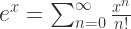
e^{x}=\sum_{n=0}^{\infty} \frac{x^{n}}{n!}

\ln(1+x)=\sum_{n=1}^{\infty} \frac{(-1)^{n-1}x^{n}}{n}

\sin x= \sum_{n=1}^{\infty} \frac{(-1)^{n-1} x^{2n-1}}{(2n-1)!}

\cos x =\sum_{n=0}^{\infty} \frac{(-1)^{n} x^{2n}}{(2n)!}

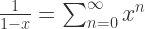
\frac{1}{1-x} =\sum_{n=0}^{\infty} x^{n}

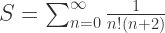
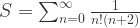
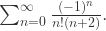
Question 1. Let S=\sum_{n=0}^{\infty} \frac{1}{n!(n+2)} . Calculate the value of S.

Solution.

Method (i).

S=\sum_{n=0}^{\infty} \frac{1}{n!(n+2)}

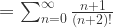
= \sum_{n=0}^{\infty} \frac{n+1}{(n+2)!}

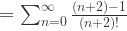
= \sum_{n=0}^{\infty} \frac{(n+2)-1}{(n+2)!}

= \sum_{n=0}^{\infty} (\frac{1}{(n+1)!}-\frac{1}{(n+2)!})

= 1

Method (ii). Integrate the Taylor series of xe^{x} to show that S=1.

The Taylor series of x e^{x} is \sum_{n=0}^{\infty} \frac{x^{n+1}}{n!} . Take the integration of the function on the interval [0,1], we get

\int_{0}^{1} xe^{x} dx

=\int_{0}^{1} \sum_{n=0}^{\infty} \frac{x^{n+1}}{n!} dx

= \sum_{n=0}^{\infty} \int_{0}^{\infty} \frac{x^{n+1}}{n!} dx

= \sum_{n=0}^{\infty} \frac{1}{n!(n+2)}=S .

The left hand side equals to 1 from integration by parts.

Method (iii). Differentiate the Taylor series of (e^{x}-1)/x.

The Taylor series of f(x)= (e^{x}-1)/x is \sum_{n=1}^{\infty} \frac{x^{n-1}}{n!} . Differentiate f(x) and get f^{'}(x)= \sum_{n=2}^{\infty} \frac{x^{n-2}}{(n-2)!n} . Moreover, f^{'}(x)= \frac{e^{x}x-(e^{x}-1)}{x^{2}} and f^{'}(1)=1=S.

Method (iv). Assume the function f(x)=\sum_{n=0}^{\infty} x^{n}/(n!(n+2)). This implies f(0)=0. Assume

g(x)=\int_{0}^{x}f(t)dt= \sum_{n=0}^{\infty} \int_{0}^{x} \frac{t^{n}}{n!(n+2)}dt = \sum_{n=0}^{\infty} \frac{x^{n+1}}{(n+2)!} = \frac{1}{x} \sum_{n=0}^{\infty} \frac{x^{n+2}}{(n+2)!} = \frac{1}{x}(e^{x}-1-x).

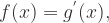
Since f(x)=g^{'}(x), we get f(x) = x^{-1}(e^{x}-1)-x^{-2}(e^{x}-1-x). That means f(1)=1.

Method (v). Assume the function f(x)=\sum_{n=0}^{\infty} x^{n}/(n!(n+2)).

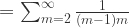
f(x)= \sum_{n=0}^{\infty} \frac{x^{n}}{(n+1)!} - \frac{x^{n}}{(n+2)!} = x^{-1}\sum_{n=0}^{\infty} \frac{x^{n+1}}{(n+1)!} - x^{-2}\sum_{n=0}^{\infty} \frac{x^{n+2}}{(n+2)!} = x^{-1} (e^{x}-1) - x^{-2}(e^{x}-1-x). Therefore, f(1)=1.

Remark. There is a similar problem: calculate \sum_{n=0}^{\infty} \frac{(-1)^{n}}{n!(n+2)}. Answer is 1-2e^{-1}.
Question 2. Let n be a positive integer. Prove that

\frac{1}{2} \int_{0}^{1} t^{n-1}(1-t)^{2} dt= \frac{1}{n(n+1)(n+2)}

and calculate the value of the summation

S=\frac{1}{1\cdot 2 \cdot 3} + \frac{1}{3\cdot 4 \cdot 5} + \frac{1}{5\cdot 6\cdot 7} + \frac{1}{7\cdot 8 \cdot 9}+.... .

Solution. 

\frac{1}{2}\int_{0}^{1} t^{n-1}(1-t)^{2}dt

= \frac{1}{2} \int_{0}^{1} (t^{n+1}-2t^{n}+t^{n-1}) dt

= \frac{1}{2} (\frac{1}{n+2}-\frac{2}{n+1}+\frac{1}{n})

= \frac{1}{n(n+1)(n+2)} .

To calculate the value of S, there are two methods.

Method (i). The summation of S, n is only taken odd numbers. From the first step, we know the summation

S=\frac{1}{2} \int_{0}^{1} (1+t^{2}+t^{4}+t^{6}+...)(1-t)^{2}dt

= \frac{1}{2} \int_{0}^{1} \frac{1}{1-t^{2}} (1-t)^{2} dt

= \frac{1}{2} \int_{0}^{1} \frac{1-t}{1+t} dt

= \frac{1}{2} \int_{0}^{1} (\frac{2}{1+t}-1)dt

= \frac{1}{2}( 2\ln(1+t)-t)_{t=0}^{t=1}

= \ln 2 -\frac{1}{2} .

Method (ii).

Since \frac{1}{n(n+1)(n+2)}= \frac{1}{2}(\frac{1}{n}-\frac{2}{n+1}+\frac{1}{n+2}) ,

S=\sum_{ odd} \frac{1}{n(n+1)(n+2)}

= \frac{1}{2} \sum_{odd} ( \frac{1}{n}- \frac{2}{n+1}+\frac{1}{n+2})

= \frac{1}{2} ( \frac{1}{1}-\frac{2}{2}+\frac{1}{3}+ \frac{1}{3}-\frac{2}{4}+\frac{1}{5}+ \frac{1}{5}-\frac{2}{6}+\frac{1}{7}+\frac{1}{7}-\frac{2}{8}+\frac{1}{9}+...)

= \frac{1}{2} ( \frac{1}{1} + 2( -\frac{1}{2}+\frac{1}{3}-\frac{1}{4}+\frac{1}{5}-\frac{1}{6}+\frac{1}{7}-...))

= \frac{1}{2} ( 1 + 2 (\ln 2-1))

= \ln 2 -\frac{1}{2} .

Here we use the Taylor series of \ln(1+x)= \sum_{n=1}^{\infty} \frac{(-1)^{n-1}x^{n}}{n} and \ln 2= 1-\frac{1}{2}+\frac{1}{3}-\frac{1}{4}+\frac{1}{5}-\frac{1}{6}+....

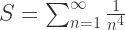
Question 3. Assume \zeta(k)=1+\frac{1}{2^{k}} + \frac{1}{3^{k}} + ... = \sum_{m=1}^{\infty} \frac{1}{m^{k}}.

Prove

\sum_{k=2}^{\infty} (\zeta(k)-1)=1.

\sum_{k=1}^{\infty} (\zeta(2k)-1)=3/4.

Proof.

\sum_{k=2}^{\infty} (\zeta(k)-1)

= \sum_{k=2}^{\infty} \sum_{m=2}^{\infty} \frac{1}{m^{k}}

= \sum_{m=2}^{\infty} \sum_{k=2}^{\infty} \frac{1}{m^{k}}

= \sum_{m=2}^{\infty} \frac{1}{(m-1)m}

= \sum_{m=2}^{\infty} ( \frac{1}{m-1} - \frac{1}{m})

= 1.

\sum_{k=1}^{\infty} ( \zeta(2k)-1)

= \sum_{k=1}^{\infty} \sum_{m=2}^{\infty} \frac{1}{m^{2k}}

= \sum_{m=2}^{\infty} \sum_{k=1}^{\infty} \frac{1}{m^{2k}}

= \sum_{m=2}^{\infty} \frac{1}{m^{2}-1}

= \sum_{m=2}^{\infty} \frac{1}{2} ( \frac{1}{m-1}-\frac{1}{m+1})

= \frac{1}{2}(1+\frac{1}{2})

= \frac{3}{4}.

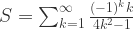
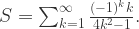
Question 4. Calculate the summation S= \sum_{k=1}^{\infty} \frac{(-1)^{k} k}{4k^{2}-1}.
Solution. 

S=\sum_{k=1}^{\infty} \frac{(-1)^{k} k}{4k^{2}-1}

=\frac{1}{4} \sum_{k=1}^{\infty} (-1)^{k} ( \frac{1}{2k-1} +\frac{1}{2k+1})

= \frac{1}{4} \sum_{k=1}^{\infty} ( \frac{(-1)^{k}}{2k-1} - \frac{(-1)^{k+1}}{2k+1})

= \frac{1}{4} \cdot \frac{-1}{2-1} = - \frac{1}{4}.

MA 1505 Tutorial 7: Integration of Two Variables Functions

In the tutorial 7, we will learn to calculate the integration of two variables, reverse the order of integration and polar coordinate.

The formulas of polar coordinate are x=r \cos(\theta), y=r \sin(\theta), where r\in (0,\infty) and \theta \in [0, 2\pi).

\iint_{D} f(x,y) dxdy= \iint_{D^{'}} f(r \cos \theta, r \sin \theta) r dr d\theta

Question 1. The application of polar coordinate. Calculate the value of

I= \int_{-\infty}^{\infty} e^{-x^{2}}dx.

Solution.

Method (i).

I=\int_{-\infty}^{\infty} e^{-x^{2}} dx= \int_{-\infty}^{\infty} e^{-y^{2}}dy .

Therefore

I^{2}=\int_{-\infty}^{\infty} \int_{-\infty}^{\infty} e^{-x^{2}-y^{2}} dxdy

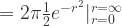
= \int_{0}^{2\pi} \int_{0}^{\infty} e^{-r^{2}} r dr d\theta

= 2\pi \int_{0}^{\infty} e^{-r^{2}}r dr

= 2\pi \frac{1}{2} e^{-r^{2}}|_{r=0}^{r=\infty}

= \pi .

Hence I=\sqrt{\pi} .

Method (ii).

Since I=\int_{-\infty}^{\infty} e^{-x^{2}}dx = 2\int_{0}^{\infty} e^{-x^{2}}dx = 2\int_{0}^{\infty} e^{-y^{2}}dy , we get

I^{2}=\int_{0}^{\infty} \int_{0}^{\infty} e^{-x^{2}-y^{2}} dy dx

Assume y=sx, we get

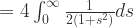
I^{2}=4 \int_{0}^{\infty} \int_{0}^{\infty} e^{-x^{2}(1+s^{2})} x ds dx

=4 \int_{0}^{\infty} \int_{0}^{\infty} e^{-(1+s^{2})x^{2}} x dx ds

=4 \int_{0}^{\infty} \frac{1}{2(1+s^{2})} ds

=4 \cdot \frac{1}{2} \arctan s|_{s=0}^{s= \infty}

= \pi

Therefore, I=\sqrt{\pi}

Question 2. Calculate the value of

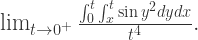
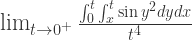
\lim_{t\rightarrow 0^{+}} \frac{\int_{0}^{t} \int_{x}^{t} \sin{y^{2}} dy dx}{t^{4}}.

Solution.

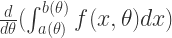
Method (i). Leibniz Integration Rule.
\frac{d}{d\theta} ( \int_{a(\theta)}^{b(\theta)} f(x,\theta)dx)

= \int_{a(\theta)}^{b(\theta)} f_{\theta}(x,\theta) dx + f(b(\theta), \theta)\cdot b^{'}(\theta) - f(a(\theta),\theta) \cdot a^{'}(\theta)

Here f_{\theta}(x,\theta) denotes the partial derivative of f(x, \theta) with respect to the variable \theta.

In the question, assume G(x,t)=\int_{x}^{t} \sin{y^{2}} dy .

Making use of L’Hospital Rule, we have
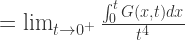
\lim_{t\rightarrow 0^{+}} \frac{\int_{0}^{t} \int_{x}^{t} \sin{y^{2}} dy dx}{t^{4}}

= \lim_{t\rightarrow 0^{+}} \frac{\int_{0}^{t} G(x,t)dx}{t^{4}}

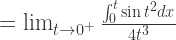
= \lim_{t\rightarrow 0^{+}} \frac{\int_{0}^{t} G_{t}(x,t)dx+ G(t,t)\cdot 1 - G(0,t)\cdot 0}{ 4 t^{3}}

= \lim_{t\rightarrow 0^{+}} \frac{\int_{0}^{t} \sin{t^{2}}dx}{4t^{3}}

= \lim_{t\rightarrow 0^{+}} \frac{ t \sin{t^{2}}}{4t^{3}}= \frac{1}{4}

Method (ii). Reverse the order of integration.

The integration domain is 0\leq x \leq t and x \leq y \leq t. It is same as 0\leq y \leq t and 0\leq x\leq y.

Answer= \lim_{t\rightarrow 0^{+}} \frac{\int_{0}^{t} \int_{0}^{y} \sin{y^{2}} dxdy}{t^{4}}

= \lim_{t\rightarrow 0^{+}} \frac{\int_{0}^{t} y \sin{y^{2}}dy}{t^{4}}

= \lim_{t\rightarrow 0^{+}} \frac{ t \sin{t^{2}}}{4t^{3}}

=\frac{1}{4} .

Question 3. MA1505 2010-2011 Semester 2, Question 6(b).

Let R be a region of xy-plane, find the largest possible value of the integration

\iint_{R} (4-x^{2}-y^{2})dxdy.

Solution. 

Since we want to find the largest possible value, then we must guarantee that on the region R, the function f(x,y)=4-x^{2}-y^{2} is non-negative. That means the region R is 4-x^{2}-y^{2}\geq 0. i.e. x^{2}+y^{2}\leq 4. Therefore, we should calculate the integration

\iint_{x^{2}+y^{2}\leq 4} (4-x^{2}-y^{2}) dxdy

= \int_{0}^{2\pi} \int_{0}^{2} (4-r^{2})r dr d\theta

= 2\pi \int_{0}^{2} (4r-r^{3})dr

= 8\pi

Question 4. I \subseteq \mathbb{R} is a real interval, calculate the maximum value of

\int_{I} (1-x^{2}) dx.

Solution.

To calculate the maximum value of the integration, the maximal interval I=[-1,1]. Therefore, the maximum value of the integration is

\int_{-1}^{1} (1-x^{2}) dx = \frac{4}{3}.

Qustion 5. Calculate the multiple integration

\int_{0}^{1} \int_{0}^{\sqrt{1-x^{2}}} e^{x^{2}+y^{2}} dy dx.

Solution.

Method (i).  Use the polar coordinate.

\int_{0}^{1} \int_{0}^{\sqrt{1-x^{2}}} e^{x^{2}+y^{2}} dydx

= \int_{0}^{\pi/2} \int_{0}^{1} e^{r^{2}} r dr d\theta

= \frac{\pi}{2} \int_{0}^{1} e^{r^{2}} r dr

= \frac{\pi}{2} (\frac{e^{r^{2}}}{2}) |_{r=0}^{r=1}

= \frac{\pi}{4}(e-1).

Method (ii). Make the substitution y=sx, then dy=x ds.

The region is 0\leq x \leq 1 and 0\leq s \leq \sqrt{1-x^{2}}/x.

That is equivalent to 0 \leq s \leq \infty and 0 \leq x \leq 1/\sqrt{1+s^{2}}.

The integration is

\int_{0}^{1} \int_{0}^{\sqrt{1-x^{2}}/x} e^{x^{2}+s^{2}x^{2}} xds dx

= \int_{0}^{\infty} \int_{0}^{1/\sqrt{1+s^{2}}} e^{(1+s^{2})x^{2}} x dx ds

= \int_{0}^{\infty} (\frac{1}{2(1+s^{2})} e^{(1+s^{2})x^{2}} |_{x=0}^{x=1/\sqrt{1+s^{2}}}) ds

= \int_{0}^{\infty} \frac{e-1}{2(1+s^{2})}ds

= \frac{e-1}{2} \arctan s|_{s=0}^{s=\infty}

= \frac{\pi}{4} (e-1).

MA 1505 Tutorial 6: Partial Derivatives and Directional Derivative

In the tutorial, we will learn the partial derivatives for multiple variable functions.

Assume z=f(x,y) is a two variable function, then we use the notations to describe the partial derivatives of f(x,y).

f_{x}=\frac{\partial f}{\partial x} denotes the partial derivative of f under the variable x.

f_{y}=\frac{\partial f}{\partial y} denotes the partial derivative of f under the variable y.

Similarly, we can also define the second derivative of f(x,y).

f_{xx}=\frac{\partial^{2} f}{\partial x^{2}} ,

f_{xy}=f_{yx}=\frac{\partial^{2}f}{\partial x\partial y}=\frac{\partial^{2}f}{\partial y\partial x}  \text{ if } f(x,y) \text{ is a } C^{2} \text{ function.}

f_{yy}=\frac{\partial^{2} f}{\partial y^{2}} .

Assume u=(a,b) is a unit vector, i.e. its length is 1. If f(x,y) is C^{1} at the point p, then we can define the directional derivative of f(x,y) at point p as

f_{x}(p) a + f_{y}(p) b

Theorem 1. Geometric mean is not larger than Arithmetic mean.

For n positive real numbers a_{1}, a_{2}, ..., a_{n} ,

(a_{1}...a_{n})^{\frac{1}{n}} \leq \frac{a_{1}+...+a_{n}}{n}

“=” if and only if a_{1}=a_{2}=...=a_{n}.

Theorem 2. Cauchy’s Inequality.

For 2n real numbers a_{1},..., a_{n}, b_{1},...,b_{n} ,

(a_{1}b_{1}+...+a_{n}b_{n})^{2}\leq (a_{1}^{2}+...+a_{n}^{2})(b_{1}^{2}+...+b_{n}^{2})

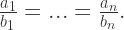
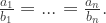
“=” if and only if \frac{a_{1}}{b_{1}}=...=\frac{a_{n}}{b_{n}}.

Proof.

Method (i). Construct a non-negative function f(x) with respect to variable x

f(x)= \sum_{i=1}^{n}(a_{i}x-b_{i})^{2}= (\sum_{i=1}^{n} a_{i}^{2}) x^{2} - 2(\sum_{i=1}^{n} a_{i}b_{i}) x + (\sum_{i=1}^{n} b_{i}^{2}).

Consider the equation f(x)=0, there are only two possibilities: one is the equation f(x)=0 has only one root, the other one is the function has no real roots. Therefore,

\Delta=4(\sum_{i=1}^{n} a_{i}b_{i})^{2} - 4 ( \sum_{i=1}^{n} a_{i}^{2}) \cdot ( \sum_{i=1}^{n} b_{i}^{2}) \leq 0.

Hence, (a_{1}b_{1}+...+a_{n}b_{n})^{2}\leq (a_{1}^{2}+...+a_{n}^{2})(b_{1}^{2}+...+b_{n}^{2}).

Moreover, if “=”, then f(x)=0 has only one root x_{0}, i.e. for all 1\leq i \leq n, a_{i}x_{0}-b_{i}=0. That means

\frac{a_{1}}{b_{1}} =...=\frac{a_{n}}{b_{n}}.

By the way, the solution of ax^{2}+bx+c=0 is \frac{-b \pm \sqrt{b^{2}-4ac}}{2a} and \Delta=b^{2}-4ac.

Method (ii). Since a^{2}+b^{2}\geq 2 ab, we know

ab\leq \frac{1}{2}(\lambda^{2} a^{2}+ b^{2}/\lambda^{2}) for all \lambda \neq 0.

Assume \lambda^{2}=\sqrt{(\sum_{i=1}^{n}b_{i}^{2})/(\sum_{i=1}^{n} a_{i}^{2})} , for all 1\leq i \leq n,

a_{i}b_{i}\leq \frac{1}{2} (\lambda^{2}a_{i}^{2}+b_{i}^{2}/\lambda^{2})

Take the summation at the both sides,

\sum_{i=1}^{n} a_{i}b_{i} \leq \frac{1}{2}( \lambda^{2}\sum_{i=1}^{n}a_{i}^{2} + (\sum_{i=1}^{n} b_{i}^{2})/ \lambda^{2})= \sqrt{(\sum_{i=1}^{n} a_{i}^{2}) \cdot (\sum_{i=1}^{n}b_{i}^{2})}.

Question 1. Assume u(x,y) is a C^{2} function and u>0 . u(x,y) satisfies the partial differential equation u u_{xy}= u_{x}u_{y}.

Prove

(1) \frac{\partial \ln u}{\partial y} is a function of y.

(2) \frac{\partial \ln u}{\partial x} is a function of x.

(3) The solution of u(x,y) has the form u(x,y)=f(x) g(y) for some function f(x) and g(y) .

Proof.

(1) Method (i) Make use of derivative.

First, we know \frac{\partial \ln u}{\partial y}=\frac{u_{y}}{u} . Second, take the partial derivative of the function with respect to the variable x. That means,

\frac{\partial }{\partial x} (\frac{u_{y}}{u})= \frac{u_{xy}u- u_{x}u_{y}}{u^{2}}=0 from the partial differential equation. Therefore, the function \frac{u_{y}}{u} is independent of the variable x. i.e. the function is a function of variable y.

Method (ii) Make use of integration.

Since u u_{xy}=u_{x}u_{y} , \frac{u_{x}}{u}=\frac{u_{xy}}{u_{y}} , then we take the integration of x at the both sides,

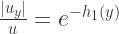
\int \frac{u_{x}}{u} dx =\int \frac{u_{xy}}{u_{y}} dx , the left hand side is \ln u, the right hand side is \ln |u_{y}| + h_{1}(y) for some function h(y). That means, \frac{|u_{y}|}{u}=e^{-h_{1}(y)} . and \frac{u_{y}}{u} is a function of y .

(2) is similar to (1).

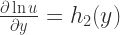
(3) From part (1), we know \frac{\partial \ln u }{\partial y} is a function of y. Assume \frac{\partial \ln u }{\partial y} = h_{2}(y). Take the integration of y at the both sides, we have

\ln u= \int h_{2}(y) dy + h_{3}(x) for some function h_{3}(x) . u = e^{\int h_{2}(y) dy} \cdot e^{h_{3}(x)} = g(y) \cdot f(x) for some functions f(x) and g(y).

Question 2. Assume L+K=150,  L and K are non-negative. Find the maximum value of f(L,K)=50 L^{0.4} K^{0.6} .

Solution.

Method (i). Langrange’s Method.

g(L,K,\lambda)=f(L,K)-\lambda(L+K-150)=50L^{\frac{2}{5}}K^{\frac{3}{5}}-\lambda(L+K-150).

Take three partial derivatives of g,

\frac{\partial g}{\partial \lambda} = -(L+K-150)=0

\frac{\partial g}{\partial L} = 50 \cdot \frac{2}{5} L^{-\frac{3}{5}}K^{\frac{3}{5}} - \lambda

\frac{\partial g}{\partial K}= 50 \cdot \frac{3}{5} L^{\frac{2}{5}} K^{-\frac{2}{5}} - \lambda=0

Solve these three equations, we get 2K=3L and L+K=150 , therefore the maximum value is taken at L=60 and K=90.

Method (ii). Change to one variable function.

Since L+K=150, we can define the one variable function

g(L)=f(L,150-L)=50 L^{\frac{2}{5}}(150-L)^{\frac{3}{5}}.

The derivative of g^{'}(L)=50 \cdot (\frac{2}{5} L^{-\frac{3}{5}}(150-L)^{\frac{3}{5}} - L^{\frac{2}{5}}\frac{3}{5}(150-L)^{-\frac{2}{5}}).

The critical point is L=60. The maximal value of g(L) is taken at L=60, K=90.

Method (iii). Mathematical Olympic Method.

Use the fact that the geometric mean is not larger than the arithmetic mean.

f(L,K)=50 L^{\frac{1}{5}}L^{\frac{1}{5}} K^{\frac{1}{5}} K^{\frac{1}{5}} K^{\frac{1}{5}}

= \frac{50}{3^{\frac{2}{5}} 2^{\frac{3}{5}}} (3L)^{\frac{1}{5}} (3L)^{\frac{1}{5}} (2K)^{\frac{1}{5}} (2K)^{\frac{1}{5}} (2K)^{\frac{1}{5}}

\leq \frac{50}{3^{\frac{3}{5}} 2^{\frac{2}{5}}} \frac{3L+3L+2K+2K+2K}{5}

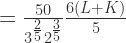
= \frac{50}{3^{\frac{2}{5}} 2^{\frac{3}{5}}} \frac{6(L+K)}{5}

= \frac{50}{3^{\frac{2}{5}} 2^{\frac{3}{5}}} \frac{6\cdot 150}{5} .

The maximum value is taken at 3L=2K. i.e. L=60, K=90.

Question 3. Assume 24x+18y+12z=144 and x, y, z are non-negative variables. f(x,y,z)=18 x^{2} y z . Find the maximum value of f(x,y,z).

Solution.

Method (i). Langrange’s Method

g(x,y,z,\lambda)=f(x,y,z)-\lambda(24x+18y+12z-144) = 18 x^{2} y z-\lambda(24x+18y+12z-144)

Take four partial derivatives of g, the critical point is taken at x=z=1.5y. i.e. the maximum value of f(x,y,z) is taken at x=z=3, y=2.

Method (ii) Math Olympic Method

f(x,y,z)=18 x \cdot x \cdot y \cdot z

= \frac{18}{12*12*18*12} (12x) \cdot (12x) \cdot (18y) \cdot (12z)

\leq \frac{18}{12*12*18*12} (\frac{12x+12x+18y+12z}{4})^{4}

= \frac{18}{12*12*18*12} (\frac{144}{4})^{4}

The maximum value is taken at 12x=12x=18y=12z, i.e. x=z=3, y=2.

Question 4.  2012 Exam MA1505 Semester 1, Question 3(a)

Assume f(x,y) has continuous partial derivatives of all orders, if

\nabla f = (xy^{2}+kx^{2}y+x^{3}) \textbf{i} + (x^{3}+x^{2}y+y^{2}) \textbf{j},

Find the value of the constant k.

Solution.

Method (i) Use derivatives.

Since f has continuous partial derivative of all orders, f_{xy}= f_{yx}.

Since f_{x}= xy^{2}+kx^{2}y+x^{3} and f_{y}=x^{3}+x^{2}y+y^{2},

we have

\frac{\partial}{\partial y} (xy^{2}+kx^{2}y+x^{3})= \frac{\partial}{\partial x} (x^{3}+x^{2}y+y^{2})

This implies 2xy+kx^{2}=3x^{2}+2xy. i.e. k=3.

Method (ii). Use integration.

f_{x}=xy^{2}+kx^{2}y+x^{3} \Rightarrow f(x,y)=\frac{1}{2}x^{2}y^{2} + \frac{k}{3}x^{3}y + \frac{1}{4}x^{4} + h_{1}(y),

f_{y}=x^{3}+x^{2}y+y^{2} \Rightarrow f(x,y)=x^{3}y+\frac{1}{2}x^{2}y^{2}+\frac{1}{3}y^{3}+h_{2}(x).

Comparing them, we know k=3, h_{1}(y)=\frac{1}{3}y^{3}+C_{1} and h_{2}(x)=\frac{1}{4}x^{4}+C_{2}, where C_{1} and C_{2} are constants.

Therefore k=3.

MA 1505 Tutorial 5: Fourier Series

In this tutorial, we will learn how to calculate the Fourier series of periodic functions.

Assume f(x) is a periodic function with period 2\pi, i.e. f(x)=f(x+2\pi) for all x \in \mathbb{R} . The Fourier Series of f(x) is defined as a_{0}+\sum_{n=1}^{\infty} (a_{n} \cos(nx) +b_{n} \sin(nx)), where

a_{0}= \frac{1}{2\pi} \int_{-\pi}^{\pi} f(x) dx,

a_{n}= \frac{1}{\pi} \int_{-\pi}^{\pi} f(x) \cos(nx) dx for all n\geq 1,

b_{n}= \frac{1}{\pi} \int_{-\pi}^{\pi} f(x) \sin(nx) dx for all n\geq 1,

Theorem 1.  If f(x) satisfies Lipchitz condition on (-\pi, \pi) , then

f(x) =a_{0}+\sum_{n=1}^{\infty} (a_{n} \cos(nx) +b_{n} \sin(nx)).

Theorem 2. Parseval’s Identity.

\frac{1}{\pi} \int_{-\pi}^{\pi} |f(x)|^{2} dx= 2a_{0}^{2}+ \sum_{n=1}^{\infty} (a_{n}^{2}+b_{n}^{2}).

Question 1. Assume f(x)=f(x+2\pi) for all x\in \mathbb{R} and f(x)=1505+1506x+1507x^{2}+1508x^{3} on [-\pi, \pi).

What is the value of a_{0}+\sum_{n=1}^{\infty}a_{n} ?

Solution. From Theorem 1, f(x)=a_{0}+\sum_{n=1}^{\infty} (a_{n} \cos(nx) +b_{n} \sin(nx)) on (-\pi, \pi) . Therefore, f(0)=a_{0}+\sum_{n=1}^{\infty}a_{n} and f(0)=1505 . Hence, a_{0}+\sum_{n=1}^{\infty}a_{n}=1505.

Question 2. Prove these identities:

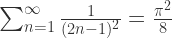
\sum_{n=1}^{\infty} \frac{1}{(2n-1)^{2}}=\frac{\pi^{2}}{8}

\sum_{n=1}^{\infty} \frac{1}{n^{2}}=\frac{\pi^{2}}{6}

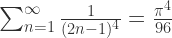
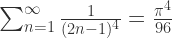
\sum_{n=1}^{\infty} \frac{1}{(2n-1)^{4}}=\frac{\pi^{4}}{96}

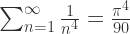
\sum_{n=1}^{\infty} \frac{1}{n^{4}}=\frac{\pi^{4}}{90}

Solution.

Choose the function f(x)=|x| on (-\pi, \pi) and f(x) is a periodic function with period 2\pi.

Use the formulas of a_{n} and b_{n}, we can prove that the Fourier series of f(x)=|x| is

\frac{\pi}{2} + \sum_{n=1}^{\infty} \frac{2((-1)^{n}-1)}{\pi}  \cdot \frac{cos(nx)}{n^{2}}

From Theorem 1, take x=0, then

0= \frac{\pi}{2} + \sum_{n=1}^{\infty} \frac{2((-1)^{n}-1)}{n^{2} \pi}  = \frac{\pi}{2} + \sum_{m=1}^{\infty} \frac{-4}{(2m-1)^{2}\pi}  = \frac{\pi}{2} - \frac{4}{\pi} \sum_{m=1}^{\infty} \frac{1}{(2m-1)^{2}}

Therefore, \sum_{n=1}^{\infty} \frac{1}{(2n-1)^{2}}=\frac{\pi^{2}}{8} .

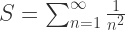
Assume S=\sum_{n=1}^{\infty} \frac{1}{n^{2}} , we get

S=\sum_{odd} \frac{1}{n^{2}} + \sum_{even} \frac{1}{n^{2}}  = \frac{\pi^{2}}{8} + \frac{1}{4} S .

Therefore S=\frac{\pi^{2}}{6} .

From Parserval’s identity, we know

\frac{2\pi^{2}}{3}= \frac{1}{\pi} \int_{-\pi}^{\pi} x^{2}dx  = 2\cdot (\frac{\pi}{2})^{2} + \sum_{n=1}^{\infty} \frac{4((-1)^{n}-1)^{2}}{\pi^{2}\cdot n^{4}}  = \frac{\pi^{2}}{2} + \sum_{m=1}^{\infty} \frac{16}{\pi^{2} (2m-1)^{4}}

Therefore \sum_{n=1}^{\infty} \frac{1}{(2n-1)^{4}} = \frac{\pi^{4}}{96} .

Assume S=\sum_{n=1}^{\infty} \frac{1}{n^{4}} , we get

S=\sum_{odd} \frac{1}{n^{4}} + \sum_{even} \frac{1}{n^{4}}  = \frac{\pi^{4}}{96} + \frac{1}{16} S

Therefore, S=\frac{\pi^{4}}{90} .

转载:丘成桐教授在台湾大学接受访谈

現在有些人很機械化地將 Annals of Mathematics 排名為數學雜誌第一,
其實它的幾個編輯並不見得都是偉大的數學家,有些甚至是小蘿蔔頭。
我在當大陸的海外院士是從 1994 年第一屆的海外院士到現在,我從來沒有受國內院士歡
迎過。不但是這樣,有一次選院士的時候,我關心他們的院士選舉,我特別寫信給他們。
當時有位院士要選他的親戚,自己不避嫌就大力推舉他的妻舅。為了公平起見,我找了這
個學科的海外五個專家,世界最有名的專家,對這個候選人做了評語。關於這個候選人的
能力,很清楚的講明,這個候選人就算在國內,在同一個學科裡面,也不見得排到前三名
。結果,我將這些海外專家的意見寄給中國科學院的院長,他沒有請我去出席,但是他將
我和其他海外專家的意見送到數學的評審委員會討論。這個院士不但不因為親戚而避嫌,
他還說:「我們中國選院士是中國的事,跟外人無關。」所以這五個海外專家的意見就全
部被忽略掉。他們的意思就是,你們不要來管我,這是我們的事。但是數學的內容好壞應
該不分國界,所以我覺得這是很荒謬的

(zz)看到一段PHD科研的话,感觉很有道理。。

这个故事中有一个普遍规律,就是博士期间研究课题的重要性 (这里说的博士期间 准确说应该是整个研究生期间,包括硕士和博士。美国的博士几乎都是直博,对严肃的研究生来说, 直博肯定更好)。这个课题最好比较容易上手,同时又比较有深度。这里的 “深度” 可以这么理解:它同某个领域里最核心的问题有微妙的关系。这个课题又不能太深,比如说它最好不要是某个领域最核心的问题,核心问题通常是不能被直接攻击的,必须迂回,在博士期间直接攻击这种问题就是自毁前程。这个课题最好需要一些特别的技巧 (多数人不会的技巧,多半来自于导师的直接传授),在整个博士研究过程中,这些技巧慢慢被自己吸收,发展,成为自己的一套思维方式。在博士毕业之后的一段独立研究中,运用这一套思维方式来试探前人提出的一些相关问题,由于这一套观点和技巧来源于自己长期 (4-5年) 对一个问题的深入研究,它们已经成为威力强大的工具,解决相关问题的希望是很大的。博士期间练就的这一套思维方式和技巧,我喜欢叫做 “看家本领”。这就像天龙八部里鸠摩智练的小无相功,可以凭它这一种内力就催动少林七十二绝技,玩得比少林高僧还似模似样。以上这两个例子,Thurston 的看家本领就是分叶结构以及相应的动力系统的观点和技巧,Freedman 的看家本领也是分叶,手术,这些他博士期间研究的东西。另一个很好的例子就是 Kontsevich,他在博士期间研究二维引力理论, 证明了 Witten 猜想,过程中学到的量子场论,弦论,代数几何, 以及对 Feynmann 图的灵活运用, 都深深地渗透到他这十多年的研究当中。他最具代表性的成果,Kontsevich integral, 一个普适量子不变量,Poisson 流形形变量子化的存在唯一,都是以 Feynmann 图为核心概念和工具,而 Poisson流形量子化和 homological mirror symmetry proposal也来源于他对二维引力的深刻理解。

我自己非常遗憾地荒废了研究生阶段最宝贵的5年,在这几年中,我的兴趣过于广泛,而读书又太流于表面,时髦的名词和理论见到无数,却从未严肃认真地去研究过其中任何一个。 最后的结果就是无一技防身,亏了导师的贤明才得以毕业后苟延残喘几年,现在懊悔不已。虽然古语有云亡羊补牢为时未晚,但习惯成自然,现在想补救已是非常困难,思维流动性太大,每个问题思考半晌之后,要么放弃,要么就跳向另一问题,其结果就是思之良久却一无所获。技巧的缺乏又导致对任何问题都没有头绪,想算却不知道算什么,却没有明确目标。这些都是在博士期间没有深入研究一个课题,没有对某个种类的对象形成良好的感觉所致。这几年中国的大学生对数学或者物理的热情高涨, 在各种论坛上就能感受到。只是大多数爱好者都是只见理论的冠冕堂皇,而不知其探求过程的琐碎与丑陋。各大数学论坛都有两极分化的趋势 — 论坛办到最后,一半帖子在高谈阔论Grothendieck,另一半帖子在问微积分线性代数概率统计的家庭作业。所以我在此以我个人的教训,来提醒至少这个客栈里正处于研究生阶段和要步入研究生阶段的后来人,要重视对具体问题,具体例子的深入,透彻的研究。

[转载] 再拍~唐~楼~天~花板!这坑爹的质量!

2012年4月25日17:25分,唐楼B区五楼,随着休息室外清脆的“啪”声,精彩的唐楼天花板
坠落事件再次上演!据悉,本次事故并未造成人员伤亡,亲睹此事件的的老师和同学情绪
稳定,并且均表示身在唐楼,做好被砸的心理准备很重要。PS:以后咱唐楼的童鞋们都戴头
盔吧!附图:

Continue reading [转载] 再拍~唐~楼~天~花板!这坑爹的质量!

zz王庆根之死 bless

南京大学小百合站 — 主题文章阅读 [讨论区: Abroad]


[本篇全文] [回复本文] [本篇作者: sandsnake] [本篇人气: 703] 0
发信人: sandsnake (sasa), 信区: Abroad
标  题: zz王庆根之死
发信站: 南京大学小百合站 (Wed Apr 25 14:48:43 2012)


对于所有海安中学的后辈而言,王庆根的自杀实在是一个很大的冲击,不亚于雷峰塔的倒
掉,对于大多数人来说,虽然关于他的只有只言片语的传说,但在海中学生的心里,他就
是神一般的存在,有两件事被人传诵最多:一是少年苦学出英才,麻袋装行李,小乡村走
出世界中学生奥林匹克竞赛金牌得主;功成名就之后,他称呼自己的“老婆”为“太太”
,着实让那个时代的海安人大开眼界,也增添了笑料。

王庆根于2012年4月6日离世,两周以后,他的死讯才在国内不少bbs出现,经过社交网站的
散布,越来越多的人知道这个不幸的消息,并加入了悼念的队伍。

王庆根的自杀是个让人瞠目结舌的结果,对于王大庆来说尤其伤痛。王大庆是海安中学的
领导之一,因为循循善诱爱讲故事深受学生追捧,几乎每一次表扬或是批评大会,他都要
拎出王庆根,用他的事例去激励心存梦想的优生,震撼玩世不恭的差生。王大庆的目标,
就是要让所有学生明白一句至理格言“知识改变命运”,类似于海安中学的校训,这句话
对于这块并不富裕土地上长大得的学生和家长来说,具有强大的诱惑力,而先行者王庆根
就用知识成功扼住了命运的咽喉,万人传诵。

他的故事从贫穷开始,像千千万万的中国农村家庭一样,他的家庭虽不至于一贫如洗,但
至少长辈无法给王庆根提供任何学业上的帮助,不过王庆根和他的妹妹在读书上都很争气
,1990年,他的命运来到高点,在巴黎,他拿到了第22届国际中学生化学奥林匹克竞赛的
金牌,对于一个中学生来说,最大的意义在于可以保送至全国最优秀的大学,而对于他的
家乡父老、师友领导来说,这块金牌有更多的含义——江苏省的化学奥赛金牌空缺被填补
;海安中学终于培养出其第一位奥赛金牌得主;王庆根的家乡南莫镇敲锣打鼓,在进镇的
路口竖起牌匾“欢迎来到奥赛金牌得主的家乡”;他的化学老师何求随后被评定为特级教
师……

但对于大多数人来说,王庆根的故事也就到此为止了,奥赛金牌之后关于他的消息并不多
,人们津津乐道的还是那几件典型事例,具有强大教育意义的事迹。海安县政府网站上有
一篇王庆根的专题报道,文中对王庆根的贫困家庭给予十分的同情:“王庆根刚刚升人高
二的时候,他的母亲患了癌症。”不过文章的结尾还是一个大团圆,当描写到王庆根携奥
赛金牌返乡的场景时写道:“更令人欣喜的是,王庆根久病卧床的母亲奇迹般地基本康复
,出现在欢迎队伍的前面,母子相见,喜泪双流。”

旧日的事迹像复读机一样在家乡被一遍遍诵读的时候,另一边王庆根的学生生涯坚实而轻
快,和网上流传的南大化学硕士学位不同,1993年王庆根只是在南京大学拿到化学学学位
,随后他去到美国斯坦福大学深造,从国内名校去到了世界最杰出的研究型大学。也有人
曾经提出疑问,奥赛金牌得主为什么选择南京大学,王大庆解释,当时小王可以保送至全
国任意一所高校,但是南京方面的诚意最终打动了他。

或许在有些人眼里,南京大学对于奥赛金牌的得主来说略微屈才了,但是王庆根依旧是那
块金子,斯坦福大学的金子招牌更是证明这个穷小子一如既往地优秀。海安老乡一定敢说
中国诺贝尔奖的空缺靠王庆根填补!王庆根是不是曾经有过这样的梦想不得而知,不过99
%中国小学生的梦想都是当科学家。

事实上,王庆根最后也没有在化学事业上更进一步。2001年,虽然拿到了斯坦福的化学博
士学位,王庆根最终没有选择从事相关行业,即使斯坦福的化学专业在全美排名相当靠前
,寻找一份体面收入的工作并不困难,但是他还是选择和他乃以成名的化学完全无关的计
算机行业,1998年,王庆根开始修斯坦福计算机课程,3年后他拿到了计算机硕士学位,毕
业后他曾在做电子地图的公司decarta服务三年,职务是软件工程师,2004年进入更为知名
的paypal公司,随后8年他亦是在软件工程师的岗位上度过,从普通员工做到高级工程师,
事发前他已经是公司的首席工程师(Principle Software Engineer)。

在地球的另一端,王的家乡,这样的经历可以理解为这位中国青年拥有全才和通才,但作
为王庆根的同乡,Yong却对我摇了摇头,Yong比王庆根小两岁,虽然和王庆根没有交往,
但他和王庆根有着类似的经历——成绩优秀,同期赴美留学,后来侨居美国,但最关键的
是——他们在赴美之后都重新选择专业,而且读的都是计算机科学。Yong在国内一直读到
地质专业的硕士,但这并不妨碍他轻易地抛弃原来的专业转投计算机,而他的太太,当时
还在国内当英语教师,陪读去到美国之后也选择修计算机的学位。

换八竿子打不到的专业可谓学术大忌,意味着多年的学术积累付之东流。但是1994年,当
Mosaic浏览器及World Wide Web出现的时候,无数人都为之疯狂,互联网时代的到来让人
觉得这是一座永不枯竭的金矿,正如美国历史上非常有名的淘金热潮一样,无论你之前从
事什么,都请拿起铁铲吧,挖下去你就可以成为大富翁;互联网的兴起的背景下,无数中
国留学生改换曾经痴迷的专业,转投计算机科学。Yong回忆道:“当时即使在社区大学修
几门计算机相关课程,都可以找到非常好的工作。”但对于王庆根,Yong依然惋惜:“如
果他从事化学行业,在那边同样能找到不错的工作,但计算机当时显然更赚钱。”不到10
年,这段短暂的繁荣很快走向萧条,后来被总结成“互联网泡沫”,一场让千万人失业的
黄粱美梦。当然在大公司paypal的优秀员工王庆根自然不至于失业,但是是否失意,只有
他自己知道。有一位网友感叹:“美国就是这样一个地方,好端端学化学的,因为工作不
好找,转行主计算机,人才浪费了,人生也就暗淡了。和其他同学朋友一比,如果再遇到
一些挫折容易想不开。”

有消息说王庆根自杀于抑郁症,确切消息不得而知,他留下了太太和两个孩子,可以推断
的是,王庆根从未轻松,从海安中学,到南京大学,再到斯坦福;从奥赛化学金牌得主,
到计算机软件工程师,王庆根的一生不可能轻松,他的背后不只是含辛茹苦数十年的父母
亲人,更肩负起为家乡争光的重任,奥赛金牌、世界名校,他头顶光环,不允许失败,改
变贫穷改变命运,计算机硕士学位手到擒来,也无法帮助他预见互联网泡沫的到来。不知
道在他的老家,他的亲人是否幸福富足;不知道在他的新家,他的太太和两个不到10岁的
孩子如何继续生活。他的母校南京大学的小百合bbs有人转帖,一个海外团体正在为他的遗
孀和两个孩子募捐,结果两大派别就paypal员工有钱没钱大打嘴仗。

别人眼中的王庆根,从贫穷开始,到金牌结束,没有人知道他到底要的是什么,知识拔高
了他的形象,并没能改变他的命运,在命运终结之后,他的形象得以真实,归根结底,他
只是一个追求幸福的普通人,不管以前有没有走错路,今后一路走好王庆根。
--
※ 来源:.南京大学小百合站 http://bbs.nju.edu.cn [FROM: 160.39.40.249]

[本篇全文] [回复本文] [本篇作者: Goethe] [本篇人气: 28] 1
发信人: Goethe (歌德), 信区: Abroad
标  题: Re: zz王庆根之死
发信站: 南京大学小百合站 (Thu Apr 26 00:14:18 2012)

计算机依然是最好找工作的专业,么有之一。

--
※ 来源:.南京大学小百合站 http://bbs.nju.edu.cn [FROM: 35.10.222.247]

[本篇全文] [回复本文] [本篇作者: qinhaiping] [本篇人气: 16] 2
发信人: qinhaiping (2008 god bless china), 信区: Abroad
标  题: Re: zz王庆根之死
发信站: 南京大学小百合站 (Thu Apr 26 01:06:00 2012)

一声叹息,回头来看,他应该博士毕业以后回国的。


--
※ 来源:.南京大学小百合站 http://bbs.nju.edu.cn [FROM: 71.202.20.96]

[本篇全文] [回复本文] [本篇作者: leono1good] [本篇人气: 17] 3
发信人: leono1good ((【苏E&F】猪宝宝)), 信区: Abroad
标  题: Re: zz王庆根之死
发信站: 南京大学小百合站 (Thu Apr 26 01:56:24 2012)

顶LS!


--
※ 来源:.南京大学小百合站 http://bbs.nju.edu.cn [FROM: 128.125.102.183]

[本篇全文] [回复本文] [本篇作者: 51tomato] [本篇人气: 17] 4
发信人: 51tomato (下雨不发愁), 信区: Abroad
标  题: Re: zz王庆根之死
发信站: 南京大学小百合站 (Thu Apr 26 03:55:58 2012)

"不到10年,这段短暂的繁荣很快走向萧条,后来被总结成“互联网泡沫”,一场让千万人
失业的黄粱美梦。当然在大公司paypal的优秀员工王庆根自然不至于失业,但是是否失意
,只有他自己知道。"
作者显然不了解目前CS找工作的形势。。 【 在 sandsnake 的大作中提到: 】

--
※ 来源:.南京大学小百合站 http://bbs.nju.edu.cn [FROM: 203.178.135.47] ※ 修改:.51tomato 於 Apr 26 05:23:39 2012 修改本文.[FROM: 203.178.135.47] 

[本篇全文] [回复本文] [本篇作者: T66] [本篇人气: 19] 5
发信人: T66 (南京—北京), 信区: Abroad
标  题: Re: zz王庆根之死
发信站: 南京大学小百合站 (Thu Apr 26 03:57:59 2012)

+1

--
※ 来源:.南京大学小百合站 http://bbs.nju.edu.cn [FROM: 131.179.54.152]

[本篇全文] [回复本文] [本篇作者: shiningrain] [本篇人气: 11] 6
发信人: shiningrain (不靠谱文艺老年), 信区: Abroad
标  题: Re: zz王庆根之死
发信站: 南京大学小百合站 (Thu Apr 26 04:28:38 2012)

+1  不要太好找啊。。
随便找 。。
卢瑟飘过


--
※ 来源:.南京大学小百合站 bbs.nju.edu.cn.[FROM: rain.nju.edu.cn]

[本篇全文] [回复本文] [本篇作者: shiningrain] [本篇人气: 9] 7
发信人: shiningrain (不靠谱文艺老年), 信区: Abroad
标  题: Re: zz王庆根之死
发信站: 南京大学小百合站 (Thu Apr 26 04:28:56 2012)

顺便向66大神问好


--
※ 来源:.南京大学小百合站 bbs.nju.edu.cn.[FROM: rain.nju.edu.cn]

[本篇全文] [回复本文] [本篇作者: willian] [本篇人气: 15] 8
发信人: willian (pingfan哥哥不pingfan), 信区: Abroad
标  题: Re: zz王庆根之死
发信站: 南京大学小百合站 (Thu Apr 26 04:32:08 2012)

+1 
--
※ 来源:.南京大学小百合站 http://bbs.nju.edu.cn [FROM: 35.13.149.56]

[本篇全文] [回复本文] [本篇作者: DoubleWings] [本篇人气: 16] 9
发信人: DoubleWings (南瓜), 信区: Abroad
标  题: Re: zz王庆根之死
发信站: 南京大学小百合站 (Thu Apr 26 05:50:25 2012)

首席工程师(Principle Software Engineer)
这个“首席”不知道翻译得是否靠谱。
怎么说呢,缺乏长期职业规划,找工作以工资为重心衡量的话,栽跟头也就认了吧。
当年偶还在初中的时候,对于当时的计算机热,就嗤之以鼻。偶现在在读化学相关的博士
,而且每天很开心(不过phd确实没什么钱) 

--
※ 来源:.南京大学小百合站 http://bbs.nju.edu.cn [FROM: 130.101.20.195]

[本篇全文] [回复本文] [本篇作者: sudo] [本篇人气: 14] 10
发信人: sudo (被人民民主专政的united), 信区: Abroad
标  题: Re: zz王庆根之死
发信站: 南京大学小百合站 (Thu Apr 26 06:32:31 2012)

这个,没有确切的证据表明他自杀就是因为职业发展不顺吧。
而且这篇文章对IT找工作的描述完完全全是错的。或许有一天IT萧条,千万人失业。但是
肯定不是现在。


--
※ 来源:.南京大学小百合站 http://bbs.nju.edu.cn [FROM: 163.1.130.189]

[本篇全文] [回复本文] [本篇作者: xiaolaji] [本篇人气: 11] 11
发信人: xiaolaji (【MATH 03】xiaolaji), 信区: Abroad
标  题: Re: zz王庆根之死
发信站: 南京大学小百合站 (Thu Apr 26 07:08:09 2012)

太可惜了啊。在得抑郁症的时候,真的应该及时的进行药物治疗,并且坚持下去。
--
※ 来源:.南京大学小百合站 http://bbs.nju.edu.cn [FROM: 99.63.106.184]

[本篇全文] [回复本文] [本篇作者: yzsjpy] [本篇人气: 6] 12
发信人: yzsjpy (下一站又是哪里·【Nadir】鼓手), 信区: Abroad
标  题: Re: zz王庆根之死
发信站: 南京大学小百合站 (Thu Apr 26 08:39:03 2012)

他化学博士貌似不顺,进的是一个dead end的方向。还好毕业后脑子很活转了cs。
话说paypal最近挺霉的,副总刚死嘛,虽然不是自杀


--
※ 来源:.南京大学小百合站 http://bbs.nju.edu.cn [FROM: 35.11.50.101]

[本篇全文] [回复本文] [本篇作者: EVA01] [本篇人气: 6] 13
发信人: EVA01 (故乡的茶干), 信区: Abroad
标  题: Re: zz王庆根之死
发信站: 南京大学小百合站 (Thu Apr 26 08:50:19 2012)

不是海安人,不过以前高中上物理竞赛时听老师谈过一个进入南大的国际奥赛金牌选手,说什么在南大的第一年就被学校拉去到处讲座招生。现在想来应该就是这位了,哀悼一下

~~
Sent from my Windows Phone HTC Radar C110e
--
※ 来源:.南京大学小百合站 http://bbs.nju.edu.cn [FROM: 117.136.35.12]

本主题共有 13 篇文章. 
[回文章] [返回上一页][本讨论区]

– – – – – – – – – – – – – – – – – CopyRight(C) 1997-2012, NJU Lily BBS – – – – – – – – – – – – – – – – – 

zr9558's Blog