战胜拖延—–让PHD达成每天必要的工作时间

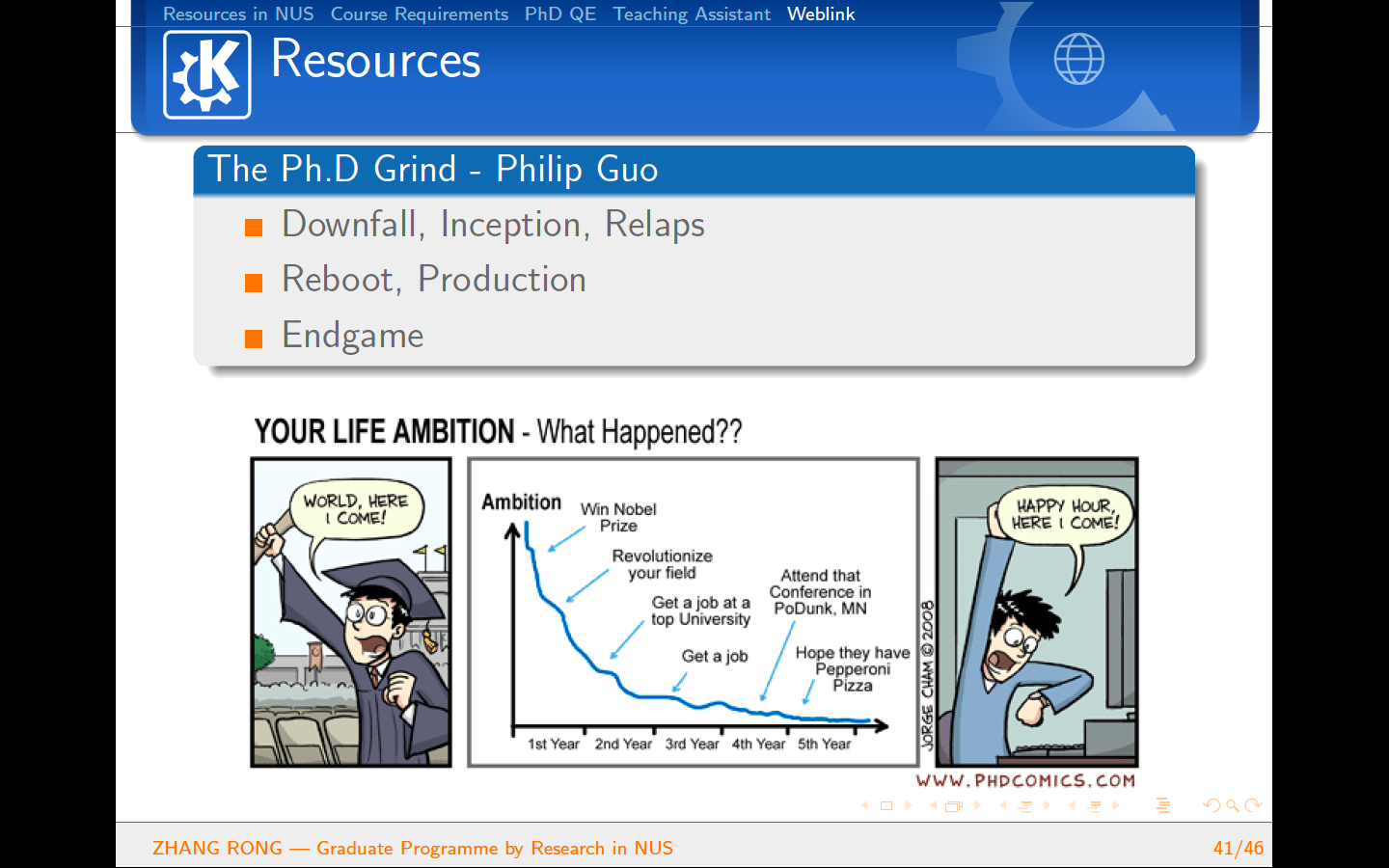
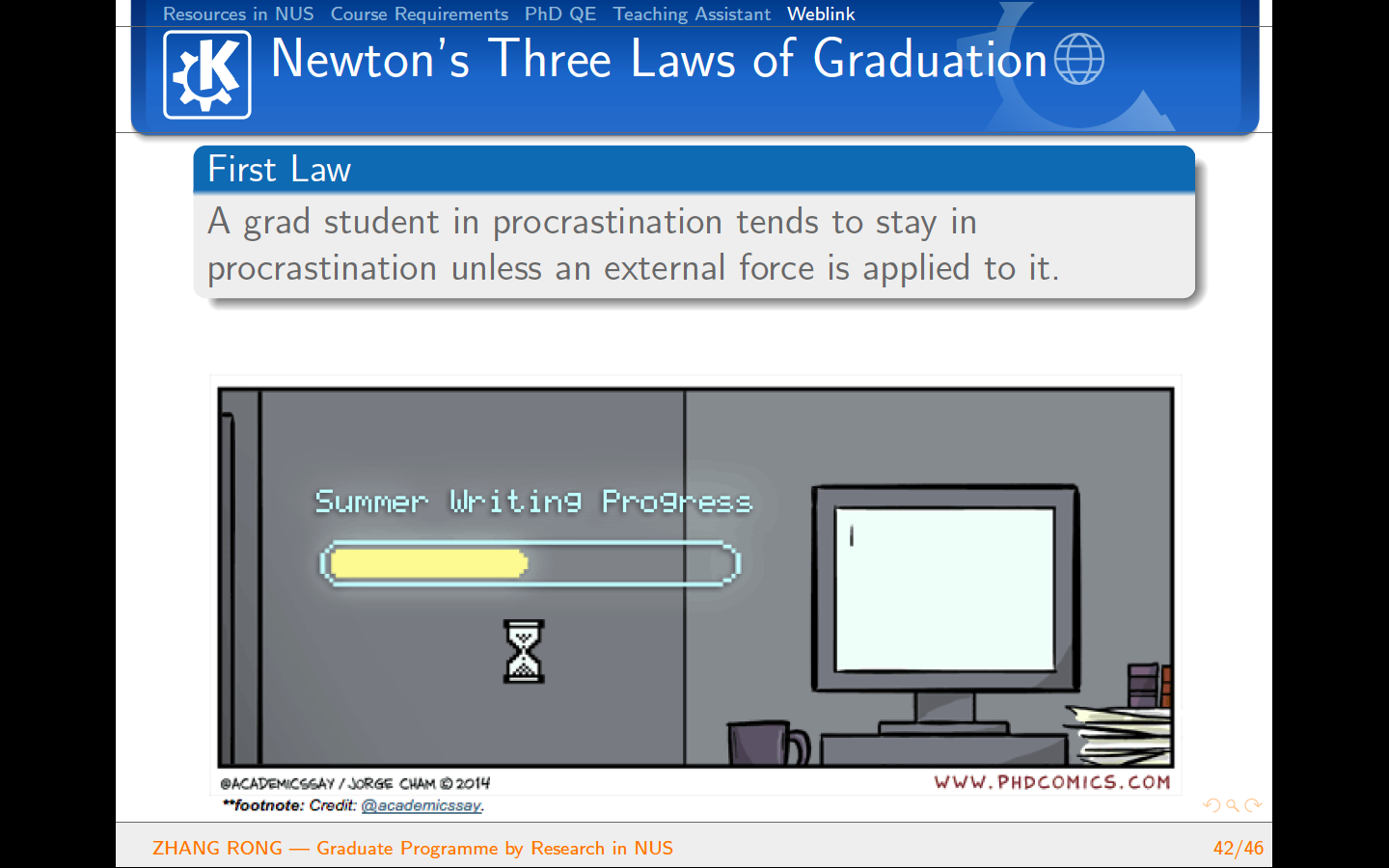
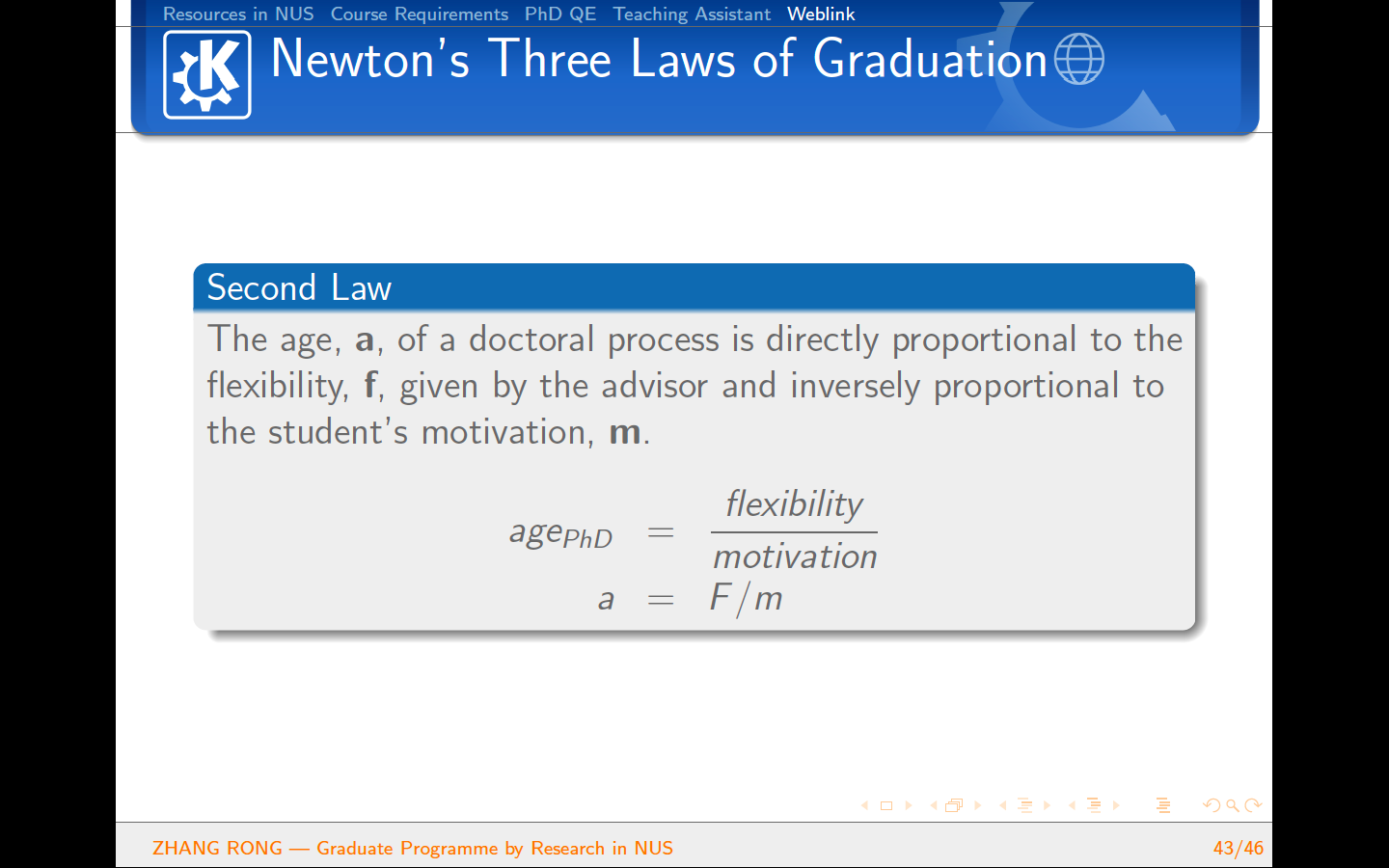
作为一个PHD,每次被老板问道每周工作多少时间,总是支支吾吾回答不出,于是老板质问:你每天工作一个小时还是两个小时!瞬间就会让自己在当天晚上感到非常的焦虑和恐慌,但是第二天醒来之后继续忘记前一天的恐慌,依旧保持着一种非常拖延的状态。白天依旧无所事事,深陷PHD的时间陷阱而不能自拔;每到深夜,就会为自己在白天的虚度光阴而悔恨。每天,每周,每个月,甚至一整年都处于一种非常拖延的状态,科研依旧毫无进展,每次看到别的PHD一年写出几篇文章,都会觉得自己的压力越来越大。即使在这种情况下,拖延症还是有可能继续困扰着每一个PHD,甚至会一直的影响下去。对于一个患有严重拖延症的PHD而言,要保证一天好几个小时的科研时间,简直就是天方夜谭。而且有一段时间,患者的学习的状态时好时坏,科研一直停滞不前,就像这样:白天起床—焦虑—瞎忙—挫败—焦虑—放松—发现自己之前做错了—挫败—拖延—忧愁。那段时间,别说一天能够工作8,9个小时,哪怕能够克服心理障碍并且高效的工作一个小时,都已经是非常不容易的了。

后来到了高年级,面临着毕业的压力,科研必须有进展,痛定思痛,于是就开始想办法克服自己多年的拖延。据说连续两周让自己保持一种状态就可以形成习惯,要突然改变自己拖延的状态谈何容易。苦海无涯,回头是岸。但是对于一个高年级的PHD而言,苦海无涯是真,回头是岸是假。猛然回头看一眼,已经没有退路,只能竭尽全力游到对岸。同时也会觉得,身边的人能做到的事情,自己也没啥做不到的。于是思考许久,就想到用GOOGLE日历记录时间的方法来看看自己每天都干了啥。

首先第一步需要做的,就是弄清楚自己每天必须要做的事情有哪些。作为一个PHD,当然科研是我们必须要做的,但是我们出门在外,远离家乡,肯定还有很多生活上面的琐事需要我们来处理。同时,学校也会要求每一个PHD每个学期完成一定数量的助教任务。做这些事情都肯定会占用我们的时间。这个时候,就需要我们先提前一周把这些杂事先在GOOGLE日历上面标记出来,表示这些时间段是没有弹性的,是我们必须处理的。标记这类时间的时候,一定要做到尽量精细。比方说:坐车的时间,花在路上大概需要多少时间,吃饭的时候,休息的时间,运动的时间,社交活动的时间,诸如此类。

标记完这些时间之后,就可以很清楚的看到自己每天,每周,甚至每个月能够在科研上面最多投入多少时间。于是剩下的就是开始执行科研这项事情。科研毕竟不是上班,上班重复的工作多,需要创造的时间少。但是科研恰好相反,需要自己创造的时候是非常多的。由于博士论文是需要PHD自己独立完成一个项目或者一个课题,这个时候就非常容易给人带来一种挫败感。能够选择读PHD的,虽然不全是特别聪明的人,但是至少不是傻瓜,至少在读本科的时候都得到过老师们赞许的人。对于学习这件事,只要在自己的能力范围内规定一天看多少书,基本上还是能够按时解决。但是科研这种事情恰好不同,规定一个PHD在几天甚至几周内搞定一个博士课题,几乎是不可能的事情。就算天天不睡觉,天天想问题,在这段时间内也未必有新的想法来解决手上的问题。如果是一个完美主义者,在科研的过程中就很容易产生一种挫败感,因为科研的道路并不像自己所想象的那样一帆风顺,都是在曲折中不停地往前走。这个时候就一定要放弃那种所谓的完美主义,有的事情做到就好,不需要完美,只要自己在不停的做这件事情就可以了。为了保证自己每天都有一定的时间投入在科研上,就必须要时刻记录好自己的工作时间。如果是严重的拖延症患者,一开始工作的时间不能够太长,就以一个小时,甚至半个小时作为最佳的时间。这个就是所谓的30分钟工作法。每当自己专心的投入科研半个小时,就可以在日历上面记录自己工作了半个小时。如果三心二意的在看书,就不要记录这段时间。每天投入的时间也不需要太长,一定要放弃那种一天能够工作10个小时的想法,一开始的时候每天投入三个小时即可。只要自己做完了这三个小时的科研,剩下的21个小时就可以自己做自己的事情,吃饭睡觉,想做啥做啥。这个30分钟工作法的目的就在于减轻PHD的时间焦虑,改进自己的工作学习流程,精确的保质保量。把一天,一周,甚至一个月分成可以控制的时间片段,通过不断地积累来促进科研的进展。俗话说:不积跬步,无以至千里;不积小流,无以成江海。要对抗拖延,就必须选择一个小的,可以操作的目标,集中注意力做30分钟,甚至一个小时。此时不需要惦记着一个很宏大的目标,只需要着重于脚下的路。

看到这里,也许有人会说,每天3小时算什么,每天有24小时呢。当然,对于每天能够持续思考科研难题8,9个小时的人来说,3个小时确实少了许多。但是,对于普通人来说,科研与学习有本质的区别,在学习的过程中,通过自己的聪明才智能够持续不断地做出书后面的习题,从而刺激自己每天不停地学习下去。在科研过程中,几乎没有任何一个合格的博士课题是能够让一个PHD在几天,几周,甚至几个月之内完成的。在一个人持续几个月没有新结果新想法的时候,就会没有动力来刺激自己继续进行这项工作,继续做这项工作,就很有可能给自己带来一种更大的挫败感。在这个时候,就需要把自己的注意力从最终的结果转移到过程上面,只需要关注自己每天,每周,甚至每个月工作了多少时间即可,不要一直想着自己什么时候能够做出来结果,也不要期望着自己努力了几天就能够解决最终的科研问题。每天需要做的就是进行一次不完美,但是完全符合人性的努力。其实每天3小时的工作量虽然看上去不够多,但是几年累积下来,就是一个非常大的工作量,一年的平均科研时间已经达到了1000小时。不要以读完一本书,写完一篇论文,或者连续工作4个小时作为自己的奋斗目标,而要以30-60分钟的高质量专注工作为目标。

最后,对于一个PHD来说,科研中的失败肯定是家常便饭,如果一直怀着一种完美主义的心态,就不会愿意去冒险,不会愿意去采取行动。当你在为了自己而找各种各样借口的时候,就是一种退缩;而怀着一种成长的心态,就会乐于采取行动去解决问题,即使这件事情看上去很难,看上去是多么的遥不可及,或者说不是很喜欢去做它。与其相信自己找的各种借口,让它们带着你进入泥沼,不如不去理睬这些借口,直接采取行动去解决问题。

Perron-Frobenius Operator

Perron-Frobenius Operator

Consider a map f which possibly has a finite (or countable) number of discontinuities or points where possibly the derivative does not exist. We assume that there are points

\displaystyle q_{0}<q_{1}<\cdot\cdot\cdot <q_{k} or q_{0}<q_{1}<\cdot\cdot\cdot<q_{\infty}<\infty

such that f restricted to each open interval A_{j}=(q_{j-1},q_{j}) is C^{2}, with a bound on the first and the second derivatives. Assume that the interval [q_{0},q_{k}] ( or [q_{0},q_{\infty}] ) is positive invariant, so f(x)\in [q_{0},q_{k}] for all x\in [q_{0}, q_{k}] ( or f(x)\in [q_{0},q_{\infty}]  for all x\in[q_{0},q_{\infty}] ).

For such a map, we want a construction of a sequence of density functions that converge to a density function of an invariant measure. Starting with \rho_{0}(x)\equiv(q_{k}-q_{0})^{-1} ( or \rho_{0}(x)\equiv(q_{\infty}-q_{0})^{-1} ),assume that we have defined densities up to \rho_{n}(x), then define define \rho_{n+1}(x) as follows

\displaystyle \rho_{n+1}(x)=P(\rho_{n})(x)=\sum_{y\in f^{-1}(x)}\frac{\rho_{n}(y)}{|Df(y)|}.

This operator P, which takes one density function to another function, is called the Perron-Frobenius operator. The limit of the first n density functions converges to a density function \rho^{*}(x),

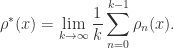
\displaystyle \rho^{*}(x)=\lim_{k\rightarrow \infty}\frac{1}{k}\sum_{n=0}^{k-1}\rho_{n}(x).

The construction guarantees that \rho^{*}(x) is the density function for an invariant measure \mu_{\rho^{*}}.

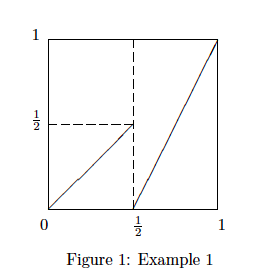
Example 1. Let

\displaystyle f(x)= \begin{cases}  x &\mbox{if } x\in(0,\frac{1}{2}), \\  2x &\mbox{if } x\in(\frac{1}{2},1).  \end{cases}

Screen Shot 2014-11-08 at 9.55.51 am

We construct the first few density functions by applying the Perron-Frobenius operator, which indicates the form of the invariant density function.
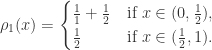
Take \rho_{0}(x)\equiv1 on [0,1]. From the definition of f(x), the slope on (0,\frac{1}{2}) and (\frac{1}{2},1) are 1 and 2, respectively. If x\in (\frac{1}{2},1), then it has only one pre-image on (\frac{1}{2},1); else if x\in(0,\frac{1}{2}), then it has two pre-images, one is x^{'} in (0,\frac{1}{2}), the other one is x^{''} in (\frac{1}{2},1). Therefore,

\rho_{1}(x)= \begin{cases}  \frac{1}{1}+\frac{1}{2} &\mbox{if } x\in(0,\frac{1}{2}), \\  \frac{1}{2} &\mbox{if } x\in(\frac{1}{2},1).  \end{cases}

By similar considerations,

\displaystyle \rho_{2}(x)=\begin{cases}1+\frac{1}{2}+\frac{1}{2^{2}} &\mbox{if } x\in(0,\frac{1}{2}), \\ \frac{1}{2^{2}} &\mbox{if } x\in(\frac{1}{2},1).\end{cases}

By induction, we get

\displaystyle \rho_{n}(x)=\begin{cases}1+\frac{1}{2}+\cdot\cdot\cdot+\frac{1}{2^{n}} &\mbox{if } x\in(0,\frac{1}{2}), \\ \frac{1}{2^{n}} &\mbox{if } x\in(\frac{1}{2},1).\end{cases}

Now, we begin to calculate the density function \rho^{*}(x). If x\in(0,\frac{1}{2}), then
\displaystyle  \rho^{*}(x)=\lim_{k\rightarrow \infty}\frac{1}{k}\sum_{n=0}^{k-1}\rho_{n}(x)  =\lim_{k\rightarrow \infty}\frac{1}{k}\sum_{n=0}^{k-1} \sum_{m=0}^{n}\frac{1}{2^{m}}  =\lim_{k\rightarrow \infty}\frac{1}{k}\sum_{n=0}^{k-1}\left(2-\frac{1}{2^{n}}\right)=2.
If x\in(\frac{1}{2},1), then
\displaystyle  \rho^{*}(x)=\lim_{k\rightarrow \infty}\frac{1}{k}\sum_{n=0}^{k-1}\rho_{n}(x)  =\lim_{k\rightarrow \infty}\frac{1}{k}\sum_{n=0}^{k-1}\frac{1}{2^{n}}  =\lim_{k\rightarrow \infty}\frac{1}{k}\left(2-\frac{1}{2^{k}}\right)=0.
i.e.

\displaystyle \rho^{*}(x)= \begin{cases}  2 &\mbox{if } x\in(0,\frac{1}{2}), \\  0 &\mbox{if } x\in(\frac{1}{2},1).  \end{cases}

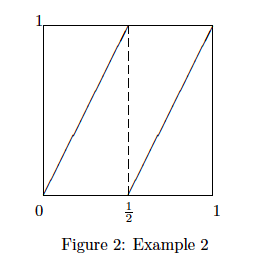
Example 2. Let

\displaystyle f(x)=\begin{cases}  2x &\mbox{if } x\in(0,\frac{1}{2}), \\  2x-1 &\mbox{if } x\in(\frac{1}{2},1).  \end{cases}

Screen Shot 2014-11-08 at 9.56.12 am

Take \rho_{0}(x)\equiv1 on (0,1). By induction, \rho_{n}(x)\equiv1 on (0,1) for all n\geq 0. Therefore, \rho^{*}(x)\equiv1 on (0,1).

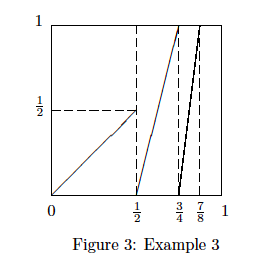
Example 3. Let

\displaystyle f(x)=\begin{cases}  x &\mbox{if } x\in(0,\frac{1}{2}), \\  2^{n+1}\cdot\left(x-\left(1-\frac{1}{2^{n}}\right)\right) &\mbox{if } x\in\left(1-\frac{1}{2^{n}},1-\frac{1}{2^{n+1}}\right) \text{ for all } n\geq 1.\end{cases}

Screen Shot 2014-11-08 at 9.56.31 am

Take \rho_{0}(x)\equiv1 on (0,1). Assume

\displaystyle \rho_{n}(x)= \begin{cases}  a_{n} &\mbox{if } x\in(0,\frac{1}{2}), \\  b_{n} &\mbox{if } x\in(\frac{1}{2},1).  \end{cases}

for all n\geq 0. It is obviously that a_{0}=b_{0}=1. By similar considerations,
\displaystyle \rho_{n+1}(x)= \begin{cases}  \frac{a_{n}}{1}+\frac{b_{n}}{4}+\frac{b_{n}}{8}+\frac{b_{n}}{16}+\cdot\cdot\cdot= a_{n}+\frac{b_{n}}{2} &\mbox{if } x\in(0,\frac{1}{2}), \\  \frac{b_{n}}{4}+\frac{b_{n}}{8}+\frac{b_{n}}{16}+\cdot\cdot\cdot = \frac{b_{n}}{2} &\mbox{if } x\in(\frac{1}{2},1).  \end{cases}
That means

\displaystyle \left( \begin{array}{ccc}  a_{n+1} \\  b_{n+1}  \end{array} \right)  =\left( \begin{array}{ccc}  a_{n}+\frac{1}{2}b_{n} \\  \frac{1}{2}b_{n}  \end{array} \right)  = \left( \begin{array}{ccc}  1 & \frac{1}{2} \\  0 & 1  \end{array} \right)  \left( \begin{array}{ccc}  a_{n} \\  b_{n}  \end{array} \right)

for all n\geq 0. From direct calculation, \displaystyle a_{n}=2-\frac{1}{2^{n}} and \displaystyle b_{n}=\frac{1}{2^{n}} for all n\geq 0. Therefore,

\displaystyle \rho^{*}(x)=\lim_{k\rightarrow \infty}\frac{1}{k}\sum_{n=0}^{k-1}\rho_{n}(x)=\begin{cases}  2 &\mbox{if } x\in (0,\frac{1}{2}), \\  0 &\mbox{if } x\in (\frac{1}{2},1).  \end{cases}

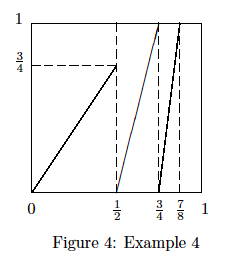
Example 4. Let

\displaystyle f(x)=\begin{cases}  1.5 x &\mbox{if } x\in(0,\frac{1}{2}), \\  2^{n+1}\cdot\left(x-\left(1-\frac{1}{2^{n}}\right)\right) &\mbox{if } x\in\left(1-\frac{1}{2^{n}},1-\frac{1}{2^{n+1}}\right) \text{ for all } n\geq 1.\end{cases}

Screen Shot 2014-11-08 at 9.56.38 am

Take \rho_{0}(x)\equiv1 on (0,1). Assume

\displaystyle \rho_{n}(x)= \begin{cases}  a_{n} &\mbox{if } x\in(0,\frac{3}{4}), \\  b_{n} &\mbox{if } x\in(\frac{3}{4},1).  \end{cases}

for all n\geq 0. It is obviously that a_{0}=b_{0}=1. By similar considerations,

\displaystyle \left( \begin{array}{ccc}  a_{n+1} \\  b_{n+1}  \end{array} \right)  =\left( \begin{array}{ccc}  \frac{11}{12}a_{n}+\frac{1}{4}b_{n} \\  \frac{1}{4}a_{n}+\frac{1}{4}b_{n}  \end{array} \right)  = \left( \begin{array}{ccc}  \frac{11}{12} & \frac{1}{4} \\  \frac{1}{4} & \frac{1}{4}  \end{array} \right)  \left( \begin{array}{ccc}  a_{n} \\  b_{n}  \end{array} \right)

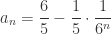
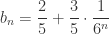
for all n\geq 0. From matrix diagonalization , \displaystyle a_{n}=\frac{6}{5}-\frac{1}{5}\cdot\frac{1}{6^{n}} and \displaystyle b_{n}=\frac{2}{5}+\frac{3}{5}\cdot\frac{1}{6^{n}} for all n\geq 0.

Therefore,

\displaystyle \rho^{*}(x)=\lim_{k\rightarrow \infty}\frac{1}{k}\sum_{n=0}^{k-1}\rho_{n}(x)=\begin{cases}  \frac{6}{5} &\mbox{if } x\in (0,\frac{3}{4}), \\  \frac{2}{5} &\mbox{if } x\in (\frac{3}{4},1).  \end{cases}

Perron-Frobenius Theory

Definition. Let A=[a_{ij}] be a k\times k matrix. We say A is non-negative if a_{ij}\geq 0 for all i,j. Such a matrix is called irreducible if for any pair i,j there exists some n>0 such that a_{ij}^{(n)}>0 where a_{ij}^{(n)} is the (i,j)-th element of A^{n}. The matrix A is irreducible and aperiodic if there exists n>0 such that a_{ij}^{(n)}>0 for all i,j.

Perron-Frobenius Theorem Let A=[a_{ij}] be a non-negative k\times k matrix.

(i) There is a non-negative eigenvalue \lambda such that no eigenvalue of A has absolute value greater than \lambda.

(ii) We have \min_{i}(\sum_{j=1}^{k}a_{ij})\leq \lambda\leq \max_{i}(\sum_{j=1}^{k}a_{ij}).

(iii) Corresponding to the eigenvalue \lambda there is a non-negative left (row) eigenvector u=(u_{1},\cdot\cdot\cdot, u_{k}) and a non-negative right (column) eigenvector v=(v_{1},\cdot\cdot\cdot, v_{k})^{T}.

(iv) If A is irreducible then \lambda is a simple eigenvalue and the corresponding eigenvectors are strictly positive (i.e. u_{i}>0, v_{i}>0 all i).

(v) If A is irreducible then \lambda is the only eigenvalue of A with a non-negative eigenvector.

Theorem.
Let A be an irreducible and aperiodic non-negative matrix. Let u=(u_{1},\cdot\cdot\cdot, u_{k}) and v=(v_{1},\cdot\cdot\cdot, v_{k})^{T} be the strictly positive eigenvectors corresponding to the largest eigenvalue \lambda as in the previous theorem. Then for each pair i,j, \lim_{n\rightarrow \infty} \lambda^{-n}a_{ij}^{(n)}=u_{j}v_{i}.

Now, let us see previous examples, again. The matrix A is irreducible and aperiodic non-negative matrix, and \lambda=1 has the largest absolute value in the set of all eigenvalues of A. From Perron-Frobenius Theorem, u_{i}, v_{j}>0 for all pairs i,j. Then for each pari i,j,
\lim_{n\rightarrow \infty}a_{ij}^{(n)}=u_{j}v_{i}. That means \lim_{n\rightarrow \infty}A^{(n)} is a strictly positive k\times k matrix.

Markov Maps

Definition of Markov Maps. Let N be a compact interval. A C^{1} map f:N\rightarrow N is called Markov if there exists a finite or countable family I_{i} of disjoint open intervals in N such that

(a) N\setminus \cup_{i}I_{i} has Lebesgue measure zero and there exist C>0 and \gamma>0 such that for each n\in \mathbb{N} and each interval I such that f^{j}(I) is contained in one of the intervals I_{i} for each j=0,1,...,n one has

\displaystyle \left| \frac{Df^{n}(x)}{Df^{n}(y)}-1 \right| \leq C\cdot |f^{n}(x)-f^{n}(y)|^{\gamma} \text{ for all } x,y\in I;

(b) if f(I_{k})\cap I_{j}\neq \emptyset, then f(I_{k})\supseteq I_{j};

(c) there exists r>0 such that |f(I_{i})|\geq r for each i.

As usual, let \lambda be the Lebesgue measure on N. We may assume that \lambda is a probability measure, i.e., \lambda(N)=1. Usually, we will denote the Lebesgue measure of a Borel set A by |A|.

Theorem.  Let f:N\rightarrow N be a Markov map and let \cup_{i}I_{i} be corresponding partition. Then there exists a f-invariant probability measure \mu on the Borel sets of N which is absolutely continuous with respect to the Lebesgue measure \lambda. This measure satisfies the following properties:

(a) its density \frac{d\mu}{d\lambda} is uniformly bounded and Holder continuous. Moreover, for each i the density is either zero on I_{i} or uniformly bounded away from zero.

If for every i and j one has f^{n}(I_{j})\supseteq I_{i} for some n\geq 1 then

(b) the measure is unique and its density \frac{d\mu}{d\lambda} is strictly positive;

(c) f is exact with respect to \mu;

(d) \lim_{n\rightarrow \infty} |f^{-n}(A)|=\mu(A) for every Borel set A\subseteq N.

If f(I_{i})=N for each interval I_{i}, then

(e) the density of \mu is also uniformly bounded from below.

Notes on Shape of Inner Space

Shape of Inner Space

shing-tung_yau_nadis_s._the_shape_of_inner_space

String Theory and the Geometry of the Universe’s Hidden Dimensions

Shing-Tung YAU and Steve NADIS

Chapter 3: P.39

My personal involvement in this area began in 1969, during my first semester of graduate studies at Berkeley. I needed a book to read during Chrismas break. Rather than selecting Portnoy’s Complaint, The Godfather, The Love Machine, or The Andromeda Strain-four top-selling books of that year-I opted for a less popular title, Morse Theory, by the American mathematician John Milnor. I was especially intrigued by Milnor’s section on topology and curvature, which explored the notion that local curvature has a great influence on geometry and topology. This is a theme I’ve pursued ever since, because the local curvature of a surface is determined by taking the derivatives of that surface, which is another way of saying it is based on analysis. Studying how that curvature influences geometry, therefore, goes to the heart of geometric analysis.

Having no office, I practically lived in Berkeley’s math library in those days. Rumor has it that the first thing I did upon arriving in the United States was visiting that library, rather than, say, explore San Francisco as other might have done. While I can’t remember exactly what I did, forty years hence, I have no reason to doubt the veracity of that rumor. I wandered around the library, as was my habit, reading every journal I could get my hands on. In the course of rummaging through the reference section during winter break, I came across a 1968 article by Milnor, whose book I was still reading. That article, in turn, little else to do at the time (with most people away for the holiday), I tried to see if I could prove something related to Preissman’s theorem.

Chapter 4: P.80

From this sprang the work I’ve become most famous for. One might say it was my calling. No matter what our station, we’d all like to find our true calling in life-that special thing we were put on this earth to do. For an actor, it might be playing Stanley Kowalski in A Streetcar Named Desire. Or the lead role in Hamlet. For a firefighter, it could mean putting out a ten-alarm blaze. For a crime-fighter, it could mean capturing Public Enemy Number One. And in mathematics, it might come down to finding that one problem you’re destined to work on. Or maybe destiny has nothing to do with it. Maybe it’s just a question of finding a problem you can get lucky with.

To be perfectly honest, I never think about “destiny” when choosing a problem to work on, as I tend to be a bit more pragmatic. I try to seek out a new direction that could bring to light new mathematical problems, some of which might prove interesting in themselves. Or I might pick an existing problem that offers the hope that in the course of trying to understand it better, we will be led to a new horizon.

The Calabi conjecture, having been around a couple of decades, fell into the latter category. I latched on to this problem during my first year of graduate school, though sometimes it seemed as if the problem latched on to me. It caught my interest in a way that no other problem had before or has since, as I sensed that it could open a door to a new branch of mathematics. While the conjecture was vaguely related to Poincare’s classic problem, it struck me as more general because if Calabi’s hunch were true, it would lead to a large class of mathematical surfaces and spaces that we didn’t know anything about-and perhaps a new understanding of space-time. For me the conjecture was almost inescapable: Just about every road I pursued in my early investigations of curvature led to it.

Chapter 5: P.104

A mathematical proof is a bit like climbing a mountain. The first stage, of course, is discovering a mountain worth climbing. Imagine a remote wilderness area yet to be explored. It takes some wit just to find such an area, let alone to know whether something worthwhile might be found there. The mountaineer then devises a strategy for getting to the top-a plan that appears flawless, at least on paper. After acquiring the necessary tools and equipment, as well as mastering the necessary skills, the adventurer mounts an ascent, only to be stopped by unexpected difficulties. But others follow in their predecessor’s footsteps, using the successful strategies, while also pursuing different avenues-thereby reaching new heights in the process. Finally someone comes along who not only has a good plan of attack that avoids the pitfalls of the past but also has the fortitude and determination to reach the summit, perhaps planting a flag there to mark his or her presence. The risks to life and limb are not so great in math, and the adventure may not be so apparent to the outsider. And at the end of a long proof, the scholar does not plant a flag. He or she types in a period. Or a footnote. Or a technical appendix. Nevertheless, in our field there are thrill as well as perils to be had in the pursuit, and success still rewards those of us who’ve gained new views into nature’s hidden recesses.

Normal Families

Reference Book: Joel L.Schiff- Normal Families

Some Classical Theorems

Weierstrass Theorem Let \{ f_{n}\} be a sequence of analytic functions on a domain \Omega which converges uniformly on compact subsets of \Omega to a function f. Then f is analytic in \Omega, and the sequence of derivatives \{ f_{n}^{(k)}\} converges uniformly on compact subsets to f^{(k)}, k=1,2,3....

Hurwitz Theorem Let \{ f_{n}\} be a sequence of analytic functions on a domain \Omega which converges uniformly on compact subsets of \Omega to a non-constant analytic function f(z). If f(z_{0})=0 for some z_{0}\in\Omega, then for each r>0 sufficiently small, there exists an N=N(r), such that for all n>N, f_{n}(z) has the same number of zeros in D(z_{0},r) as does f(z). (The zeros are counted according to multiplicity).

The Maximum Principle If f(z) is analytic and non-constant in a region \Omega, then its absolute value |f(z)| has no maximum in \Omega.

The Maximum Principle’ If f(z) is defined and continuous on a closed bounded set E and analytic on the interior of E, then the maximum of |f(z)| on E is assumed on the boundary of E.

Corollary 1.4.1 If \{ f_{n}\} is a sequence of univalent analytic functions in a domain \Omega which converge uniformly on compact subsets of \Omega to a non-constant analytic function f, then f is univalent in \Omega.

Definition 1.5.1 A family of functions \mathcal{F} is locally bounded on a domain \Omega if, for each z_{0}\in \Omega, there is a positive number M=M(z_{0}) and a neighbourhood D(z_{0},r)\subset \Omega such that |f(z)|\leq M for all z\in D(z_{0}, r) and all f\in \mathcal{F}.

Theorem 1.5.2 If \mathcal{F} is a family of locally bounded analytic functions on a domain \Omega, then the family of derivatives \mathcal{F}^{'}=\{ f^{'}: f\in \mathcal{F}\} form a locally bounded family in \Omega.

The converse of Theorem 1.5.2 is false, since \mathcal{F}=\{n: n=1,2,3...\}. However, the following partial converse does hold.

Theorem 1.5.3 Let \mathcal{F} be a family of analytic functions on \Omega such that the family of derivatives \mathcal{F}^{'} is locally bounded and suppose that there is some z_{0}\in \Omega with |f(z_{0})|\leq M<\infty for all f\in \mathcal{F}. Then \mathcal{F} is locally bounded. (Hint: find a path connecting z_{0} and z.)

Definition 1.6.1 A family \mathcal{F} of functions defined on a domain \Omega is said to be equicontinuous (spherically continuous) at a point z^{'}\in \Omega if, for each \epsilon>0, there is a \delta=\delta(\epsilon,z^{'})>0 such that |f(z)-f(z^{'})|<\epsilon(\chi(f(z),f(z^{'}))<\epsilon) whenever |z-z^{'}|<\delta, for every f\in \mathcal{F}. Moreover, \mathcal{F} is equicontinuous (spherical continuous) on a subset E\subset \Omega if it is continuous (spherically continuous) at each point of E.

Normal Families of Analytic Functions

Definition 2.1.1  A familiy \mathcal{F} of  analytic functions on a domain \Omega\subset \mathbb{C} is normal in \Omega if every sequence of functions \{f_{n}\}\subset \mathcal{F} contains either a subsequence which converges to a limit function f\not\equiv \infty uniformly on each compact subset of \Omega, or a subsequence which converges uniformly to \infty on each compact subset.

The family \mathcal{F} is said to be normal at a point z_{0}\in\Omega if it is normal in some neighbourhood of z_{0}.

Theorem 2.1.2 A family of analytic functions \mathcal{F} is normal in a domain \Omega if and only if \mathcal{F} is normal at each point in \Omega.

Theorem 2.2.1 Arzela-Ascoli Theorem. If a sequence \{f_{n}\} of continuous functions converges uniformly on a compact set K to a limit function f\not\equiv \infty, then \{f_{n}\} is equicontinuous on K, and f is continuous. Conversely, if \{f_{n}\} is equicontinuous and locally bounded on \Omega, then a subsequence can be extracted from \{f_{n}\} which converges locally uniformly in \Omega to a (continuous) limit function f.

Montel’s Theorem If \mathcal{F} is a locally bounded family of analytic functions on a domain \Omega, then \mathcal{F} is a normal family in \Omega.

Koebe Distortion Theorem Let f(z) be analytic univalent in a domain \Omega and K a compact subset of \Omega. Then there exists a constant c=c(\Omega, K) such that for any z,w\in K, c^{-1}\leq |f^{'}(z)| / |f^{'}(w)| \leq c.

Vitali-Porter Theorem Let \{f_{n}\} be a locally bounded sequence of analytic functions in a domain \Omega such that \lim_{n\rightarrow \infty}f_{n}(z) exists for each z belonging to a set E\subset \Omega which has an accumulation point in \Omega. Then \{ f_{n}\} converges uniformly on compact subsets of \Omega to an analytic function.

Proof. From Montel’s Theorem, \{ f_{n}\} is normal, extract a subsequence \{ f_{n_{k}}\} which converges normally to an analytic function f. Then \lim_{k\rightarrow \infty} f_{n_{k}}(z)=f(z) for each z\in E.  Suppose, however, that \{ f_{n}\} does not converge uniformly on compact subsets of \Omega to f. Then there exists some \epsilon>0, a compact subset K\subset \Omega, as well as a subsequence \{f_{m_{j}}\} and points z_{j}\in K satisfying |f_{m_{j}}(z_{j})- f(z_{j})| \geq \epsilon, j=1,2,3,.... Now \{ f_{m_{j}}\} itself has a subsequence which converges uniformly on compact subsets to an analytic function g, and g\not\equiv f from above. However, since f and g must agree at all points of E, the Identity Theorem for analytic functions implies f\equiv g on \Omega, a contradiction which establishes the theorem.

Fundamental Normality Test Let \mathcal{F} be the family of analytic functions on a domain \Omega which omit two fixed values a and b in \mathbb{C}. Then \mathcal{F} is normal in \Omega.

Generalized Normality Test Suppose that \mathcal{F} is a family of analytic functions in a domain \Omega which omit a value a\in \mathbb{C} and such that no function of \mathcal{F} assumes the value b\in \mathbb{C} at more that p points. Then \mathcal{F} is normal in \Omega.

2.3 Examples:

Assume U is the unit disk in the complex plane, \Omega is a region (connected open set) in \mathbb{C}.

1. \mathcal{F}=\{ f_{n}(z)=z^{n}: n=1,2,3...\} in U. Then \mathcal{F} is normal in U, but not compact since 0 \notin \mathcal{F}. In the domain U^{'}: |z|>1, \mathcal{F} is normal.

2. \mathcal{F}=\{ f_{n}(z)=\frac{z}{n}: n=1,2,3...\} is a normal family in \mathcal{C} but not compact.

3. \mathcal{F}=\{ f: f analytic in \Omega  and |f|\leq M \}. Then \mathcal{F} is normal in \Omega and compact.

4. \mathcal{F}=\{ f: f analytic in \Omega and \Re f>0\}. Then \mathcal{F} is normal but not compact. Hint: \mathcal{G}=\{g=e^{-f}:f\in \mathcal{F}\} is a uniformly bounded family.

5. \mathcal{S}=\{ f: f analytic, univalent in U, f(0)=0, f^{'}(0)=1 \}. These are the normalised “Schlicht” functions in U. \mathcal{S} is normal and compact.

Normal Families of Meromorphic Functions

Assume a function f(z) is analytic in a neighbourhood of a, except perhaps at a itself. In other words, f(z) shall be analytic in a region 0<|z-a|<\delta. The point a is called an isolated singularity of f(z). There are three cases about an isolated singularity. The first one is a removable singularity, the second one is a pole, the third one is an essential singularity.  A function f(z) which is analytic in a region \Omega, except for poles, is said to be meromorphic in \Omega.

The chordal distance \chi(z_{1}, z_{2}) between z_{1} and z_{2} is

\chi(z_{1}, z_{2}) = \frac{|z_{1}-z_{2}|}{\sqrt{1+|z_{1}|^{2}}\sqrt{1+|z_{2}|^{2}}} if z_{1} and z_{2} are in the finite plane, and

\chi(z_{1}, \infty) = \frac{1}{\sqrt{1+|z_{1}|^{2}}}, if z_{2}=\infty. Clearly, \chi(z_{1}, z_{2})\leq 1, and \chi(z_{1}^{-1}, z_{2}^{-1}) = \chi(z_{1}, z_{2}). The chordal metric and spherical metric are uniformly equivalent and generate the same open sets on the Riemann sphere.

Definition 1.2.1 A sequence of functions \{ f_{n}\} converges spherically uniformly to f on a set E\subset \mathbb{C} if, for any \epsilon>0, there is a number n_{0} such that n\geq n_{0} implies \chi(f(z), f_{n}(z))<\epsilon, for all z\in E.

Definition 3.1.1 A family \mathcal{F} of meromorphic functions in a domain \Omega is normal in \Omega if every sequence \{ f_{n} \} \subset \mathcal{F} contains a subsequence which converges spherically uniformly on compact subsets of \Omega.

Theorem 3.1.3 Let \{ f_{n}\} be a sequence of meromorphic functions on a domain \Omega. Then \{ f_{n}\} converges spherically uniformly on compact subsets of \Omega to f if and only if about each point z_{0}\in \Omega there is a closed disk K(z_{0},r) in which |f_{n}-f|\rightarrow 0 or |1/f_{n} - 1/f| \rightarrow 0 uniformly as n\rightarrow \infty.

Corollary 3.1.4 Let \{ f_{n}\} be a sequence of meromorphic functions on \Omega which converges spherically uniformly on compact subsets to f. Then f is either a meromorphic function on \Omega or identically equal to \infty.

Corollary 3.1.5  Let \{ f_{n}\} be a sequence of analytic functions on a domain \Omega which converge spherically uniformly on compact subsets of \Omega to f. Then f is either analytic on \Omega or identically equal to \infty.

Theorem 3.2.1 A family \mathcal{F} of meromorphic functions in a domain \Omega is normal if and only if \mathcal{F} is spherically equicontinuous in \Omega.

Fundamental Normality Test Let \mathcal{F} be a family of meromorphic functions on a domain \Omega which omit three distinct values a, b, c \in \mathbb{C}. Then \mathcal{F} is normal in \Omega.

Vitali-Porter Theorem Let \{f_{n}\} be a sequence belonging to a spherically equicontinuous family of meromorphic functions such that \{ f_{n}(z)\} converges spherically on a point set E having an accumulation point in \Omega. Then \{ f_{n}\} converges spherically uniformly on compact subsets of \Omega.

Let f(z) be meromorphic on a domain \Omega. If z\in \Omega is not a pole, the derivative in the spherical metric, called the spherical derivative, is given by f^{\#}(z) =\lim_{z^{'}\rightarrow z}\frac{\chi(f(z),f(z^{'}))}{|z-z^{'}|} =\frac{|f^{'}(z) |}{1+|f(z)|^{2}}. If \zeta is a pole of f(z), define f^{\#}(\zeta) = \lim_{z\rightarrow \zeta} \frac{|f^{'}(z)|}{1+|f(z)|^{2}} .

Marty’s Theorem A family \mathcal{F} of meromorphic functions on a domain \Omega is normal if and only if for each compact subset K\subset \Omega, there exists a constant C=C(K) such that spherical derivative f^{\#}(z) =\frac{|f^{'}(z) |}{1+|f(z)|^{2}}\leq C, z\in K, f\in \mathcal{F}, that is, f^{\#} is locally bounded.

[转载]痛批计算数学所

发信人: rodm48gmf (—>—>—>—>—>—>—>—>—>—),

信区: D_Maths

标 题: 老板痛批计算数学所 (转)

发信站: 南京大学小百合站 (Sat Oct 11 15:59:23 2014)

昨天讨论班上,一位师兄就博士论文向老板咨询。老板语重心长的说:现在好歹也是博士了,论文里必须要有些自己的东西,能拿别人的东西拼凑!接着话锋一转,说道:最近中国的大飞机搞得很热闹,发动机是别人的不算,连自己测试出来的飞机模型数据因为没 有算法也不会算,只好花了6000万美金问老美买软件。但美方条件相当苛刻,要求中方把初始数据的备份拷给美方,等美方分析完了,再把最终结果告诉你,中间过程没法看到。 这下可好,不但算法核心没法掌握,连同我们的飞机性能也让人家了如指掌了,不用侦查卫星,就把你查个底朝天。

老板接着说:回头看我们的计算数学所,近几年来对数学理论本身的要求越来越弱化。招的学生在本科就学些计算数学专业的数值分析,数学软件。到了研究生阶段,只看见天天 泡在电脑前面敲键盘、调试程序,写出的算法无非是对已有的东西小打小闹,根本没有理论深度。也不是他不花功夫,是实在是层次太低,别说微分几何、代数拓扑这些常规的东西都不懂,即使是本科的数学物理方程,真正学好的人也没几个。对偏微分方程的认识皮 毛也谈不上,你说他怎么写的出好的算法。

老板还说,若把那些大飞机、卫星项目让企业来做,就更加不行了。那些工程师自从高校中出去以后,就开始吃老本,天下算法一大抄,有的甚至为了拟合精度而篡改实验数据,这样造出来的飞机、卫星能不掉下来吗?当然为了混口饭吃,这么做也并不难理解。

最后,老板说道:反观数学所,我们也没必要高兴到哪里去。可能我们这儿招的做PDE的学 生,数学物理方程还没计算所的好呢。现在国家急了,对重大计算项目特别重视,基金委拨了2亿元立项,十二五期间务必在这方面有重大突破。所以啊,不管怎么说,大家做东西 一定得有自己的想法,一步步把结果做上去!现在无论是做大飞机、还是搞卫星,都需要研究人员不仅会编写程序,还要懂得其中深刻的数学原理,可能它的理论难点就涉及某些奇点理论,这就需要大家懂微分几何、懂流形拓扑、懂奇点理论。物理背景的重要性是毋庸置疑的,量子理论作为物理的两大基石之一,处处发挥重要作用。如果我们的研究人员都具备了这样的素质,我们的科研才有希望。而中国的计算数学差就差在两点:一、没有 数学理论做依托,只会微积分和矩阵论。二、系统集成能力太差,编出Windows之类的操作系统根本不可能!

※ 来源:.南京大学小百合站 http://bbs.nju.edu.cn

[FROM: 114.212.206.39]

Prediction of Final Exam 2014-2015 Semester I

Module:                 MA 1505 Mathematics I

Time:                      2 hours ( 120 minutes ), Saturday, 22-Nov-2014 (Morning)

Questions:             8 questions, each question contains two questions. i.e. 16 questions.

Average speed:     7.5 minutes per question.

Scores:                  20% mid-term exam, 80% final exam. i.e. Each question in the final exam is 5%.

Remark:                 Another Possibility: 5 Chapters, each chapter contains 1 big question, and each question contains three small questions, i.e. 15 questions. 8 minutes per question.

The contents in high school:

Trigonometric functions, some basic inequalities and identities.

The contents before mid-term exam: Please review the details of them.

Chapter 2: Differentiation

Derivatives of one variable functions, derivatives of parameter functions, Chain rule of derivatives, the tangent line of the curve, L.Hospital Rule, critical points of one variable, local maximum and local minimum of one variable function.

Chapter 3: Integration

Integration by parts, Newton-Leibniz Formula, the area of the domain in the plane, the volume of the solid which is generated by a curve rotated with an axis.

Chapter 4: Series

Taylor Series and Power Series, radius of convergence of power series, the convergence domain of power series, the sum of geometric series and arithmetic series.

Chapter 5: Three Dimensional Spaces

Cross Product and Dot Product of vectors, projection of vectors, the equation of the plane and the line in 3-dimensional space, Distance from a point to a plane, Distance from a point to a line, the distance between two lines in two or three dimensional spaces, the distance between two parallel planes. Intersection points of two different curves.

The contents after mid-term exam: Must prepare them.

By the way, 2-3 questions means at least 2 questions, at most 3 questions. 0-1 question means 0 question or 1 question.

Geometric Graphs in Three Dimensional Space:

http://www.wolframalpha.com

z=x^{2}+y^{2}, z=-(x^{2}+y^{2})              infinite paraboloid

z=x^{2}-y^{2}             hyperbolic paraboloid

(x-x_{0})^{2}+(y-y_{0})^{2}+(z-z_{0})^{2}=R^{2}  sphere with radius R>0 and center (x_{0},y_{0},z_{0})

x^{2}+y^{2}=R^{2},  y^{2}+z^{2}=R^{2}, z^{2}+x^{2}=R^{2}       cylinder

ax+by+cz=d, \text{ where } a,b,c,d \in \mathbb{R}             Plane

y=x^{2}+c \text{ and } x=y^{2}+c, \text{ where } c\in \mathbb{R}             Parabola

Chapter 6: Fourier Series:

Fourier Coefficients of functions with period 2\pi: 1 question. Especially, a_{2014} and b_{2014}  (Integration by parts).

Fourier Coefficients of functions with period 2L: 1 question, where L is a positive real number. Especially, a_{2014} and b_{2014} (Integration by parts).

Calculate the summation of Fourier coefficients: 0-1 question. Especially, \sum_{n=0}^{\infty} a_{n} and \sum_{n=1}^{\infty} a_{n}.

Cosine and sine expansion of function on the half domain: 1 question.

Chapter 7: Function of Several Real Variables

Directional derivatives, partial derivatives, gradient of functions with two or three variables, Chain Rule of partial derivatives: 1-2 questions. (Pay attention to whether the vector is a unit vector or not. If it is not a unit vector, you should change it to a unit vector first, and then calculate the directional derivatives).

Critical points of two variable functions (saddle point, local maximum, local minimum): 0-1 question. (Calculate the partial derivatives first, then evaluate the critical points, so we can decide the property of the critical points from some rules).

Lagrange’s method: 0-1 question. (Calculate the maximum value of functions under some special conditions. Construct the function first, evaluate partial derivatives secondly, and calculate the critical points of the new functions. In addition, if you use  inequality “arithmetic mean” is greater than “geometric mean”, then the question will become easier.)

Chapter 8: Multiple Integral

Double integral, polar coordinate: 1 question. (The formula of polar coordinate in the plane).

Reverse the order of integration of double integral: 1 question. (Draw the picture of domain R and reverse the order of dx and dy).

Volume of the solid: 1 question. (Double integral, find the function z=z(x,y) and the domain R on the xy-plane. If the domain R is a disk or a sector, then you can use the polar coordinate).

Area of the surface: 1 question. (Partial Derivatives of functions with two variables, the domain R on the xy-plane. If the domain R is a disk or a sector, then you can use the polar coordinate. The area of a surface is a special case of the surface integral of a scalar field).

Triple integral: 0-1 question. (The method to calculate the triple integral is similar to double integral).

Chapter 9: Line Integrals

Length of a curve: 0-1 question. (Parameter equation of the curves. Length of a curve is a special case of line integral of a scalar field).

Line integrals of scalar fields: 1 question. (The equation of line segment, the equation of the circle with radius R, the length of vectors). Geometric meaning: the area of the wall along the curve.

Line integrals of vector fields: 1 question. (The equation of line segments, the equation of the circle with radius R, Dot product of vectors). Physical meaning: Work done.

Conservative vector fields and Newton-Leibniz formula of gradient vector fields: 0-1 question. (Definition of conservative vector field and its equivalent condition. When the value of a line integral of vector field is independent to the curve C, where C has the fixed initial point and the terminal point?).

Green’s Theorem: 1 question. (Two cases: the boundary is open; the boundary is closed. If the curve is open, you should close it by yourself.) Pay attention to the orientation, i.e. anticlockwise and left hand rule.

Chapter 10: Surface Integrals

Tangent plain of a surface: 0-1 question. (Partial derivatives, Cross product of two vectors, Normal vector of a plane)

Surface integrals of scalar fields: 1 question. (The equation of surface z=z(x,y) and the projection of the surface on the xy-plane, Cross product of vectors, the length of vectors. Change the surface integrals of scalar fields to double integrals).

Surface integrals of vector fields: 1 question. (The equation of surface z=z(x,y) and the projection of the surface on the xy-plane, Cross product and Dot product of vectors).

Stokes’ Theorem: 1 question. (This is a rule on line integrals of vector fields and surface integrals of vector fields. Remember the operator curl. Pay attention to the orientation of the curve on the boundary, i.e. the right hand rule).

Divergence Theorem: 0-1 question. (This is a rule on surface integrals of vector fields and triple integrals. Remember the operator div).

Prediction of Middle Term Test

Module:                 MA 1505 Mathematics I

Time:                     1 hours ( 60 minutes )

Questions:            10 Multiple Choice Questions.

Average speed:     6 minutes per question.

Scores:                  20% in final score.

The contents in high school:

Trigonometric functions, some basic inequalities and identities.

Questions in middle term test:

Question 1. Derivatives, Tangent line of a function, Intersection point of tangent line and x-axis, y-axis. Basic Rules of differentiation, Chain Rule.

Question 2. Critical points of a function, how to calculate the maximum and minimum value of a function.

Question 3. Integration by parts, integrate trigonometric functions.

Question 4. Fundamental theorem of calculus.

Question 5. Find the area which is bounded by some curves.

Question 6. Mathematical models. ( e.g. light and ball drop, ship and so on).

Question 7. Radius of convergence of a power series, the interval of convergence of a power series.

Question 8. Calculate the Taylor series of functions, Calculate the coefficients of Taylor series.

Question 9. How  to use Taylor series to calculate the solution of an equation.

Question 10. How to use Taylor series to calculate the summation of some series. ( Integration and differentiation).

Question 11. The length of a curve, the tangent line of a curve.

Question 12. Dot product and cross product of two vectors, equation of planes, normal vector of a plane, distance between a point and a plane.

[转载]办公用房

作 者: zr9558

标 题: [转载] 办公用房

时 间: Fri Jan 18 11:45:03 2013

点 击: 108

【 以下文字转载自 D_Maths 讨论区 】

【 原文由 gfzhang 所发表 】

小时候家里经济条件不好。那时每人的口粮都有定额。由于我的两个哥哥比我大好多,而且成天帮父母做很重的活儿,每当过年过节有些好吃的东西时,父母会稍稍分给两个哥哥多一些。那时一遇到这样的场面我就很不开心。而事情的结局往往是父母把最多的那份又分给了我。可记忆中我从来没有吃掉最多的这一份,我最后还是把它给了我年龄最大的哥哥,毕竟他看上去已是个大人了。我想当时自己想要的只是想知道父母并没有从内心里偏向谁。

今天分办公室的这一幕竟让我又回想起这些已尘封多年的往事。 因为自己执拗的表现,书记和主任把我的名字调到了很靠前的位置。看到那张新的名单我意识到这并不是我真正想要的。我现在的办公室已足够好了。我从未打算搬到蒙明伟楼去。 最主要的是我从未在 办公室里做过哪怕一件有意义的事情。相比我,很多老师更需要学习,因此更需要一间条件好一些的办公室。我想要的只是确认把我排在教授中的最后一名并不是系里在有意偏向谁。我已经知道结果了,我很满意。因此明天监考结束我就回家了。我本来就没打算去 点房子。我还用现在的这间办公室。希望大家到时都能分到自己想要的房间,并提前祝大家春节愉快。

※ 来源:.南京大学小百合站 http://bbs.nju.edu.cn [FROM: 223.65.140.72]

※ 修改:.gfzhang 於 Jan 17 21:11:27 2013 修改本文.[FROM: 223.65.140.72]

※ 修改:.gfzhang 於 Jan 17 21:13:00 2013 修改本文.[FROM: 223.65.140.72]

※ 修改:.gfzhang 於 Jan 17 21:28:03 2013 修改本文.[FROM: 223.65.140.72] —

MA 1505 Tutorial 1: Derivative

Definition of Derivative:

f^{'}(x)=\lim_{\Delta x\rightarrow 0} \frac{f(x+\Delta x)-f(x)}{\Delta x}

Rule: Assume f(x) and g(x) are two differentiable functions, the basic rules of derivative are

(f\pm g)^{'}(x)=f^{'}(x)\pm g^{'}(x)

(f\cdot g)^{'}(x)= f^{'}(x) g(x) + f(x)g^{'}(x)

(f/g)^{'}(x)=(f^{'}(x)g(x)-f(x)g^{'}(x))/(g(x))^{2}

(f\circ g)^{'}(x)=f^{'}(g(x))g^{'}(x)

Definition of Critical Point: x_{0} is called a critical point of f(x), if f^{'}(x_{0})=0.

If f^{'}(x)>0 on some interval I, then f(x) is increasing on the interval I. Similarly, if f^{'}(x)<0 on some interval I, then f(x) is decreasing on the interval I.

Tangent Line: Assume f(x) is a differentiable function on the interval I, then the tangent line of f(x) at the point x_{0}\in I is y-f(x_{0})=f^{'}(x_{0})(x-x_{0}), where f^{'}(x_{0}) is the slope of the tangent line.

Derivative of Parameter Functions: Assume y=y(t) and x=x(t), the derivative y^{'}(x) is y^{'}(t)/x^{'}(t), because the Chain Rule of derivatives.

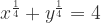
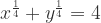
Question 1. Calculate the tangent line of the curve x^{\frac{1}{4}} + y^{\frac{1}{4}}=4 at the point (16,16).

Method (i). Take the derivative of the equation x^{\frac{1}{4}}+y^{\frac{1}{4}}=4 at the both sides, we get

\frac{1}{4}x^{-\frac{3}{4}} + \frac{1}{4}y^{-\frac{3}{4}} y^{'}=0.

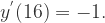
Assume x=y=16, we have the derivative y^{'}(16)=-1. That means the tangent line of the curve at the point (16,16) is y-16=-(x-16). i.e. y=-x+32.

Method (ii). From the equation, we know y(x)=(4-x^{\frac{1}{4}})^{4} , then calculating the derivative directly. i.e.

y^{'}(x)=4(4-x^{\frac{1}{4}})^{3}\cdot (-1)\cdot \frac{1}{4}x^{-\frac{3}{4}}

Therefore, y^{'}(16)=-1.

Method (iii). Making the substitution x=4^{4}\cos^{8}\theta, y=4^{4}\sin^{8}\theta, then (16,16) corresponds to \theta=\pi/4. From the derivative of the parameter functions, we know

\frac{dy}{dx}= \frac{dy/d\theta}{dx/d\theta}=\frac{4^{4}\cdot 8\sin^{7}\theta\cdot \cos\theta}{4^{4}\cdot 8\cos^{7}\theta\cdot (-\sin\theta)}

If we assume \theta=\pi/4, then y^{'}(16)=-1.

Method (iv). Geometric Intuition. Since the equation x^{\frac{1}{4}}+y^{\frac{1}{4}}=4 is a symmetric graph with the line y=x, and (16,16) is also on the symmetric line. Therefore, the slope of the curve at the point (16,16) is -1. Hence, the tangent line is y=-x+32.

Question 2. Let y=(1+x^{2})^{-2} and x=\cot \theta. Find dy/dx and express your answer in terms of \theta.

Method (i). y=\frac{1}{1+x^{2}}= \sin^{2}\theta ,

\frac{dy}{dx}=\frac{dy/d\theta}{dx/d\theta} = \frac{2\sin\theta \cos \theta}{-\sin^{-2}\theta}= - \sin^{2}\theta\sin2\theta.

Method (ii). \frac{dy}{dx}=-\frac{2x}{(1+x^{2})^{2}} = -\frac{2\cot \theta}{(1+\cot^{2}\theta)^{2}}=-\sin^{2}\theta\sin 2\theta.

PHD身边的时间陷阱

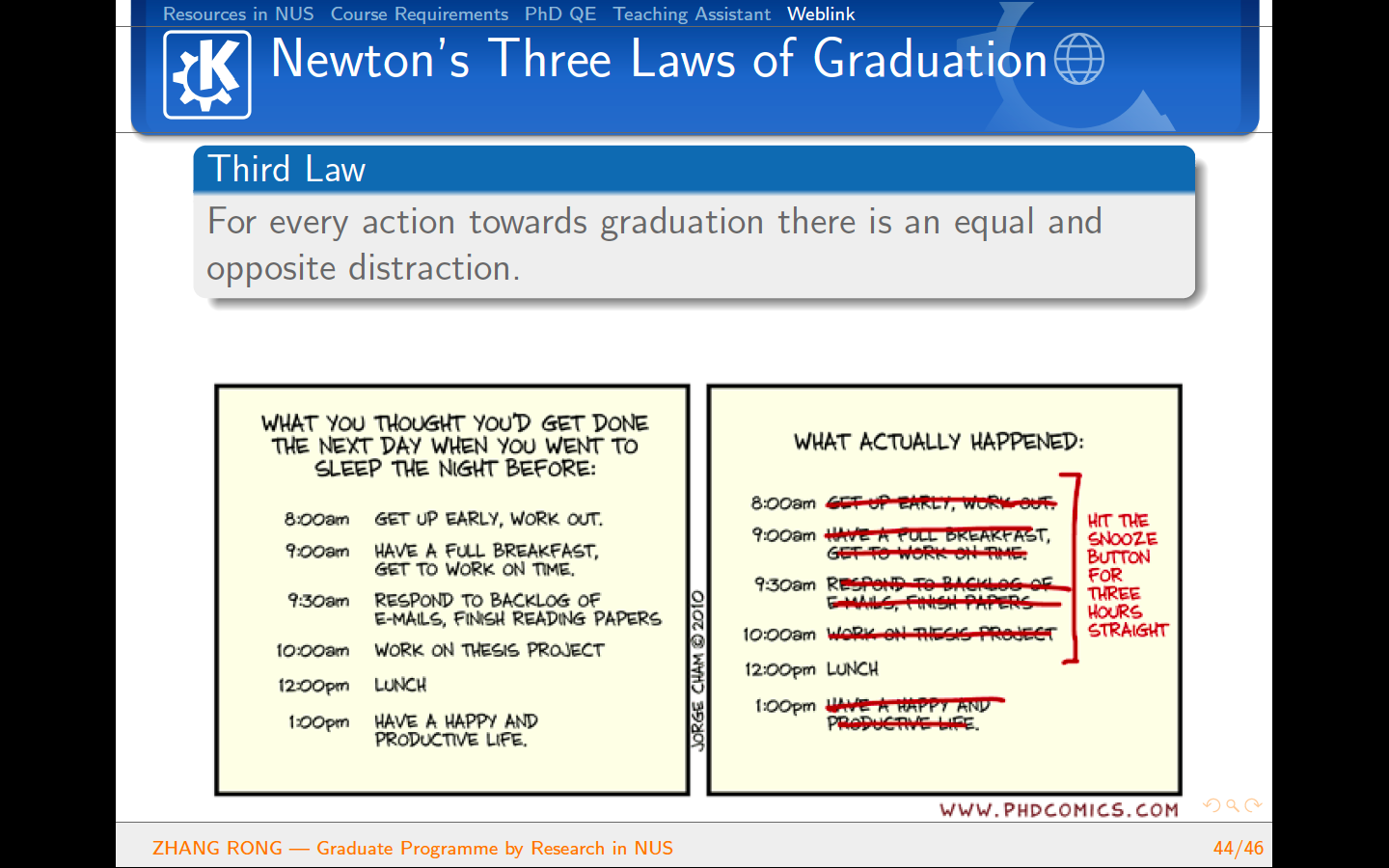
对于一个读博士的学生来说,一天的科研工作可以从早晨八点开始,直至深夜,但是以什么样的状态,什么样的心情来进行这一天的科研就是一个关键的问题。通常来说,在办公室就有一个坑,一个专门坑PHD的时间陷阱,而挖这个陷阱的往往就是自己。

一个PHD可以在早晨8:00起床,洗漱完了之后就可以在8:30左右到达办公室。走到楼下,去楼下的小卖部买了一个小面包就上楼了。到了之后,先去打一壶开水,去卫生间把昨天的杯子清洗一下,然后泡一杯咖啡放在办公桌前面。

8:30这个时候通常都会不由自主的打开电脑,然后链接无线网络,心想:一天的工作开始了。但是打开电脑之后,第一个打开的往往不是LaTex或者Word文档,而是各种各样的浏览器。首先登录的就是自己的邮箱,看一看有没有学校发来的邮件,老板发来的邮件。OK,如果没有,那就看一下有没有各种打折促销的邮件。如果有,那就看一下各类网购的网站,看看有没有自己需要的东西。这样在网上晃一下,就已经一个小时过去了。

9:30。这个时候facebook上面一个消息弹了出来,原来是一个朋友留了一个言,登陆上去回复一下,顺便更新一下自己的最新状态,并且回复一些朋友的新鲜事。这个时候看到了一个不错的新闻,登录百度搜索了一下,去网易,新浪上面看一下网友们的评论,顺便灌了一点水。

坐了一个多小时,应该起来晃一下了,就哼着小曲去了卫生间,慢慢的洗了个手,就已经10:00了。这个时候,系里面的邮件来了,让大家后天交一份报告,于是慢慢的打开了Word文档。纠结了十分钟之后,不知道如何下手,突然想到Google是最好的老师,上去搜索了一大堆资料,储存在电脑硬盘里面,觉得先看一下再开始写自己的报告比较合适,于是已经过了10:30了。这个时候想到早晨自己起来得早,饭没有吃饱,就半个小时就可以吃今天的午饭了,不需要在早上科研了。这样理所当然的就觉得玩一会算了,就顺理成章的说服自己打开了Diablo 3,上去看了下自己过去的装备,今天没有完成的任务是什么,打造了一些新的装备,拆卸了一些没用的东西。

好了,11:15到了,Office突然想起了敲门声,另外办公室的一个PHD来敲门了,喊大家去吃午饭,因为12:00的时候食堂里面人山人海。下楼吃饭,吃完饭了,12:00刚刚好,看着下面排队的人群,觉得自己提前下来吃饭非常的明智。

回到办公室,觉得刚吃完饭,可以休息一下,不应该马上投入苦逼的科研工作,于是再次打开了电脑,点击了浏览器,输入了新浪的网址,看了一下最新的体育新闻,最新的NBA比分结果,最新的足球转会消息。看了新闻之后,觉得不满足,打开了YouTube,看一看自己昨天没有看完的电视剧。

好,此时已经是14:00了。应该开始写自己应该写的论文了,打开LaTex,发现自己昨天思考的方法错了,应该重新审视自己的论文步骤。哎,还是翻一下别人遇到类似问题怎么处理的吧。再次打开GOOGLE搜索,搜了一会,发觉Google的功能非常的强大,搜到了自己需要的论文,但是如果没有登录学校的数据库,就没法下载论文。那就打开了学校的图书馆网址,填写了自己的用户名和密码,ok,一切顺利,下载好了论文并且去打印室打印出来。

15:00,突然瞅了一眼自己的日程安排,突然想起来这个时候是系里面的Tea Break,有免费的食物和咖啡,于是拿着自己的杯子就下楼,找到一些PHD同学,系里面的老师聊了一下天,吃了一些事物,谈论了一下最近的新闻。一个小时后,Tea Break结束,拿着自己的杯子返回Office。

现在已经16:00了,突然觉得自己的桌子有点脏,于是拿着抹布去了卫生间,弄湿了来Office把自己的桌子擦拭干净。16:15,这个时候想起来,炉石传说每天新的任务就在这个时候更新。拿出了Ipad,打开了炉石传说的app,看了一下今天的任务,就觉得自己今天肯定能够完成,于是玩了几把炉石传说。

在17:00觉得貌似可以开始下楼吃晚饭了,于是就喊上office的几位好友,一同前往楼下的食堂。在电梯里的时候,有人提议去外面吃一顿吧,改善下自己的伙食,在下面的食堂已经吃腻了。于是就去了地铁站,直奔外面的餐馆。吃完饭,就可以收拾收拾自己在office没有完成的工作返回宿舍了。

其实在PHD的办公室中,一直都有这种时间陷阱,会让人有一种自己总处于很忙碌的错觉。看着自己电脑右上角的时间一点一点过去,但是自己应该做的事情却一点都没有干。这种就是拖延症,让自己无法从这种状况下逃离,只能在一个漩涡里面越陷越深。

Manjul Bhargava and his 290 theorem

zx31415's avatarFight with Infinity

ICM 2014今天在韩国首尔召开。正如之前所预测的那样,Manjul Bhargava获得了2014年的Fields Medal. 一同获奖的还有Artur Avila, Martin HairerMaryam Mirzakhani.

这份名单相当有趣:史上第一位女性获奖者(或许是为了赶在美国第一位女总统之前?);4人广义上的“祖国”(印度、巴西、奥地利以及伊朗)此前均无Fields奖得主(何其政治正确!当然这也反映了现今欧美基础学科研究人员的“去欧美化”趋势);3人的研究工作和遍历理论紧密相关;2人有参加IMO的经历(有此经历的Fields奖得主越来越多,当然,其中并没有华人的身影——丘成桐或许会愿意就数学研究和奥林匹克数学的关系作进一步的评论);等等。

本文将介绍获奖者Manjul Bhargava的一项“初等”工作:简化了Conway-Schneeberger 15定理的证明,并进一步证明了Conway的290猜想。

1.
我们感兴趣的是在整格$latex Bbb Z^n$上取整值的$latex n$元多项式$latex f$。若$latex f$是齐次的,这相当于要求$latex f$的系数为整数。对可表示集$latex R_f:=f(Bbb N^n) subset Bbb Z$(约定$latex 0 in Bbb N$)的研究贯穿了整个数论史:
(1.1)Fermat集中研究了用2元2次整系数多项式表示素数$latex p$的问题,并发现
若$latex f(x,y)=x^2+y^2$,则$latex p in R_f$当且仅当$latex p$形如$latex 4a+1$;
若$latex f(x,y)=x^2+2y^2$,则$latex p in R_f$当且仅当$latex p$形如$latex 8a+1$或$latex 8a+3$;
若$latex f(x,y)=x^2-2y^2$,则$latex p in R_f$当且仅当$latex p$形如$latex 8a+1$或$latex 8a+7$;
若$latex f(x,y)=x^2+3y^2$,则$latex p in R_f$当且仅当$latex p$形如$latex 3a+1$;
若$latex f(x,y)=x^2+5y^2$,则$latex p in R_f$当且仅当$latex p$形如$latex 20a+1$或$latex 20a+9$;
此类现象是代数数论乃至类域论的渊薮。
(1.2)由Fermat二平方和定理开始,Euler等数学家获得了一系列经典结果。
(Fermat二平方和定理, 由Euler证明) 若$latex f(x,y)=x^2+y^2$,则自然数$latex k in R_f$当且仅当$latex k$的奇素因子(若有)均形如$latex 4a+1$。
(Lagrange四平方和定理) 若$latex f(x,y,z,w)=x^2+y^2+z^2+w^2$,则$latex R_f=Bbb N$。
(Legendre三平方和定理) 若$latex f(x,y,z)=x^2+y^2+z^2$,则自然数$latex k in R_f$当且仅当$latex k$不能写成$latex 2^{2a}(8b+7)$的形式。
(1.3) 平方数有一类推广,即所谓的多边形数:填满正多边形内部的点的个数。
(Gauss三角数定理,“Eureka定理”)令$latex f(x,y,z)=frac{x(x+1)}{2}+frac{y(y+1)}{2}+frac{z(z+1)}{2}$,则$latex R_f=Bbb N$。
推广Gauss三角数定理和Lagrange四平方和定理,我们有如下结果:
(Fermat多边形数定理,由Cauchy证明) 任意自然数均可表示为不超过$latex n$个$latex n$边形数之和。
(1.4)从Lagrange四平方和定理出发,我们也可以研究高次幂多项式的表示问题:
(Waring问题,由Hilbert解决) 给定$latex k geq 2$,$latex f=sum_{1 leq i leq g} x_i^k$。对于充分大的$latex g$,$latex R_f=Bbb N$。
关于$latex g$的下确界$latex…

View original post 234 more words

Khot, Osher, Griffiths

Terence Tao's avatarWhat's new

In addition to the Fields medallists mentioned in the previous post, the IMU also awarded the Nevanlinna prize to Subhash Khot, the Gauss prize to Stan Osher (my colleague here at UCLA!), and the Chern medal to Phillip Griffiths. Like I did in 2010, I’ll try to briefly discuss one result of each of the prize winners, though the fields of mathematics here are even further from my expertise than those discussed in the previous post (and all the caveats from that post apply here also).

Subhash Khot is best known for his Unique Games Conjecture, a problem in complexity theory that is perhaps second in importance only to the $latex {P neq NP}&fg=000000$ problem for the purposes of demarcating the mysterious line between “easy” and “hard” problems (if one follow standard practice and uses “polynomial time” as the definition of “easy”). The $latex {P neq…

View original post 1,244 more words

Lindenstrauss, Ngo, Smirnov, Villani

Terence Tao's avatarWhat's new

As is now widely reported, the Fields medals for 2010 have been awarded to Elon Lindenstrauss, Ngo Bao Chau, Stas Smirnov, and Cedric Villani. Concurrently, the Nevanlinna prize (for outstanding contributions to mathematical aspects of information science) was awarded to Dan Spielman, the Gauss prize (for outstanding mathematical contributions that have found significant applications outside of mathematics) to Yves Meyer, and the Chern medal (for lifelong achievement in mathematics) to Louis Nirenberg. All of the recipients are of course exceptionally qualified and deserving for these awards; congratulations to all of them. (I should mention that I myself was only very tangentially involved in the awards selection process, and like everyone else, had to wait until the ceremony to find out the winners. I imagine that the work of the prize committees must have been extremely difficult.)

Today, I thought I would mention one…

View original post 3,867 more words

Avila, Bhargava, Hairer, Mirzakhani

Terence Tao's avatarWhat's new

The 2014 Fields medallists have just been announced as (in alphabetical order of surname) Artur Avila, Manjul Bhargava, Martin Hairer, and Maryam Mirzakhani (see also these nice video profiles for the winners, which is a new initiative of the IMU and the Simons foundation). This time last year, I wrote a blog post discussing one result from each of the 2010 medallists; I thought I would try to repeat the exercise here, although the work of the medallists this time around is a little bit further away from my own direct area of expertise than last time, and so my discussion will unfortunately be a bit superficial (and possibly not completely accurate) in places. As before, I am picking these results based on my own idiosyncratic tastes, and are not necessarily the “best” work of these medallists.

Artur Avila works in dynamical systems and in the…

View original post 1,412 more words

2014 International Congress of Mathematics: Awards

Fields Medalist:

Artur Avila
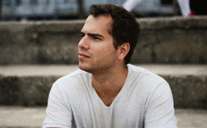
p_1

CNRS, France & IMPA, Brazil

[Artur Avila is awarded a Fields Medal] for his profound contributions to dynamical systems theory have changed the face of the field, using the powerful idea of renormalization as a unifying principle.

Avila leads and shapes the field of dynamical systems. With his collaborators, he has made essential progress in many areas, including real and complex one-dimensional dynamics, spectral theory of the one-frequency Schródinger operator, flat billiards and partially hyperbolic dynamics.

Avila’s work on real one-dimensional dynamics brought completion to the subject, with full understanding of the probabilistic point of view, accompanied by a complete renormalization theory. His work in complex dynamics led to a thorough understanding of the fractal geometry of Feigenbaum Julia sets.

In the spectral theory of one-frequency difference Schródinger operators, Avila came up with a global de- scription of the phase transitions between discrete and absolutely continuous spectra, establishing surprising stratified analyticity of the Lyapunov exponent.

In the theory of flat billiards, Avila proved several long-standing conjectures on the ergodic behavior of interval-exchange maps. He made deep advances in our understanding of the stable ergodicity of typical partially hyperbolic systems.

Avila’s collaborative approach is an inspiration for a new generation of mathematicians.


Manjul Bhargava
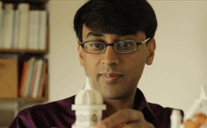
p_2

Princeton University, USA

[Manjul Bhargava is awarded a Fields Medal] for developing powerful new methods in the geometry of numbers and applied them to count rings of small rank and to bound the average rank of elliptic curves.

Bhargava’s thesis provided a reformulation of Gauss’s law for the composition of two binary quadratic forms. He showed that the orbits of the group SL(2, Z)3 on the tensor product of three copies of the standard integral representation correspond to quadratic rings (rings of rank 2 over Z) together with three ideal classes whose product is trivial. This recovers Gauss’s composition law in an original and computationally effective manner. He then studied orbits in more complicated integral representations, which correspond to cubic, quartic, and quintic rings, and counted the number of such rings with bounded discriminant.

Bhargava next turned to the study of representations with a polynomial ring of invariants. The simplest such representation is given by the action of PGL(2, Z) on the space of binary quartic forms. This has two independent invariants, which are related to the moduli of elliptic curves. Together with his student Arul Shankar, Bhargava used delicate estimates on the number of integral orbits of bounded height to bound the average rank of elliptic curves. Generalizing these methods to curves of higher genus, he recently showed that most hyperelliptic curves of genus at least two have no rational points.

Bhargava’s work is based both on a deep understanding of the representations of arithmetic groups and a unique blend of algebraic and analytic expertise.


Martin Hairer
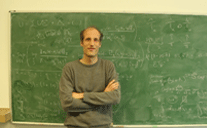
p_3

University of Warwick, UK

[Martin Hairer is awarded a Fields Medal] for his outstanding contributions to the theory of stochastic partial differential equations, and in particular created a theory of regularity structures for such equations.

A mathematical  problem that  is important  throughout science is to understand the influence of noise on differential equations, and on the long time behavior of the solutions. This problem was solved for ordinary differential equations by Itó in the 1940s. For partial differential equations, a comprehensive theory has proved to be more elusive, and only particular cases (linear equations, tame nonlinearities, etc.)  had been treated satisfactorily.

Hairer’s work addresses two central aspects of the theory.  Together with Mattingly  he employed the Malliavin calculus along with new methods to establish the ergodicity of the two-dimensional stochastic Navier-Stokes equation.

Building  on the rough-path approach of Lyons for stochastic ordinary differential equations, Hairer then created an abstract theory of regularity structures for stochastic partial differential equations (SPDEs). This allows Taylor-like expansions around any point in space and time. The new theory allowed him to construct systematically solutions to singular non-linear SPDEs  as fixed points of a renormalization procedure.

Hairer was thus able to give, for the first time, a rigorous intrinsic meaning to many SPDEs arising in physics.


Maryam Mirzakhani
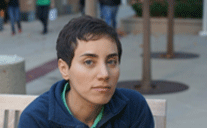
p_4

Stanford University, USA

[Maryam Mirzakhani is awarded the Fields Medal] for her outstanding contributions to the dynamics and geometry of Riemann surfaces and their moduli spaces.

Maryam Mirzakhani has made stunning advances in the theory of Riemann surfaces and their moduli spaces, and led the way to new frontiers in this area. Her insights have integrated methods from diverse fields, such as algebraic geometry, topology and probability theory.

In hyperbolic geometry, Mirzakhani established asymptotic formulas and statistics for the number of simple closed geodesics on a Riemann surface of genus g. She next used these results to give a new and completely unexpected proof of Witten’s conjecture, a formula for characteristic classes for the moduli spaces of Riemann surfaces with marked points.

In dynamics, she found a remarkable new construction that bridges the holomorphic and symplectic aspects of moduli space, and used it to show that Thurston’s earthquake flow is ergodic and mixing.

Most recently, in the complex realm, Mirzakhani and her coworkers produced the long sought-after proof of the conjecture that – while the closure of a real geodesic in moduli space can be a fractal cobweb, defying classification – the closure of a complex geodesic is always an algebraic subvariety.

Her work has revealed that the rigidity theory of homogeneous spaces (developed by Margulis, Ratner and others) has a definite resonance in the highly inhomogeneous, but equally fundamental realm of moduli spaces, where many developments are still unfolding


Nevanlinna Prize Winner:

Subhash Khot
p_5

New York University, USA 

[Subhash Khot is awarded the Nevanlinna Prize] for his prescient  definition of the “Unique Games” problem, and his leadership in the effort to understand its complexity and its pivotal role in the study of efficient approximation of optimization problems, have produced breakthroughs in algorithmic design and approximation hardness, and new exciting interactions between computational complexity, analysis and geometry.

Subhash Khot defined the “Unique Games” in 2002 , and subsequently led the effort to understand its complexity and its pivotal role in the study of optimization problems. Khot and his collaborators demonstrated that the hardness of Unique Games implies a precise characterization of the best approximation factors achievable for a variety of NP-hard optimization problems. This discovery turned the Unique Games problem into a major open problem of the theory of computation.

The ongoing quest to study its complexity has had unexpected benefits. First, the reductions used in the above results identified new problems in analysis and geometry, invigorating analysis of Boolean functions, a field at the interface of mathematics and computer science. This led to new central limit theorems, invariance principles, isoperimetric inequalities, and inverse theorems, impacting research in computational complexity, pseudorandomness, learning and combinatorics. Second, Khot and his collaborators used intuitions stemming from their study of Unique Games to yield new lower bounds on the distortion incurred when embedding one metric space into another, as well as constructions of hard families of instances for common linear and semi- definite programming algorithms. This has inspired new work in algorithm design extending these methods, greatly enriching the theory of algorithms and its applications.


Gauss Prize Winner:

Stanley Osher
p_6

University of Califonia, USA 

[Stanley Osher is awarded the Gauss Prize] for his influential contributions to several fields in applied mathematics, and his far-ranging inventions have changed our conception of physical, perceptual, and mathematical concepts, giving us new tools to apprehend the world.

1. Stanley Osher has made influential contributions in a broad variety of fields in applied mathematics. These include high resolution shock capturing methods for hyperbolic equations, level set methods, PDE based methods in computer vision and image processing, and optimization. His numerical analysis contributions, including the Engquist-Osher scheme, TVD schemes, entropy conditions, ENO and WENO schemes and numerical schemes for Hamilton-Jacobi type equations have revolutionized the field. His level set contribu- tions include new level set calculus, novel numerical techniques, fluids and materials modeling, variational approaches, high codimension motion analysis, geometric optics, and the computation of discontinuous so- lutions to Hamilton-Jacobi equations; level set methods have been extremely influential in computer vision, image processing, and computer graphics. In addition, such new methods have motivated some of the most fundamental studies in the theory of PDEs in recent years, completing the picture of applied mathematics inspiring pure mathematics.

2. Stanley Osher has unique mentoring qualities: he has influenced the education of generations of outstanding applied mathematicians, and thanks to his entrepreneurship he has successfully brought his mathematics to industry.

Trained as an applied mathematician and an applied mathematician all his life, Osher continues to surprise the mathematical and numerical community with the invention of simple and clever schemes and formulas. His far-ranging inventions have changed our conception of physical, perceptual, and mathematical concepts, and have given us new tools to apprehend the world.


Chern Medalist:

Phillip Griffiths

p_7

Institute for Advanced Study, USA 

[Phillip Griths is awarded the 2014 Chern Medal] for his groundbreaking and transformative development of transcendental methods in complex geometry, particularly his seminal work in Hodge theory and periods of algebraic varieties.

Phillip Griffiths’s ongoing work in algebraic geometry, differential geometry, and differential equations has stimulated a wide range of advances in mathematics over the past 50 years and continues to influence and inspire an enormous body of research activity today.

He has brought to bear both classical techniques and strikingly original ideas on a variety of problems in real and complex geometry and laid out a program of applications to period mappings and domains, algebraic cycles, Nevanlinna theory, Brill-Noether theory, and topology of K¨ahler manifolds.

A characteristic of Griffithss work is that, while it often has a specific problem in view, it has served in multiple instances to open up an entire area to research.

Early on, he made connections between deformation theory and Hodge theory through infinitesimal methods, which led to his discovery of what are now known as the Griffiths infinitesimal period relations. These methods provided the motivation for the Griffiths intermediate Jacobian, which solved the problem of showing algebraic equivalence and homological equivalence of algebraic cycles are distinct. His work with C.H. Clemens on the non-rationality of the cubic threefold became a model for many further applications of transcendental methods to the study of algebraic varieties.

His wide-ranging investigations brought many new techniques to bear on these problems and led to insights and progress in many other areas of geometry that, at first glance, seem far removed from complex geometry. His related investigations into overdetermined systems of differential equations led a revitalization of this subject in the 1980s in the form of exterior differential systems, and he applied this to deep problems in modern differential geometry: Rigidity of isometric embeddings in the overdetermined case and local existence of smooth solutions in the determined case in dimension 3, drawing on deep results in hyperbolic PDEs(in collaborations with Berger, Bryant and Yang), as well as geometric formulations of integrability in the calculus of variations and in the geometry of Lax pairs and treatises on the geometry of conservation laws and variational problems in elliptic, hyperbolic and parabolic PDEs and exterior differential systems.

All of these areas, and many others in algebraic geometry, including web geometry, integrable systems, and Riemann surfaces, are currently seeing important developments that were stimulated by his work.

His teaching career and research leadership has inspired an astounding number of mathematicians who have gone on to stellar careers, both in mathematics and other disciplines. He has been generous with his time, writing many classic expository papers and books, such as “Principles of Algebraic Geometry”, with Joseph Harris, that have inspired students of the subject since the 1960s.

Griffiths has also extensively supported mathematics at the level of research and education through service on and chairmanship of numerous national and international committees and boards committees and boards. In addition to his research career, he served 8 years as Duke’s Provost and 12 years as the Director of the Institute for Advanced Study, and he currently chairs the Science Initiative Group, which assists the development of mathematical training centers in the developing world.

His legacy of research and service to both the mathematics community and the wider scientific world continues to be an inspiration to mathematicians world-wide, enriching our subject and advancing the discipline in manifold ways.


Leelavati Prize Winner:

Adrián Paenza
p_8

University of Buenos Aires, Argentina 

[Adrian Paenza is awarded the Leelavati Prize] for his contributions have definitively changed the mind of a whole country about the way it perceives mathematics in daily life. He accomplished this through his books, his TV programs, and his unique gift of enthusiasm and passion in communicating the beauty and joy of mathematics.

Adrián Paenza has been the host of the long-running weekly TV program “Cient´ıficos Industria Argentina” (“Scientists Made in Argentina”), currently in its twelfth consecutive season in an open TV channel. Within a beautiful and attractive interface, each program consists of interviews with mathematicians and scientists of very different disciplines, and ends with a mathematical problem, the solution of which is given in the next program.

He has also been the host of the TV program “Alterados por Pi” (“Altered by Pi”), a weekly half-hour show exclusively dedicated to the popularization of mathematics; this show is recorded in front of a live audience in several public schools around the country.

Since 2005, he has written a weekly column about general science, but mainly about mathematics, on the back page of P´agina 12, one of Argentinas three national newspapers. His articles include historical notes, teasers and even proofs of theorems.

He has written eight books dedicated to the popularization of mathematics: five under the name “Matem´atica

. . . ¿est´as ah´ı?” (“Math . . . are you there?”), published by Siglo XXI Editores, which have sold over a million copies. The first of the series, published in September 2005, headed the lists of best sellers for a record of 73 consecutive weeks, and is now in its 22nd edition. The enormous impact and influence of these books has extended throughout Latin America and Spain; they have also been published in Portugal, Italy, the Czech Republic, and Germany; an upcoming edition has been recently translated also into Chinese.

NUS UTown成为登革热病危险区

http://www.channelnewsasia.com/news/singapore/nus-university-town/1298832.html

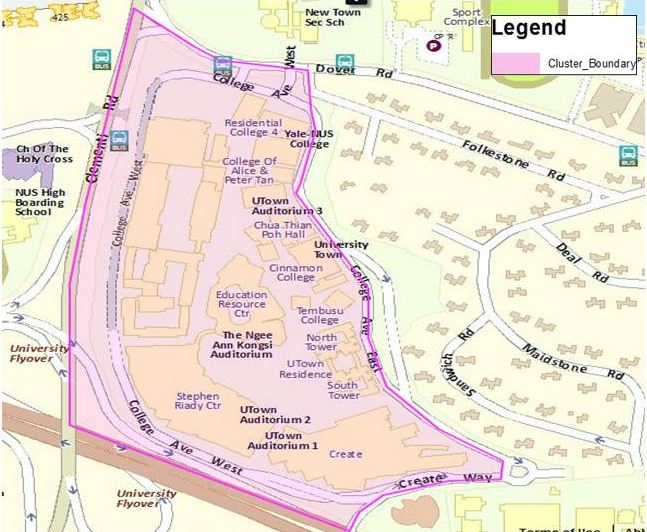
到目前为止,作为NUS的主要住宿区之一,University Town已经有十个登革热的病例。根据National Environment Agency(NEA)的报道,新加坡国立大学的University Town已经成为登革热的爆发区之一,目前已经有十个登革热的病例。总共有1800名学生住在University Town,这里是学生和教职人员的主要活动场所之一。在新加坡目前已经被划出21个登革热的危险地区,最大的区域在Choa Chua Kang,那里有527个病例。今年新加坡总共报告了12438个登革热的病例。根据NEA的网站统计,在上周日和这周周二,总共有200个病例爆发。

utown-dengue-cluster-data

2014年8月6日


何谓登革热?

登革热﹝俗称“断骨热”﹞是一种由登革热病毒引起的急性发热传染病,由蚊子传播给人类。病原体为登革热病毒( 可分为 1、2、3、4 型 )。全球每年约有五千万宗登革热个案,常见于热带和亚热带地域。近年登革热转趋活跃,影响全球各地,在东南亚部分国家,登革热已成为地方性流行病,国内有输入病例或局部暴发疫情出现。

登革热的病媒是什么?

登革热通过带有登革热病毒的雌性伊蚊叮咬而传染给人类。主要传播媒介为埃及伊蚊、白纹伊蚊。其中白纹伊蚊(俗称“花斑蚊”)在我省分布广泛,主要在清水容器中孳生,大多数在屋外或野外阴暗处流连,但亦会在户内活动。雌蚊嗜吸人血,吸血高峰在日落前两小时(约为下午五、六时),及早上八、九时。室外及室内皆可叮咬人。

登革热的传染途径是什么?

当人被带病毒蚊子叮咬后,病毒会从蚊子之唾液进入人体血液而感染。如果病者在刚发烧前至退烧期内(大约六至七日)被蚊叮,病毒就有可能传给蚊子继而传播开去。此病并不会经由人与人之间传播,与患者接触是不会被传染的。

典型登革热的病征是什么?

感染登革热病毒后,经过3至15天的潜伏期(通常为5至8日),患者多以突然发热为首发症状,持续发热3~5天,严重头痛,四肢酸痛、关节痛、肌肉痛、背痛、后眼窝痛。发病后3、4日出现红疹,恶心、呕吐,轻微的流牙血和流鼻血。病后有可能出现极度疲倦及抑郁症状,极少数病者会恶化至出血性登革热,并进一步出血、休克,严重时可引致死亡。

个人如何做好登革热防护?

现时并没有一种有效疫苗来预防登革热。预防登革热的最佳方法就是清除积水,防止伊蚊孳生,以避免给蚊子叮咬,有关预防蚊咬的措施如下:

到登革热流行区旅游或生活,应穿着长袖衣服及长裤,并于外露的皮肤及衣服上涂上蚊虫驱避药物。

如房间没有空调设备,应装置蚊帐或防蚊网。

使用家用杀虫剂杀灭成蚊,并遵照包装指示使用适当的份量。切勿向运作中的电器用品或火焰直接喷射杀虫剂,以免发生爆炸。

避免在“花斑蚊”出没频繁时段在树荫、草丛、凉亭等户外阴暗处逗留。

防止积水,清除伊蚊孳生地:

尽量避免用清水养殖植物。

对于花瓶等容器,每星期至少清洗、换水一次,勿让花盆底盘留有积水。

把所有用过的罐子及瓶子放进有盖的垃圾桶内。

将贮水容器、水井及贮水池加盖。

所有渠道要保持畅通。

将地面凹陷的地方全部填平,以防积水。

怀疑自己感染登革热时最要紧是请教医生。

如何预防控制登革热暴发?

预防登革热暴发的有效措施就是杀灭伊蚊,其中除紧急杀灭带毒成蚊外,翻盆倒罐清除伊蚊孳生地,迅速降低蚊媒密度更为重要。

灭蚊要重在落实,检查评估考核效果:定期检查有否妥善弃置可积水的器皿杂物?(例如将空罐、发泡胶盒、杯、水樽、汽水罐等放进有盖的垃圾桶内)。有否盖好贮水容器?沟渠是否畅通?有否定期清洗积水容器?(例如花樽、花盆碟、冷气机盛水器、水缸、贮水池、废旧轮胎等)有否填平凹陷的地面以防积水?要注意检查花园、园艺角、花盆盛水碟、水栽植物,小卖部、垃圾站、沟渠、洗手间、水箱、贮水池等。

近期学校开学,教育部门要做好登革热防控工作。各学校要做好开学前的杀灭成蚊、清理伊蚊孳生地。加强健康教育、增加大家对蚊虫传播疾病的认识,提高对预防登革热的意识及评估其风险,鼓励全校积极参与预防蚊患。

旅游者如何防护登革热?

登革热常出现在热带与亚热带地区。夏秋季到东南亚旅游时,,提高自我保护意识。要做好防蚊、个人保护措施。旅游后半个月内如出现发热,应尽早就医治疗,并向医生说明旅行史。

[转载]美国是天堂吗?

南大校友王庆根,原为奥赛金牌得主,斯坦福大学化学博士,Paypal的首席工程师,可以说学业和事业都很成功,却因抑郁症,本月初自杀,留下一双儿女。这是多么惨痛的悲剧!王博士的经历和我惊人地相似,同年出生,都在南大上过学,后来到美国闯荡,他的孩子和我的孩子一样大。我自己还苟活着,但同病相怜,觉得我们这些在美国生活得时间比较久的人,有必要多说说自己实际的生活状况,让其余的人做选择的时候,起码多一些参考。我和同样在美国生活的涂子沛兄(《大数据大趋势》一书作者,现居匹兹堡)相约,就这个话题,展开一些讨论。

在美国的生活,起码对中国移民来说,是“儿童的天堂,中年人的战场,老年人的地狱”。这种概括虽笼统,却不离谱。为了给儿童一个天堂,我们闯进了战场。在美国生活的不易,很少有当事人自己说过。对外人,大家要面子,家丑不外扬,有问题不暴露。对家人,大家报喜不报忧。久了不说,问题就可能酿成悲剧。

我不知王博士的离世究竟是什么原因,但不妨借题发挥,顺着“压力”这个话题,说说在美国生存的压力。我只说自己认为比较重要的几点,抛砖引玉,希望其他海外朋友补充。

国内报道,多强调王走上绝路,是因工作压力太大。表面上看这似是最合理的解释,但未必有普遍意义。就我自己的体验,海外中国人的隐形压力不止工作。事实上,工作压力有时候还算次要。美国职场环境相对宽松,大部分美国上司处事随和。做同类工作,可能在国内的压力更大。当然我这里说的一切话都是笼统的说法,具体情况因人而异。

那看不见的让人崩溃的压力究竟来自何方?我最近就遇到几个人,也抱怨说自己快得忧郁症了。原因和工作本身无关,倒是都牵涉到海外生活的孤立无助,或是紧张的家庭关系。

这种紧张来源有很多,比如孩子上学。美国学校通常三点下课。很多地方又规定,不到法定年龄,孩子不可无大人陪伴,单独在家。如果夫妻双方都上班,孩子的接送和安全就成了大问题。另外,美国的暑假长达三个多月,这中间孩子怎么办?有的送回国,有的请国内祖父母来带,有的花钱请人, 有的送往暑期的各种夏令营。每一种方法,都非常折腾。总的来说,我建议,能用钱解决的问题,争取用钱解决。人情债,以及由此产生的不和谐关系,能避免尽量避免,不要贪小便宜,最终后患无穷。

美国人自己也有这些问题,但他们毕竟是本地人,解决办法更多。有些是夫妇的一方把工作辞掉,或者换成兼职工作,时间上灵活起来,以便照顾孩子的起居和接送。目前来说,美国经济萧条,双职工家庭越来越多。即便这样,妇女在家不上班,也是常态,所有人都理解,她们自己也坦然。共和党的总统候选人罗姆尼的太太,被人指责“一辈子没工作过”,能谈什么经济?这个说法,反倒让罗姆尼得分。罗姆尼太太说她家中要负责五个孩子,这不叫工作什么叫工作?这个说法赢得了很多选民的认同。美国的纳税是根据全家收入来算的。除非真能挣到钱,否则,考虑到纳税、雇人看孩子成本,孩子成长中家长参与的欠缺等多方面原因,去工作反而得不偿失。如果孩子多,夫妻一方收入不高,那还不如别去上班。一定有那么一个公式,让我们计算到工作与不工作的成本-收益平衡点在哪里。

这也不仅是经济问题,个人自我认知和心态调整也很重要。来自我们大陆的家庭,心态一关就很难过。不少家庭里,夫妻在美国生活久了,可因地制宜,适应当地环境。但国内父母甚至其他亲戚的聒噪,则是新的一重压力。有些老年人一辈子下来,除了工作挣钱,找不到还有什么别的东西,可以去寄托人生的意义,也无法理解美国这边的情况,用国内环境下的心态,乱出主意。他们有的是为了面子,希望告诉他人自己的孩子在美国某某地方上班,不希望邻居同事亲戚朋友知道自己的孩子在美国“没工作”。他们不知道,这有时候是为了家庭的整体利益作出的一种主动选择。子女有时候出于孝顺,只好依从,好让国内父母显摆,小家庭的苦只有自己去尝。也有的父母观念错误,比如“不要在家吃闲饭”,“不要吃丈夫的饭”,硬是劝子女去上班。中国家庭,很多是一方出来读书,一方陪读,有了机会另外一方去读书,本来拿学位就有早晚,不是都能顺利找到理想工作。

有的家庭为了省几个钱,让国内老人过来带孩子。这会使得带孩子的问题表面上缓解,但是这会生出很多新的问题。最大的问题是医疗,在美国,保险通常只保“核心家庭”,亦即配偶和孩子。来访的父母不算dependent. 只能去另买保险。保险公司遇到这种既不是美国公民又不是年轻力壮的人投保,保险费通常很昂贵。很多家庭看情况还行,就去侥幸赌一把,不去买,但一旦父母在美国生病,又没有保险,最终医疗费惊人,甚至一下子就能把小家庭拖垮。这种风险,一些来访老人可能并不知道,有时候也不能理解。遇到这类问题,甚至在子女本来就已经压力重重的时候,因为自己不满而抱怨,让子女的家庭平添矛盾,使得人到中年、夹心饼干一样的他们痛苦不堪。

和其他任何地方的家庭一样,几代人之间的冲突总是难免,比如生活习惯,子女教育等多方面,大家都可能有差异。和国内不同的是,由于来一趟不易,很多父母一来,就把旅游签证所允许的半年用足。有了摩擦,无处可走,所以长时间困在一个地方,矛盾处理不当可能激化,影响小家庭夫妻关系。这样一来,美国生活不仅成为老人的地狱,也会成为三代人共同的地狱。

这种折磨,最终极为损害夫妻关系。再恩爱的夫妻,也架不住这种水滴石穿的长期冲突。很多海外中国夫妻关系紧张。美国人不像我们这样死要面子活受罪,遇到这些问题,会去找婚姻咨询等地方寻求帮助,商量解决夫妇双方解决不了的冲突,所有的工作都做完了还不行就索性散伙。中国人本来就含蓄,有问题自己相互都不说,更不要说寻求专业帮助,所以通常是带着问题过日子,如同两腿绑着沙袋去踢球。美国人在家庭关系中把夫妻关系摆在首要位置,夫妻关系和谐,子女会生活在幸福的环境之下,父母亲也可放心地安度晚年。中国舍本逐末,教孝不教慈,把孝道摆第一位,甚至孝道压倒人道,把很多其它的关系给扭曲了。久而久之,家庭的裂痕越来越大,小家庭又为了儿女或者父母的面子,强忍着在一起,形成过也过不好,离也离不了的亚婚姻。到了海外,在新的文化环境之下,这种冲突越发明显。我的下一本书,《生活意见》(暂定名,将由华师大出版),就谈到了很多这方面的话题。

另外一个压力源是工作许可的问题。美国的移民是一个复杂、漫长而又头痛的过程,人在美国扎下根来并不容易,有时候也没有必要,因为现在在国内,出国旅游、访学、商务也越来越容易。如果选择移民,除结婚和投资的渠道外,大部分中国留学生未来面临的是职业移民。这方面大部分人的过程相差无几:大家先读书,然后找工作,根据工作,一层层办工作许可,每一次都是一场小小的战斗。要是读博士,起码得四五年时间搭进去。然后利用一年到一年半(因专业而异)的“职业实习期”(OPT),此间可合法找工作。OPT是比较临时的工作身份,找到合适的工作后,得尽快转成工作签证。工作签证需要雇主帮你申请,雇主不肯,你只好再去找肯帮你办的雇主。工作签证三年一延,最多七年。这期间,大家努力去办理绿卡。绿卡办理分几个优先顺序,杰出人才办得很快,这要看你的学位(多为博士学位),学术成果等。余下类别多有根据国别的签证配额排期(相当于“入户指标”),排到了才可办理。这排期三五年是常事。排期中,不可轻易改变工作,这让很多人只好接受不满意的工作,这中间离开美国再回来,还要花钱申请Advance parole, “Parole”也是犯人假释的意思,真是“移民监”了。

几番折腾下来,到最终不再受“身份”限制,搞不好就八九年甚至十几年过去了。此时已人到中年,花的心,藏在蕊中,空把花季都错过了。好多人当年的梦想,早已灰飞烟灭。大家只好把兴趣放到孩子和房子身上。自我的丧失,对一个人来说是很凄凉的事。坦白地说,很多第一代移民的人生基本上就这样荒废了。能自我安慰的一点,是给孩子提供了一个好的环境,让他们不需要这样再来折腾。

不过如果心态调整好,学会享受生活,不与人攀比,不盲目追求出人头地,能看菜下饭,找到美国生活的美好之处,倒也海阔天空 ——事实上大部分美国人自己正是这么做的,能做到这样,才叫真正地“融入主流社会”了,很多人以为赚了大钱买了大房子,出人头地了,才觉得心里有底,似乎是在国外融入主流,对国内来说光宗耀祖了,这是一种极大的谬误。其实谁在乎?想想看你自己活得怎样?你开心吗?你对下一代尽到责任了吗?这些才是最重要的。

出国是有风险的事,各位需要慎重,大学刚毕业的人倒无所谓,到哪里不是重新开始?我倒不反对移民这件事本身,但是需要好好权衡。那些在国内事业有成的朋友,可能要认真考虑。千万不要有童话思维,认为到了美国,就可以“永远幸福生活”了。很多问题,不会因为你飞越了太平洋,就可以永久地留在身后。

目前喊移民的中产家庭很多。遇到一个问题,人们解决的办法,一为抗争,一为逃离(fight or flight)。来美国十年了,我发觉flight也不是长久之计。但愿我们都去努力,让中国的教育和各方面大环境能好起来,日后大家的志向,会从“美国梦”,转移到“中国梦”上面。我想我能做的,是尽量去介绍美国的教育,好让我们教育各界人士去取长补短,让日后的教育者、家长和儿童,对他人的模式,不再是只能望洋兴叹。

作者:一南大老师

奇妙的动力系统和分形几何

动力系统,听起来像工程上面的发动机,但是它却是数学的一个分支,主要研究的就是在一个固定的规则下,一个点在时间的变化下在空间中的位置变化。比方说钟的摆动,动物种族的繁衍,全球的气候变动。这类的模型都属于动力系统。这篇文章要介绍的,是动力系统与分形几何的一些奇妙性质。

失之毫厘,差之千里

Screen Shot 2014-08-01 at 9.16.26 pm

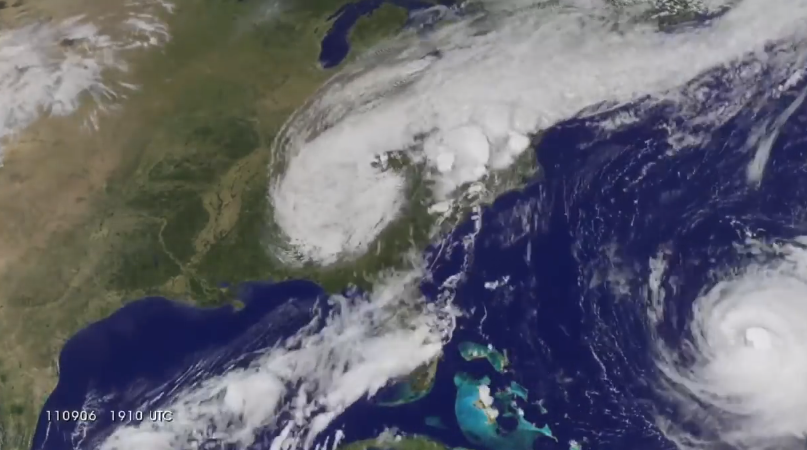
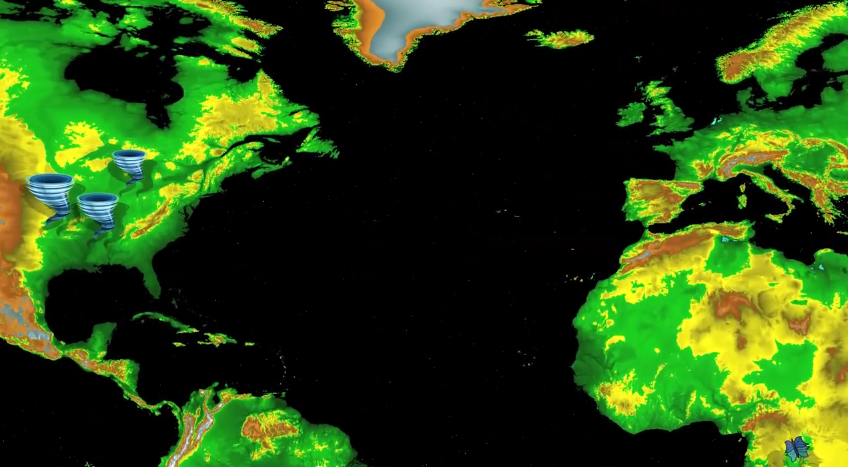
1961年,作为天气预报员的Lorenz在利用计算机来做气象预测时,为了省事,就在第二次计算的时候,直接从第一次程序的中间开始运算。但是两次的预测结果产生了巨大的差异。Lorenz看到这个结果之后大为震惊,然后经过不断地测试,发觉在自己的模型当中,只要初始的数据不一样,就会产生不同的结果,而且结果大相径庭。在1979年的科学会议上,Lorenz简单的描述了“蝴蝶效应”:

一只蝴蝶在巴西轻拍翅膀,会使更多蝴蝶跟着一起轻拍翅膀。最后将有数千只的蝴蝶都跟着那只蝴蝶一同振翅,其所产生的巨风可以导致一个月后在美国德州发生一场龙卷风。                                                                                        —–Edward Norton Lorenz

Screen Shot 2014-08-01 at 9.15.29 pm

在实际的天期预测中,影响天气变化的因素数不胜数,用成千上万的变量来预测天气都不为过。科学家在研究问题的时候,就需要把一个非常复杂的问题简单化,但是又必须保证不能过于简单化。于是Lorenz在1963年发表的文章“Deterministic Nonperiodic Flow”里面提出了一个只有三个变量x, y, z的模型:

x^{'}(t) =\sigma(y-x)

y^{'}(t)=x(\rho-z)-y

z^{'}(t)=xy-\beta z

这个模型中,x,y,z是系统的状态,t是时间。\rho, \sigma, \beta是这个系统的参数。

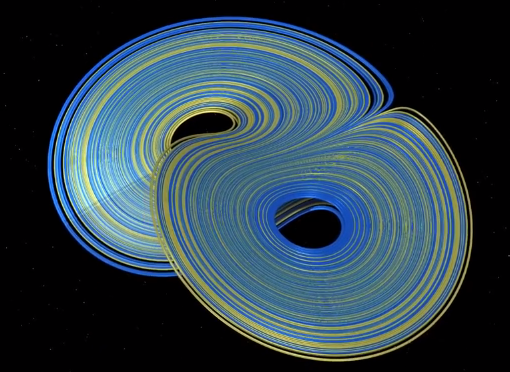
A_Trajectory_Through_Phase_Space_in_a_Lorenz_Attractor

这个模型肯定不能够精确地描述天气变化,但是对于Lorenz解释他自己的观点恰到好处。在这个模型中,变量之间有着非线性的关系,虽然只有三个变量,但是随着时间的推移,三个变量就会交织在一起,互相影响。在三维的空间里面作图的时候,随着时间的推移,系统的演变就会趋近于一个混沌的区域,就像几根线缠绕在两个图钉周围,形如一只正在拍打翅膀的蝴蝶。这个或许就是Lorenz把这现象叫做”蝴蝶效应“的原因。在Lorenz原创性的论文里面,他一针见血地指出天气的影响因素是复杂多变的,即使有了精确地模型,也没有办法做长期的预测,只能够在观测中不停地一边预计,一边修正。

Screen Shot 2014-08-01 at 9.06.57 pm

从数学的角度来看蝴蝶效应,就是在一个给定的动力系统下,一个微小的初值变动就能够带动整个系统长期而巨大的连锁反应,是一种混沌的现象。从社会学的方面来说明就是一个坏的机制,如果不加以及时地引导、调节,会给社会带来非常大的危害,戏称为”龙卷风“或“风暴”;一个好的微小的机制,只要正确指引,经过一段时间的努力,将会产生轰动效应,或称为“革命”。从心理学的角度来诠释就是表面上看起来毫无影响,非常微小的一件事情,都会带来巨大的变化。当一个人小时候的心理受到微小的心理刺激,在这个人的成长过程中,这个刺激就会被逐渐的放大并且不停地影响一个人的生活,牵一发而动全身。混沌理论改变了人们对于科学的看法,简单的数学背后隐藏的可能性远远比人们想象的多得多。

分形几何学:复杂简单化

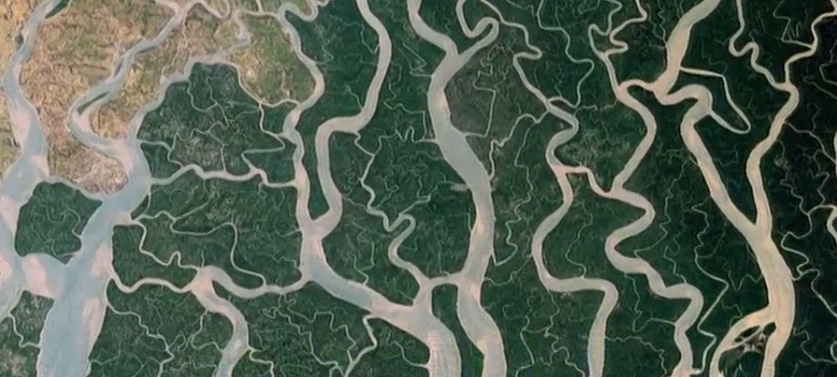
从欧几里德写几何原本开始,大家就习惯于研究非常规则的形状,比如圆形,方形,正多面体。欧几里德的几何原本就向大家展示了这些规则图形的几何美感。但是在研究了规则的图形之后,对于不规则的图形该怎么去研究就成为了困扰大家的一个问题。譬如河流的支流,树枝的形状,蜿蜒的海岸线,这些都不是规则的图形,甚至都不知道该怎么样去描述这些形状。但是通过观察就会发现它们都具有一个非常有趣的性质,那就是自相似性。比如树枝,从底部看上去,会有分岔,甚至越分越多。如果从某一个枝节往上看,它仍然是一颗树枝,形状跟原来的几乎没有什么分别。就是说在越来越小的尺寸下,不停的复制之前的形状。那么很自然的一个问题就是:怎么样在数学上去构造这些自相似的图形,而不是通过刻意的人工去生成这些图案?通常的思维习惯就是复杂必须来源于复杂,复杂不可能来源于简单,经验告诉我们复杂的东西必须守恒化。

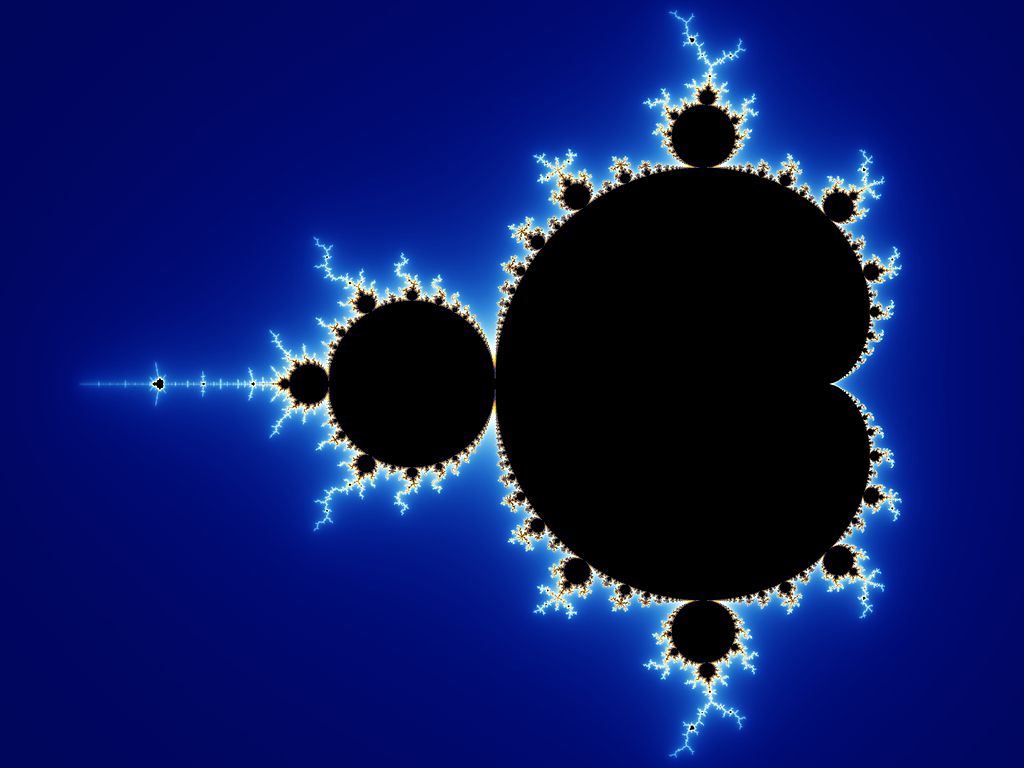
Screen Shot 2014-08-01 at 9.01.34 pm

但是数学工作者Mandelbrot在科研中却发现了一个简单得不能够再简单的规则去生成这种复杂的图形,那就是

z \mapsto z^{2}+c

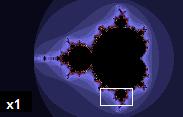
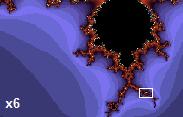
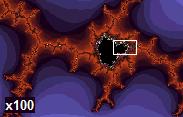
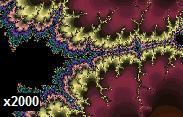
在这个简单的规则下,z会变成z^{2}+c,然后z^{2}+c作为新的自变量z,再次进行这个运算,长此下去,就将形成著名的Mandelbrot集合。前两张图片就是在上面规则下形成的完整的Mandelbrot集合。那么我们将它放大六倍,放大之后看到的形状跟第一幅图片惊人的相似,继续放大100倍,2000倍,依旧不会改变它的这个性质。

Animation_of_the_growth_of_the_Mandelbrot_set_as_you_iterate_towards_infinity1024px-Mandel_zoom_00_mandelbrot_set

Mandelbrot-similar-x1 Mandelbrot-similar-x6 Mandelbrot-similar-x100 Mandelbrot-similar-x2000

在Mandelbrot集合里面,无论被放得有多大,都会看到跟原来图形相似的形状。这样的结果就告诉大家复杂不一定来源于复杂,说不定它背后的机制非常的简单,那就是说,同一个事情,可能既是复杂的,又是简单的,这样就要重新去考虑简单和复杂之间的关系。后来有人为了纪念Benoît B. Mandelbrot创立了分形几何中的自相似性,写了一句话:Benoît B. Mandelbrot里面的字母B就代表了Benoît B. Mandelbrot。

除了有z \rightarrow z^{2}+c产生的Mandelbrot集合,还有一些经典的分形结构。比如说Cantor集合。Cantor集合是不断的从一个区间[0,1]取走中间一段获得的集合。首先去掉(\frac{1}{3}, \frac{2}{3}),剩下[0,\frac{1}{3}] \cup [\frac{2}{3}, 1]。然后把剩下两条线段的中间都去掉,剩下[0,\frac{1}{9}] \cup [\frac{2}{9}, \frac{1}{3}] \cup [\frac{2}{3}, \frac{7}{9}] \cup [\frac{8}{9}, 1]。不停的重复这个过程,最后剩下的集合就是Cantor集合。在数学中,Cantor集合是无穷无尽的,甚至是不可数的,但是却是不占据任何空间的,因为它的长度是零。下图简单的描述了Cantor集合的形成过程。



729px-Cantor_set_in_seven_iterations.svg

利用类似的想法,就可以构造出Sierpinski三角形和Siepinski地毯。

Animated_construction_of_Sierpinski_TriangleAnimated_Sierpinski_carpet

路漫漫其修远兮

这些也许就是动力系统的本质,在及其简单的规则背后,随着时间的不断推移,就能够创造出令人惊叹不已的复杂系统,就像河流支流的形成和Mandelbrot集合,就像天气以及动物的种族变化。这种规则的制定并不需要一个碍手碍脚的设计师,它就像是宇宙与生俱来的本事。人们对这种复杂的事物感到不自然的原因,可能就是在这种情况下不需要一个创造者。在给定初始条件的情况下,在给定的自然规则下,宇宙就可以自由的发展。而这个发展存在于自然科学和社会科学中,甚至生活中的方方面面。宇宙的复杂性以及美丽,都来源于简单的规则和不断的重复,规则虽然简单,但是过程却十分复杂,并且结果是不可预知的。即使有了科学的确定性,仍然也无法知道未来的样子。
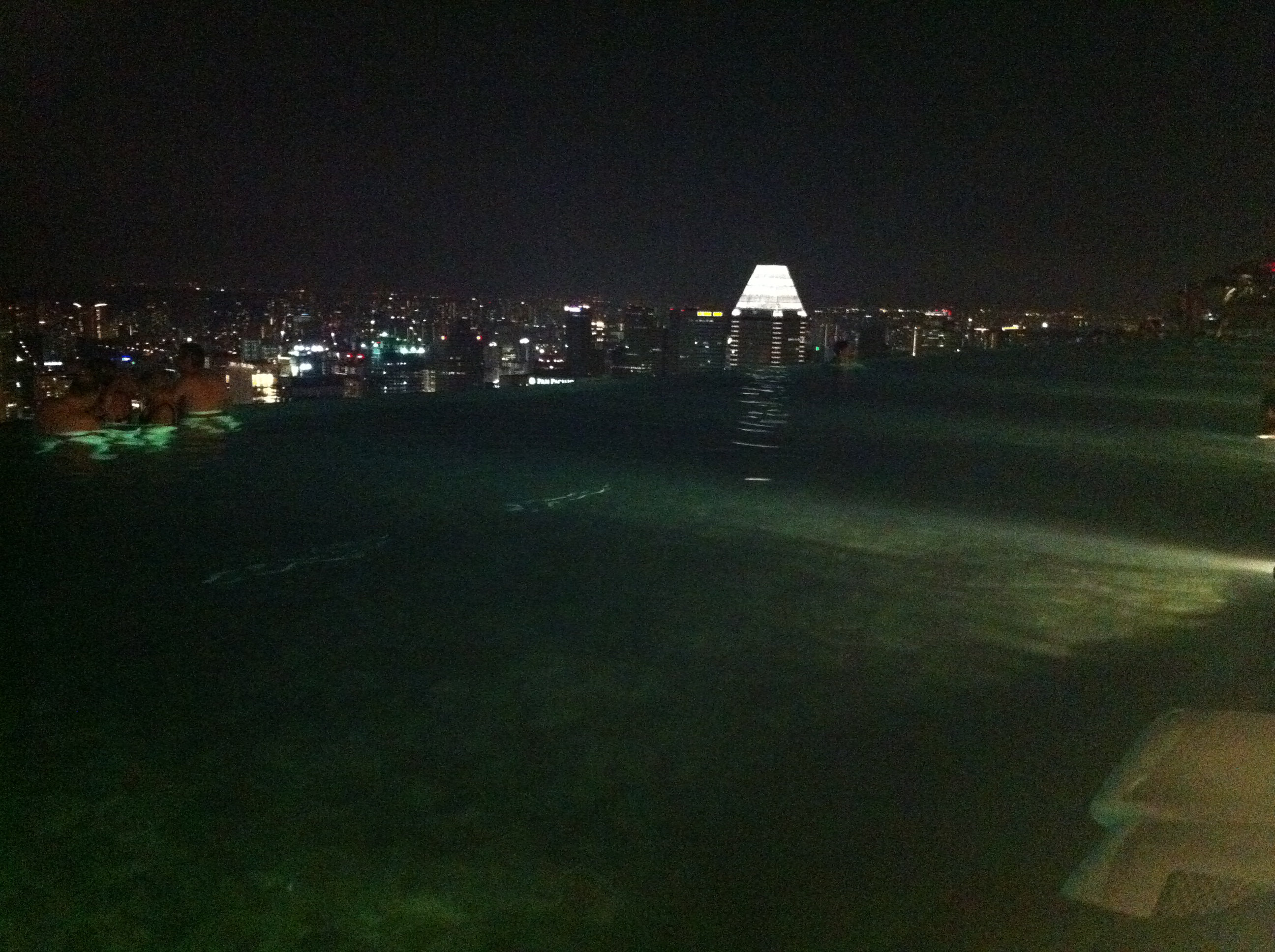


Marina Bay Sands, 金沙酒店

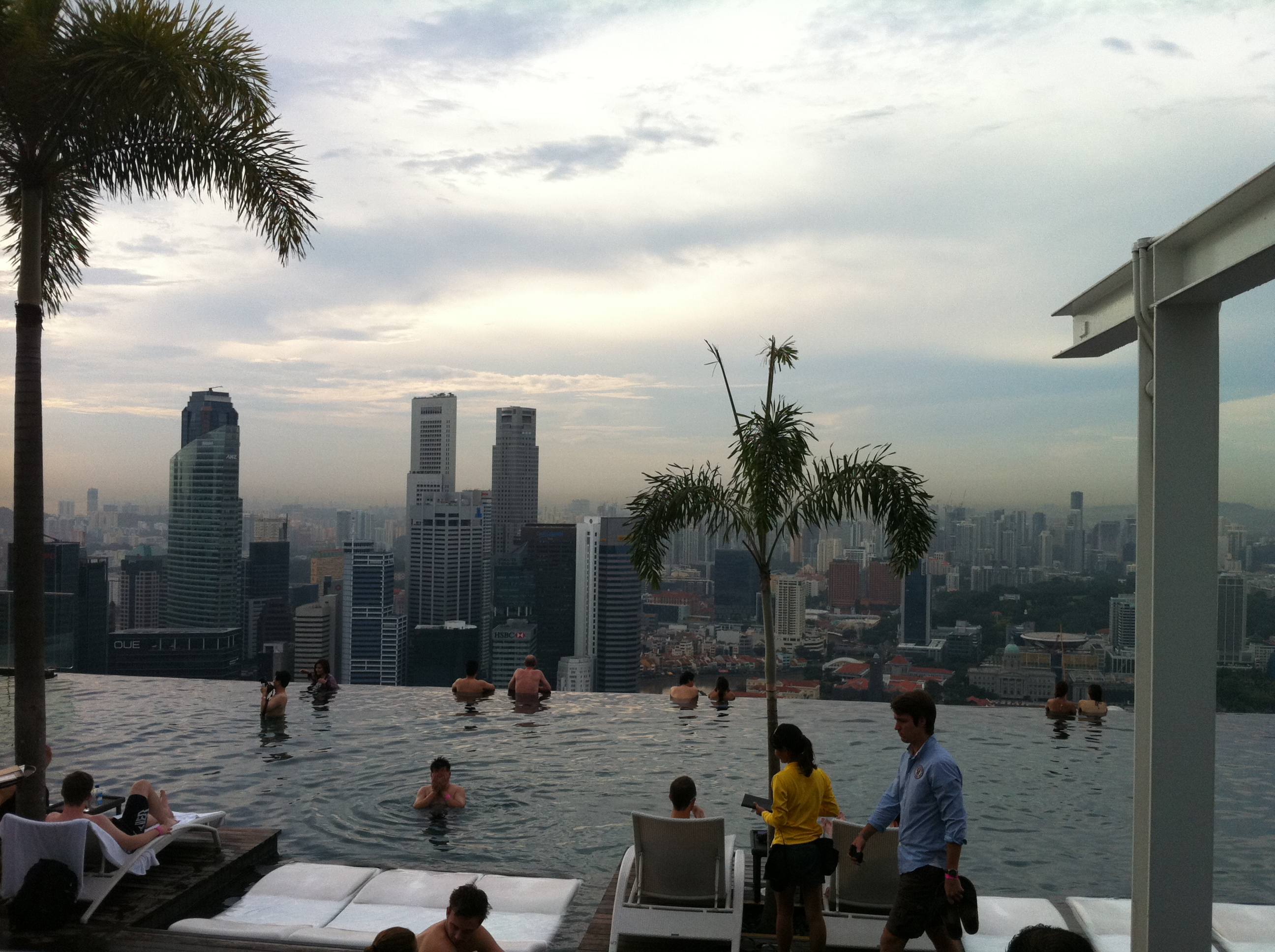
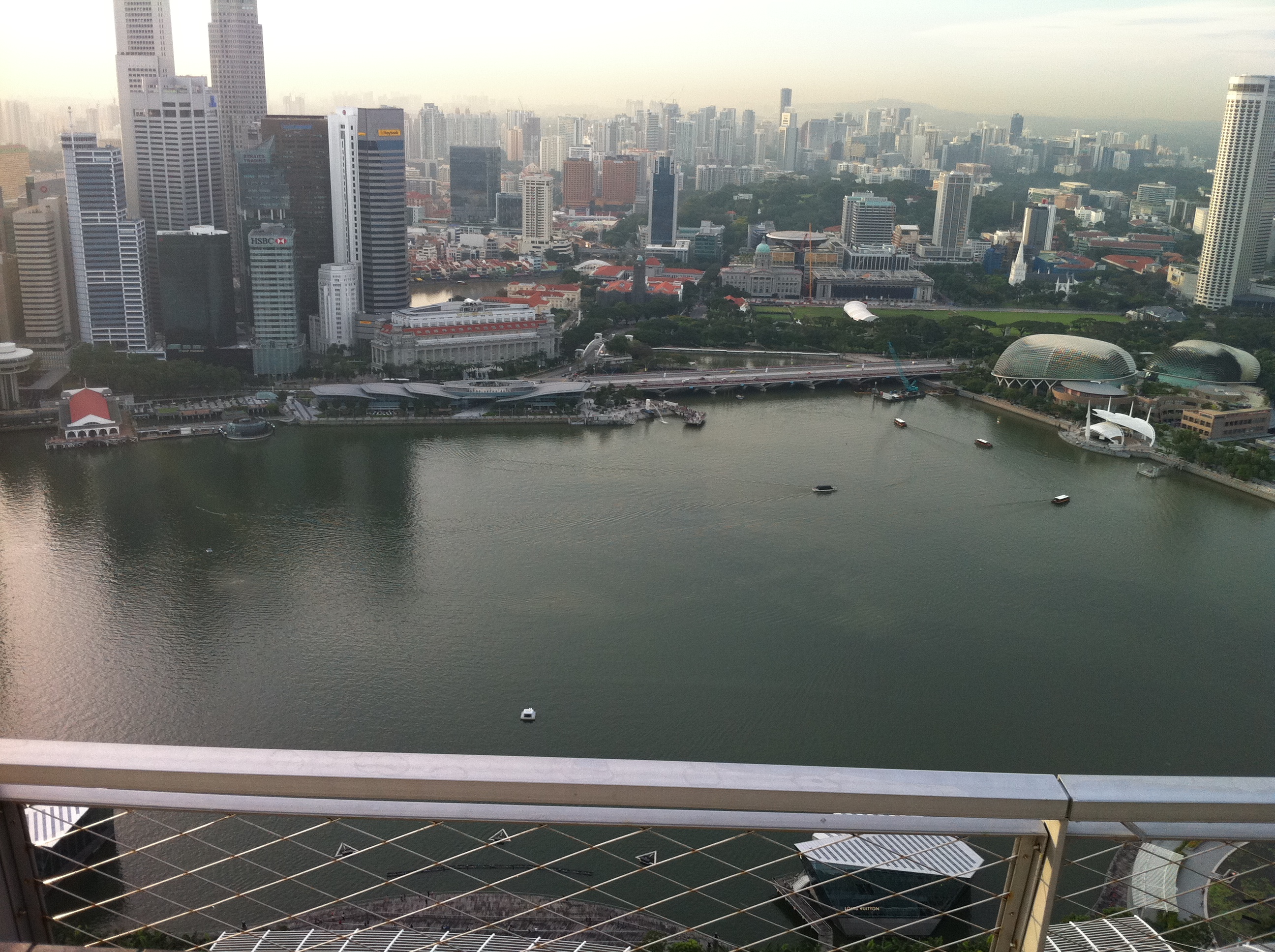
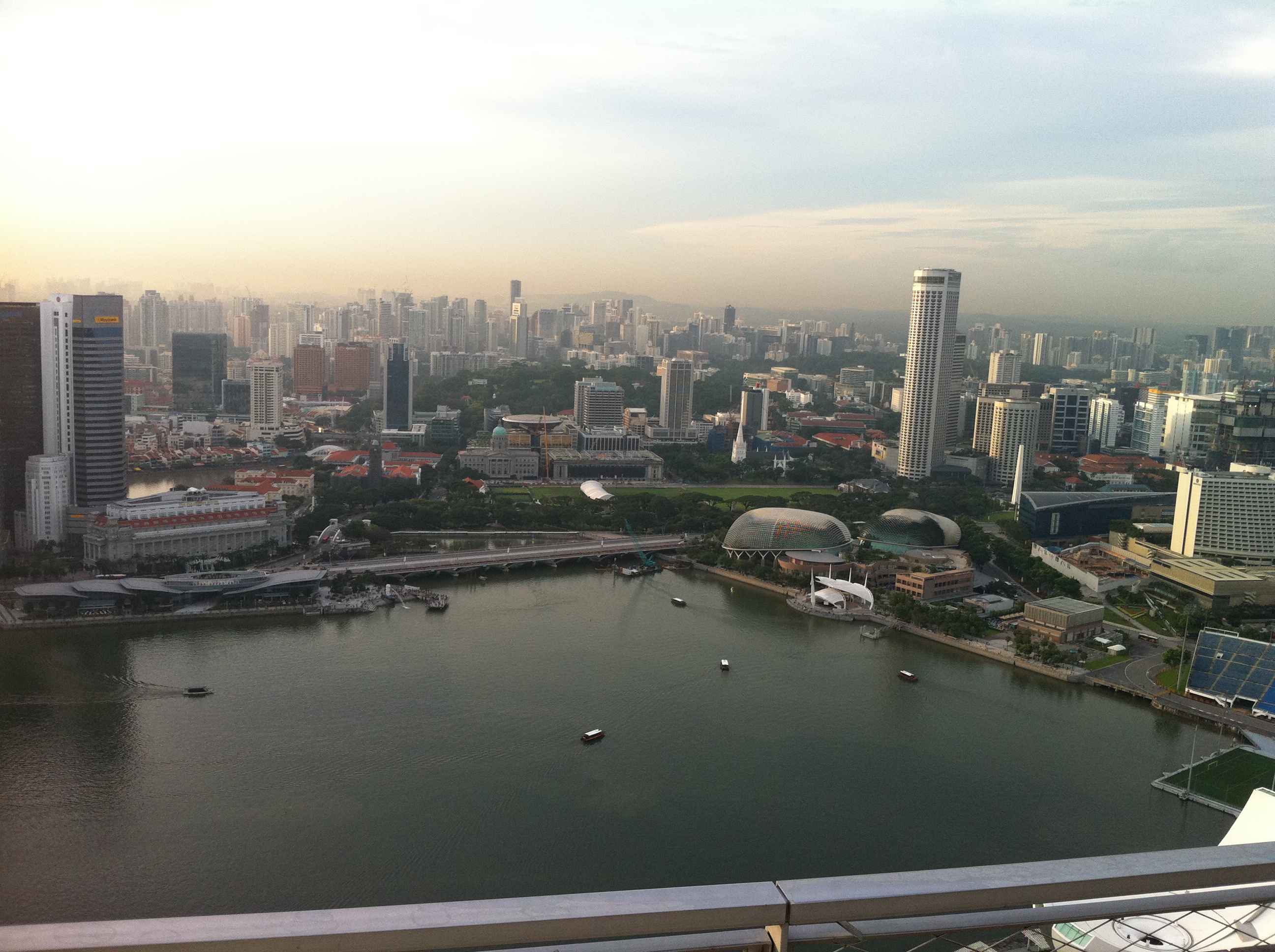
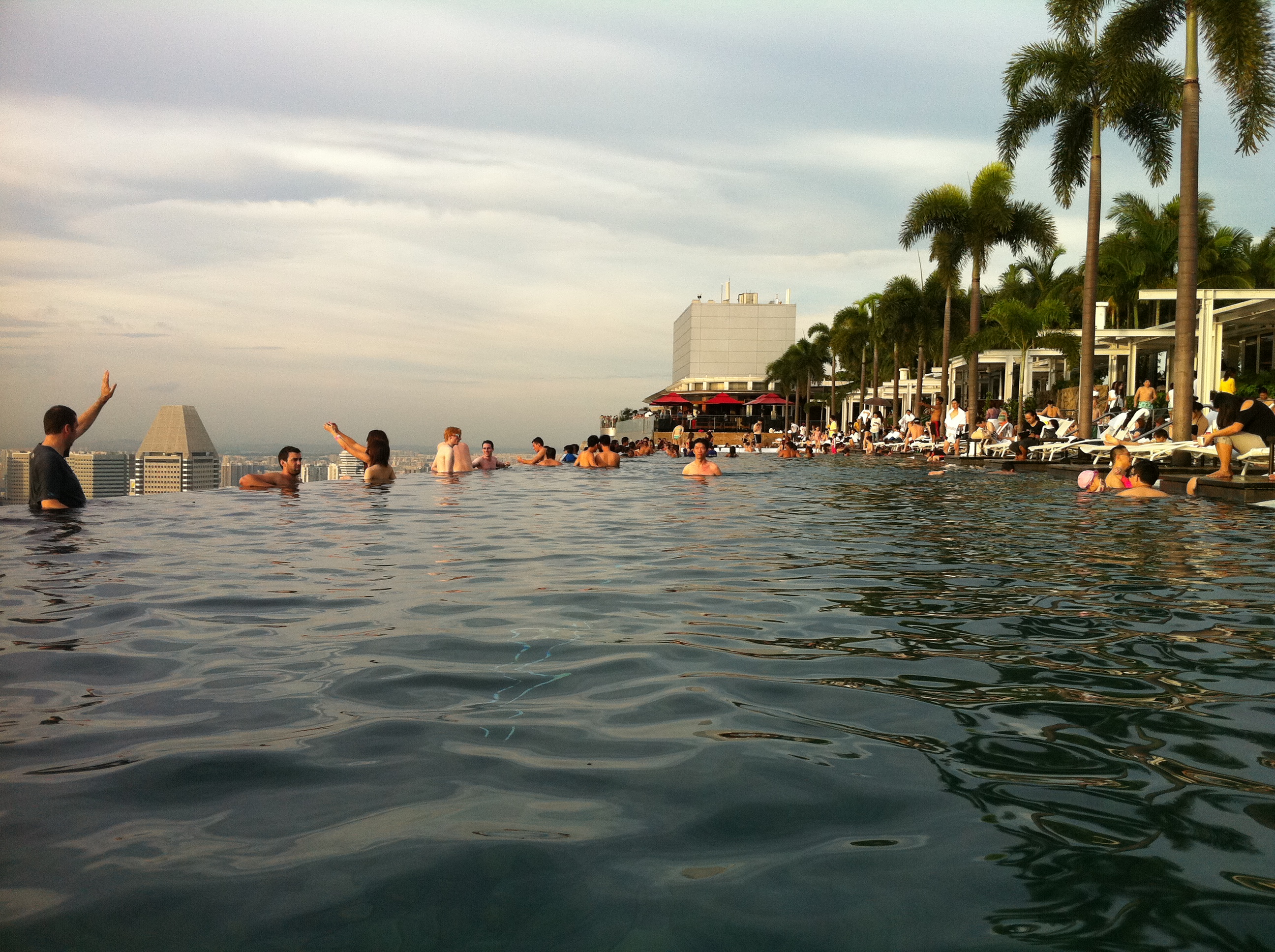
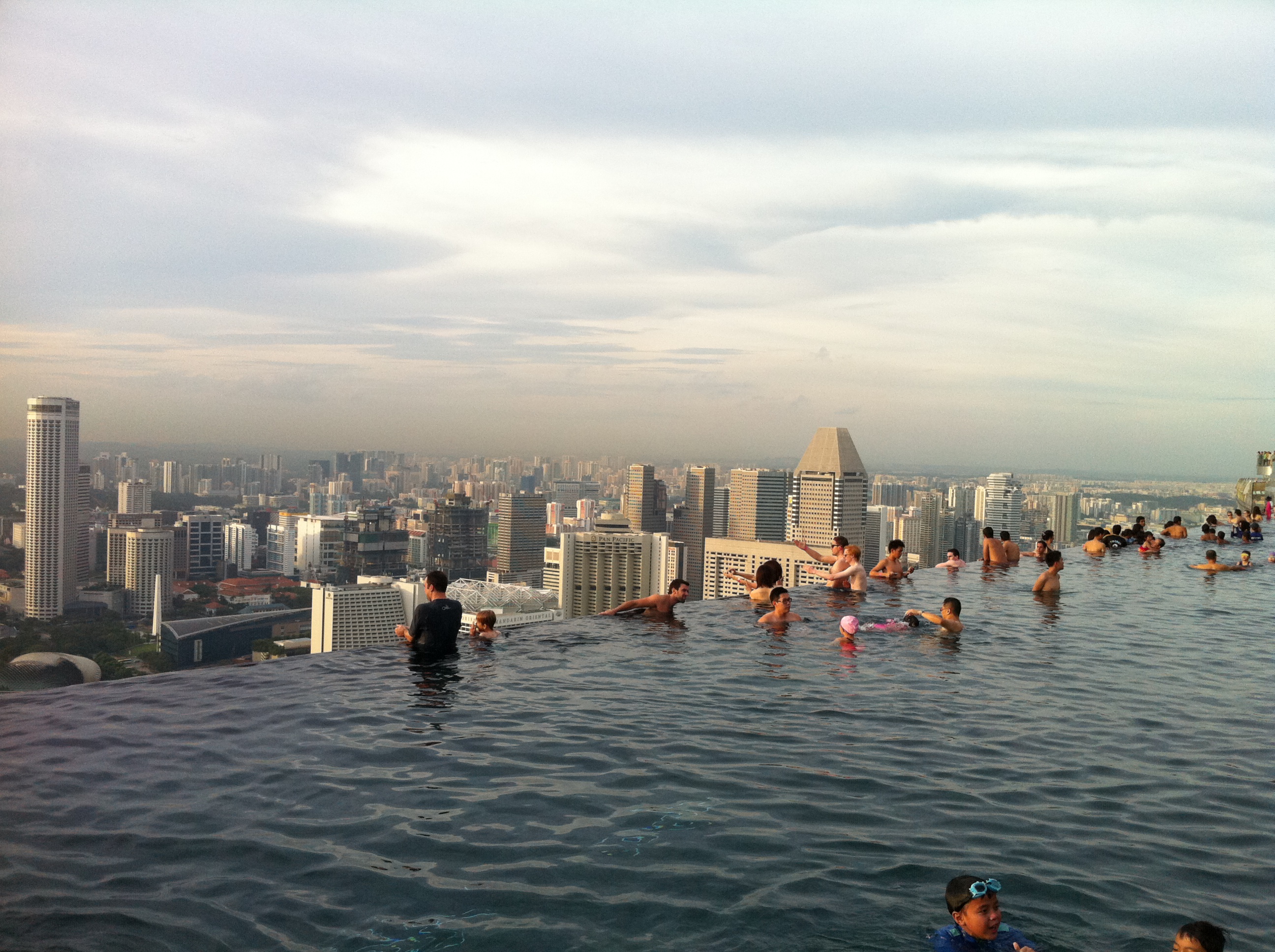
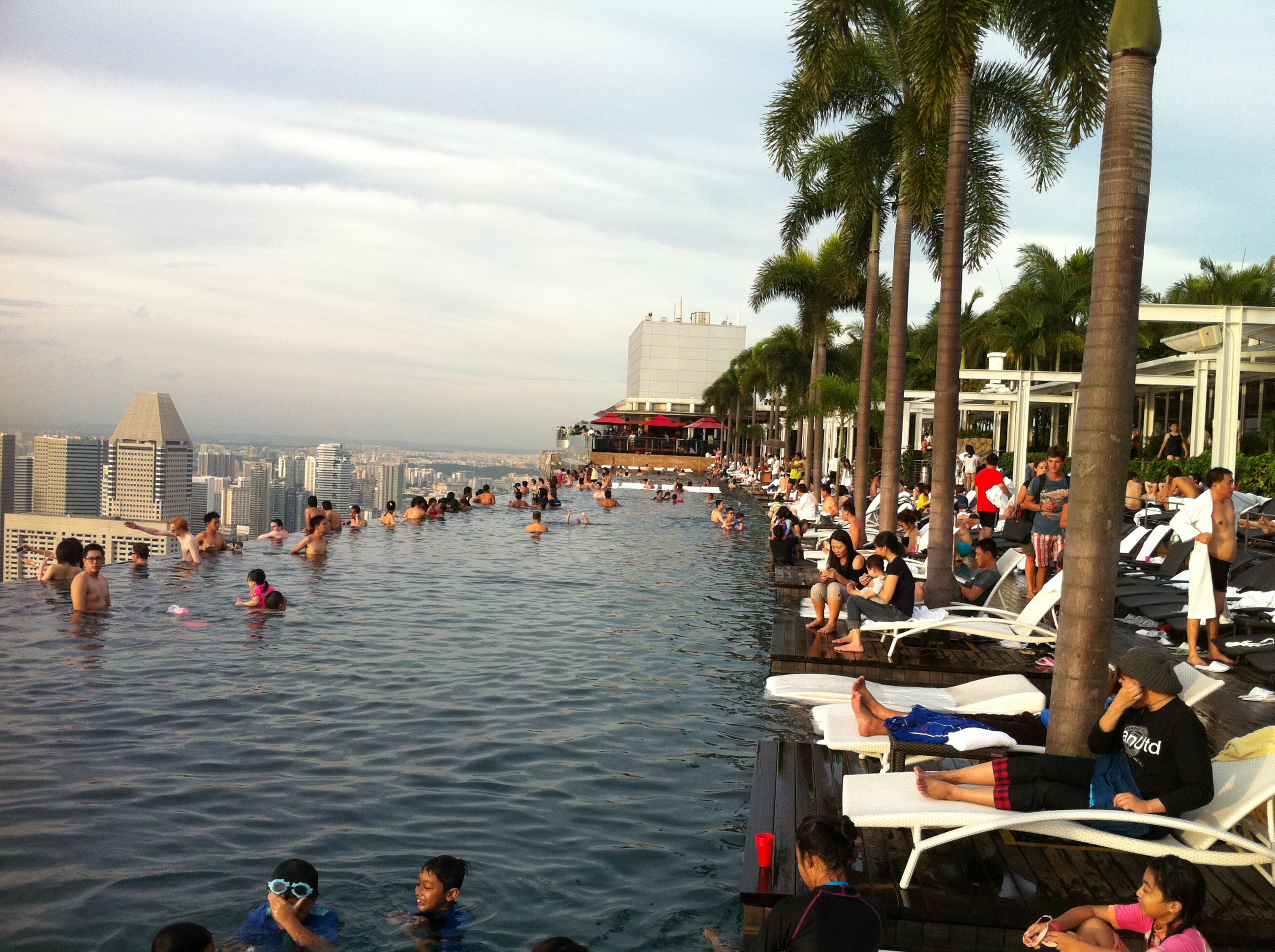
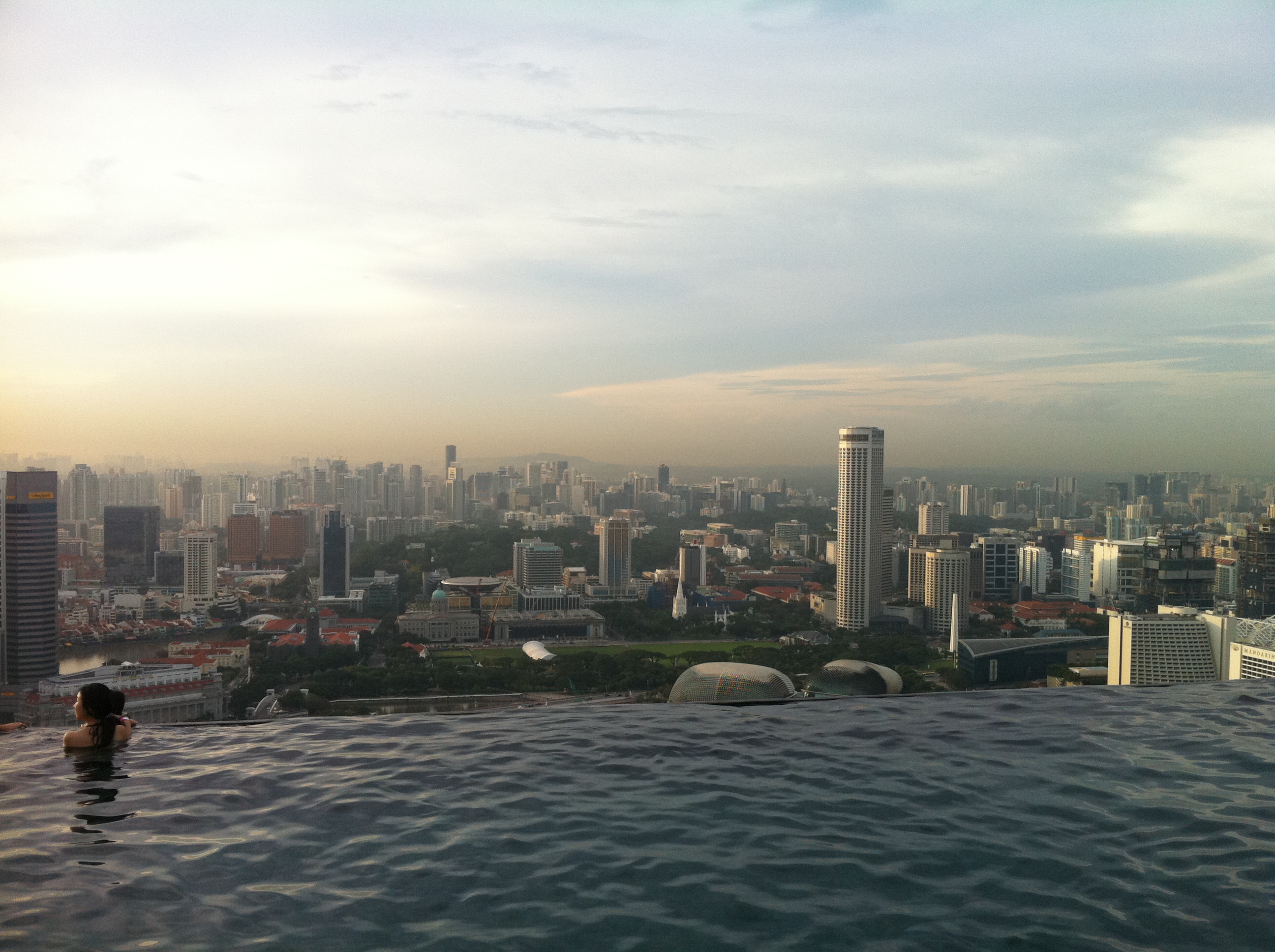
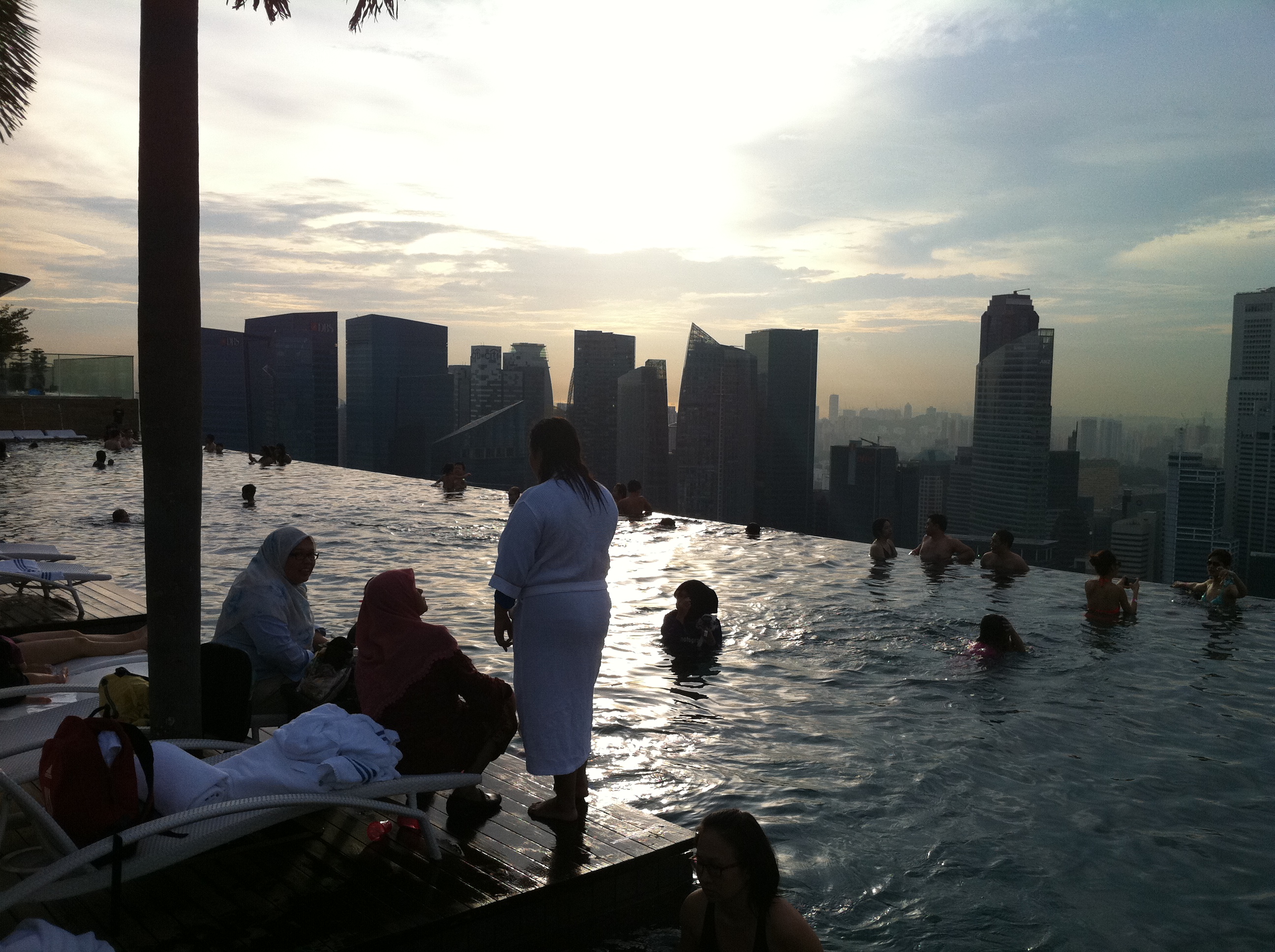
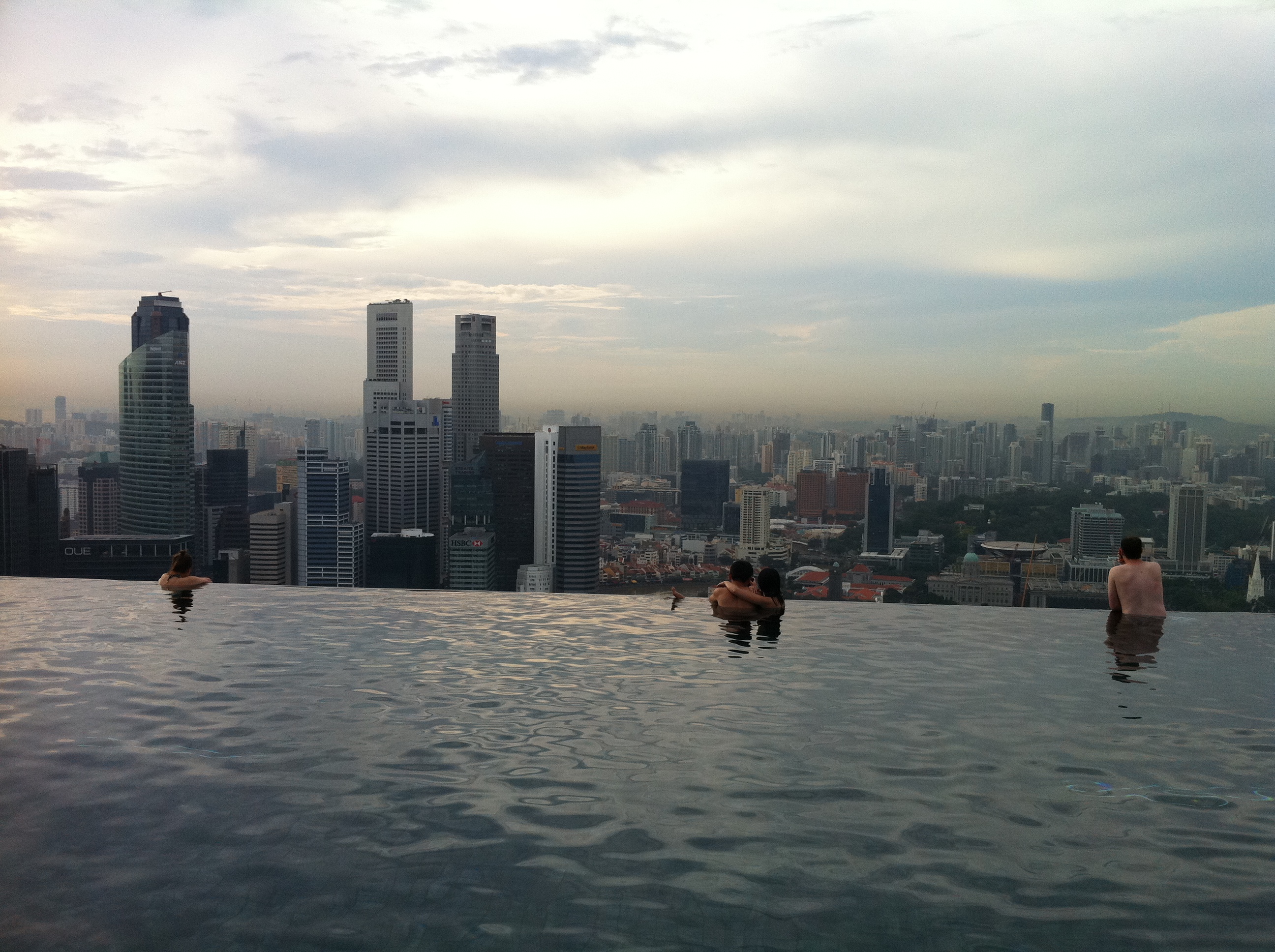
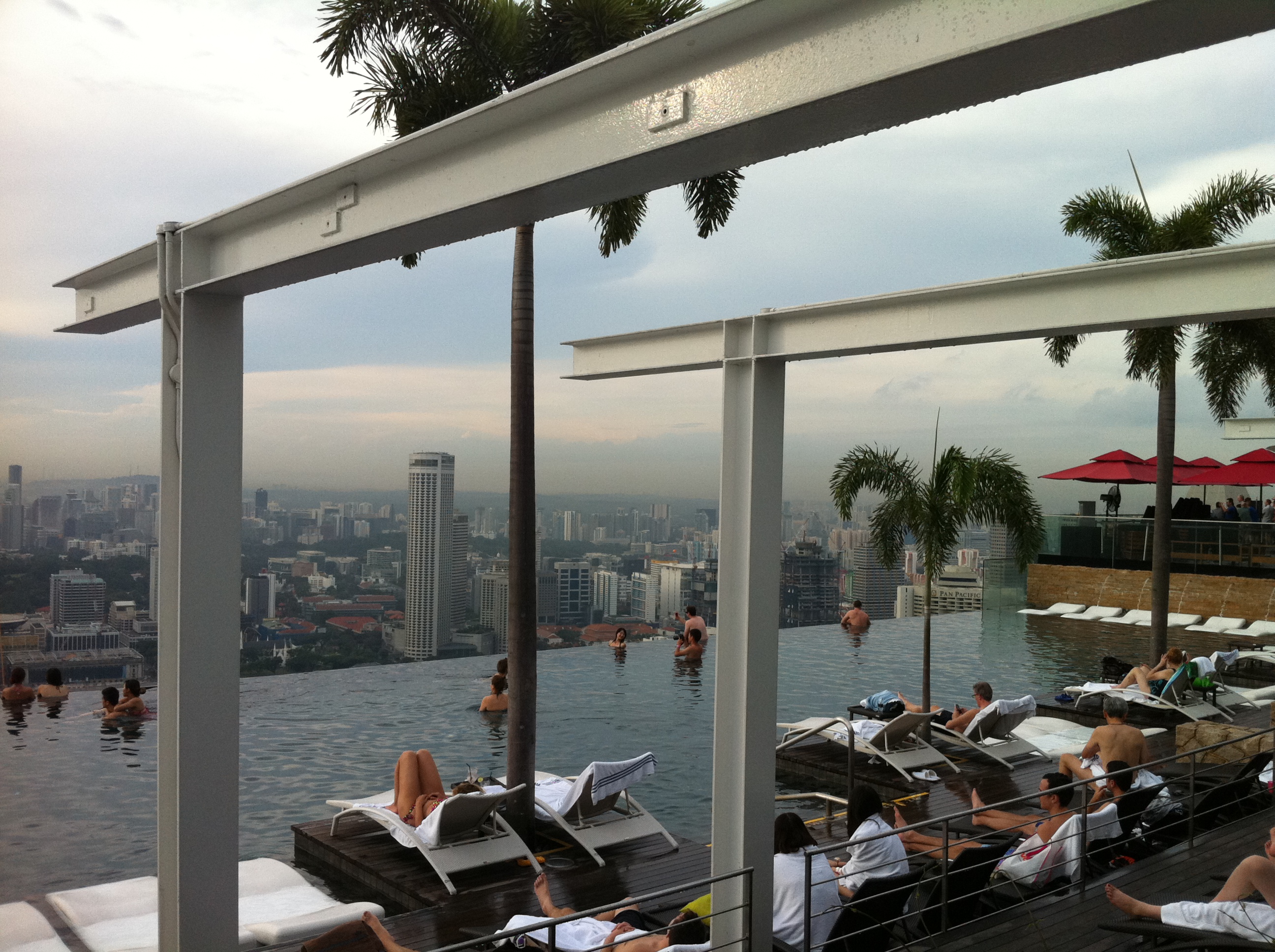
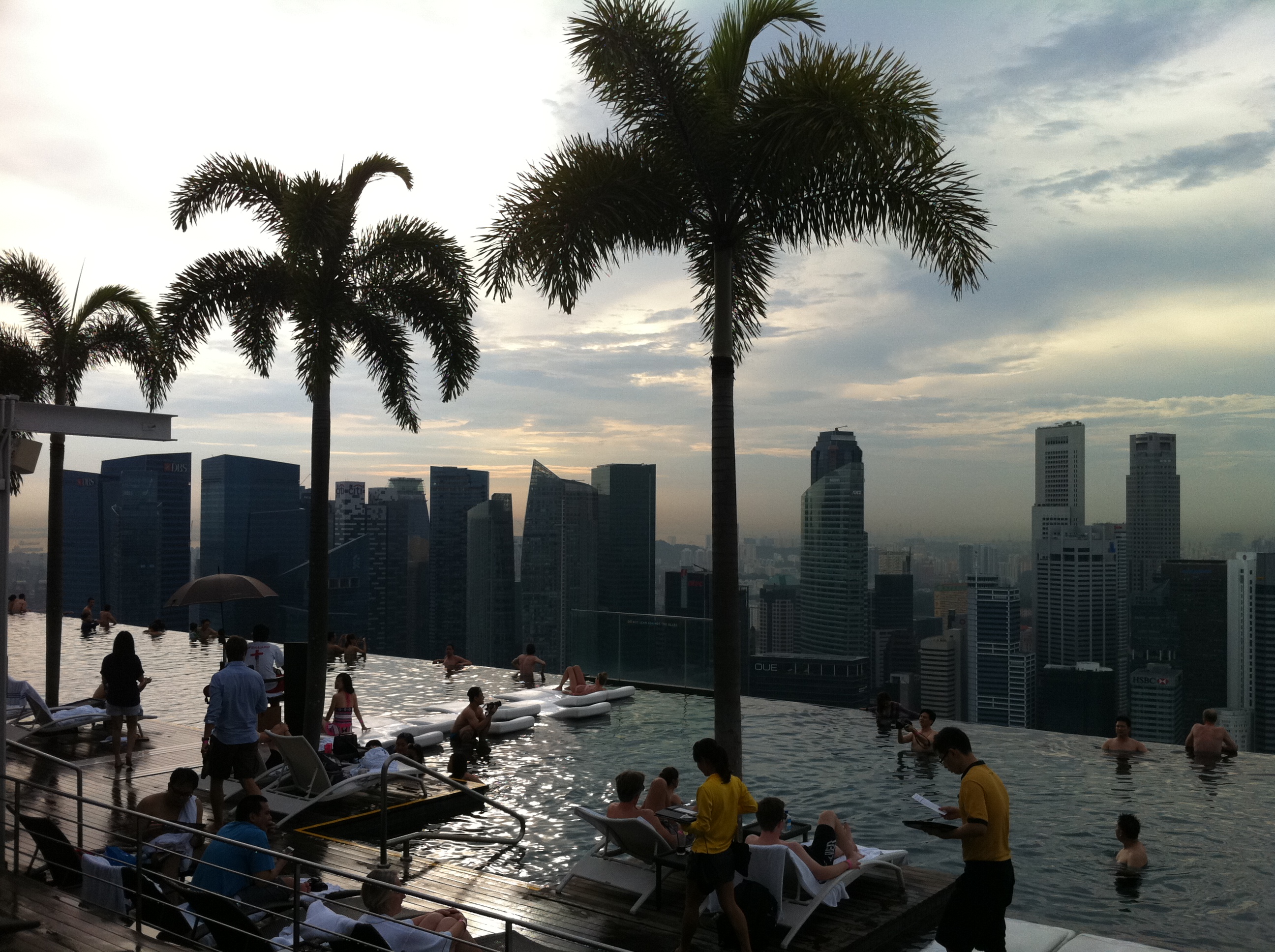
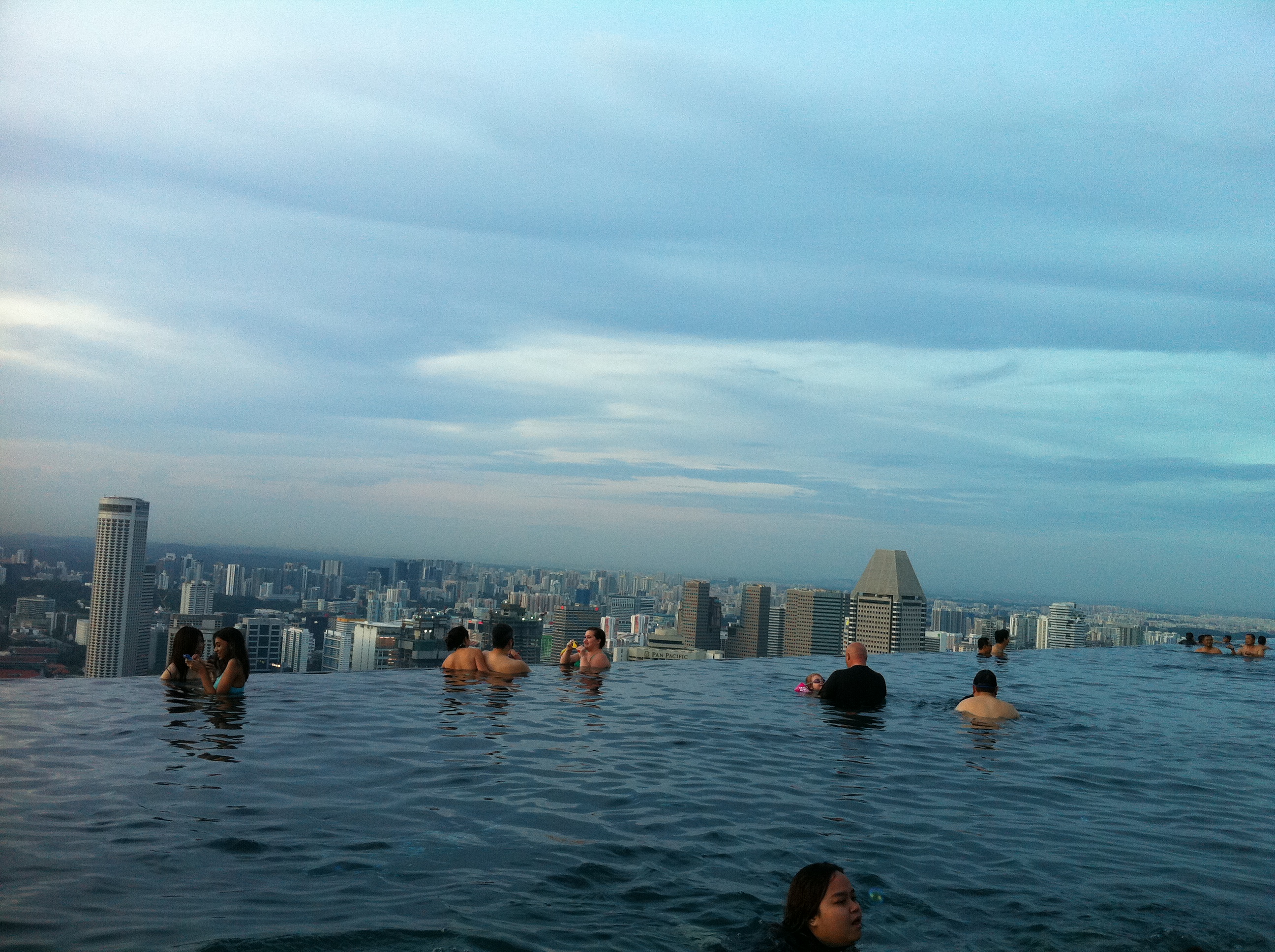
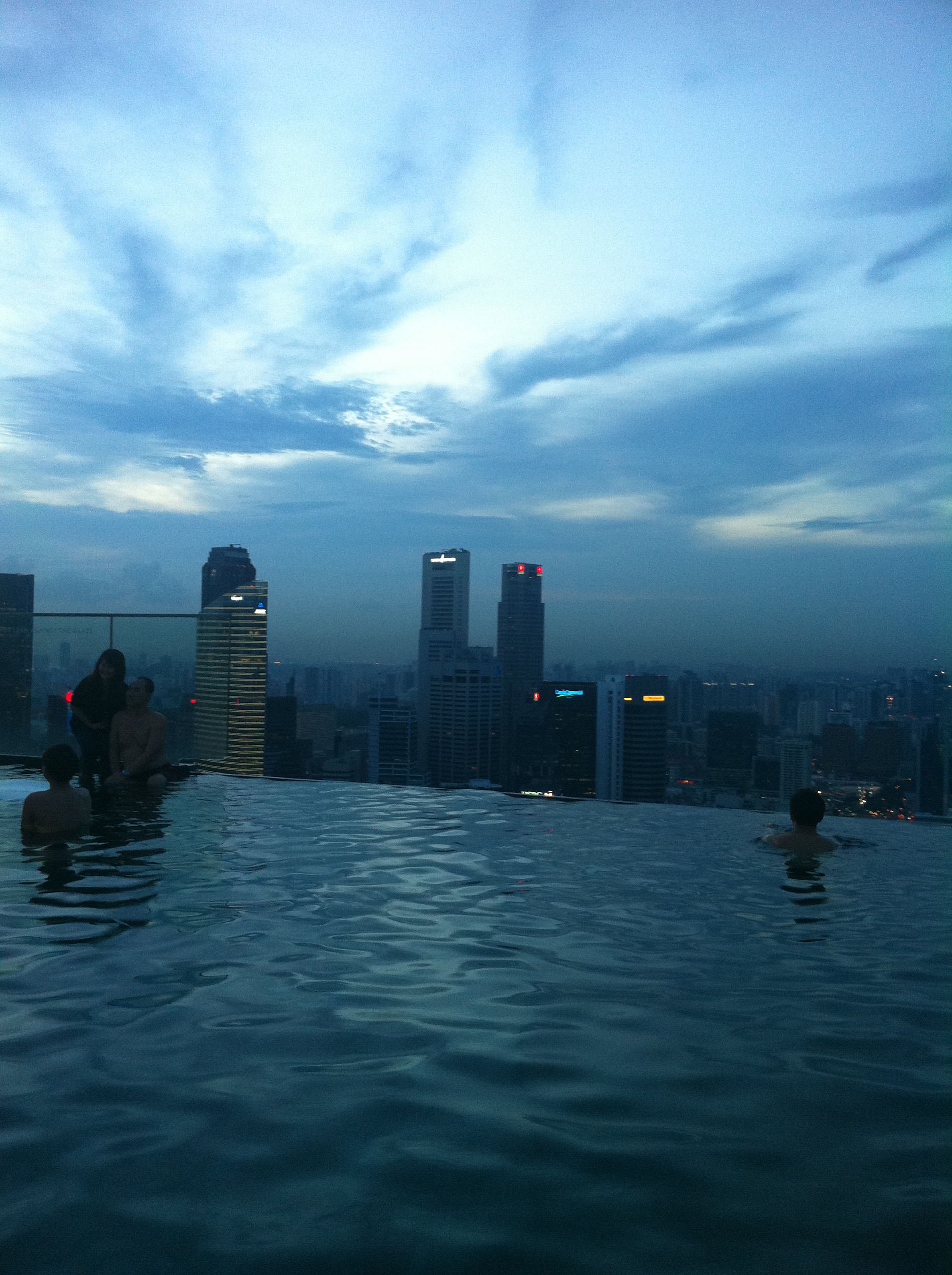
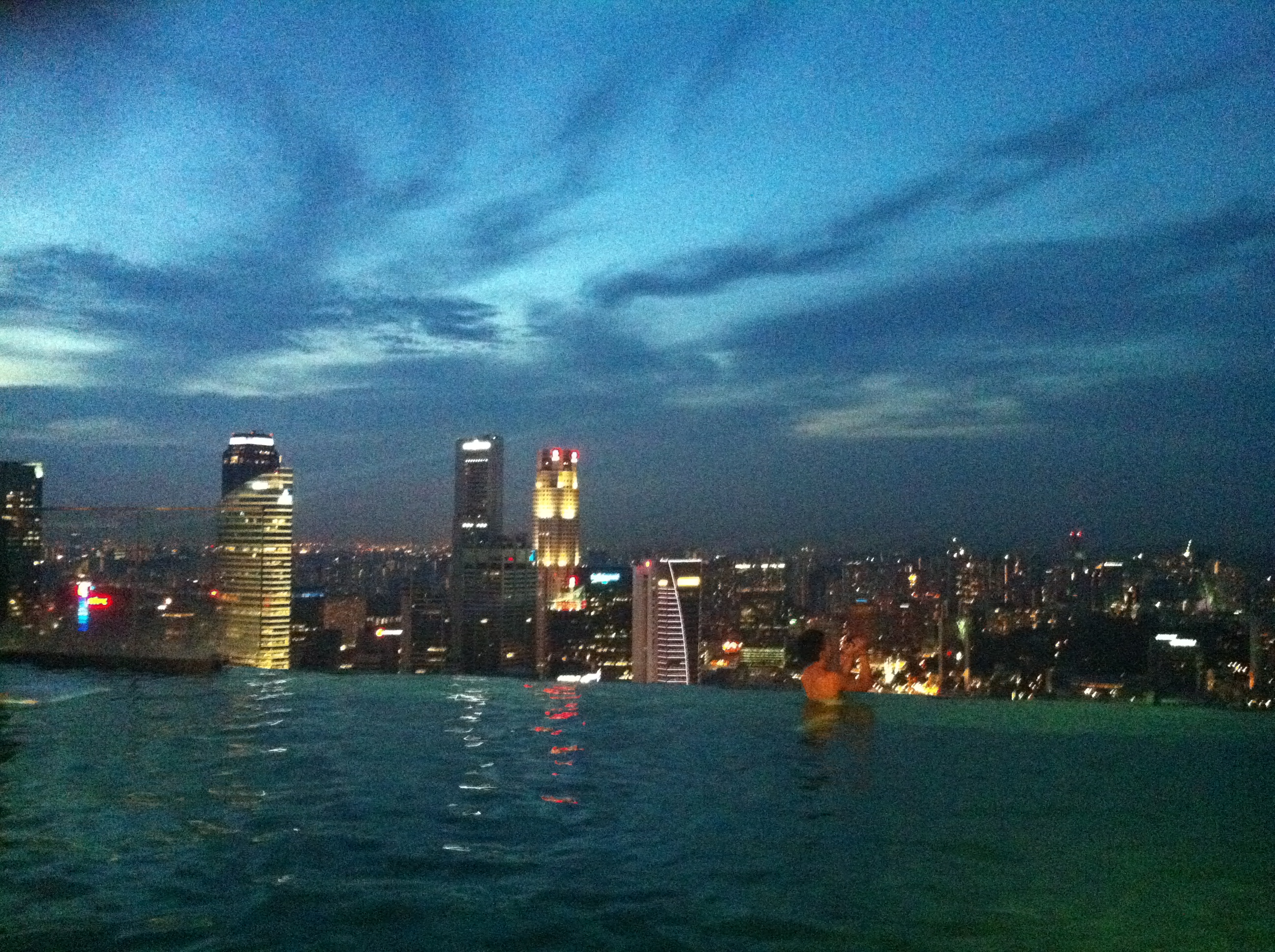
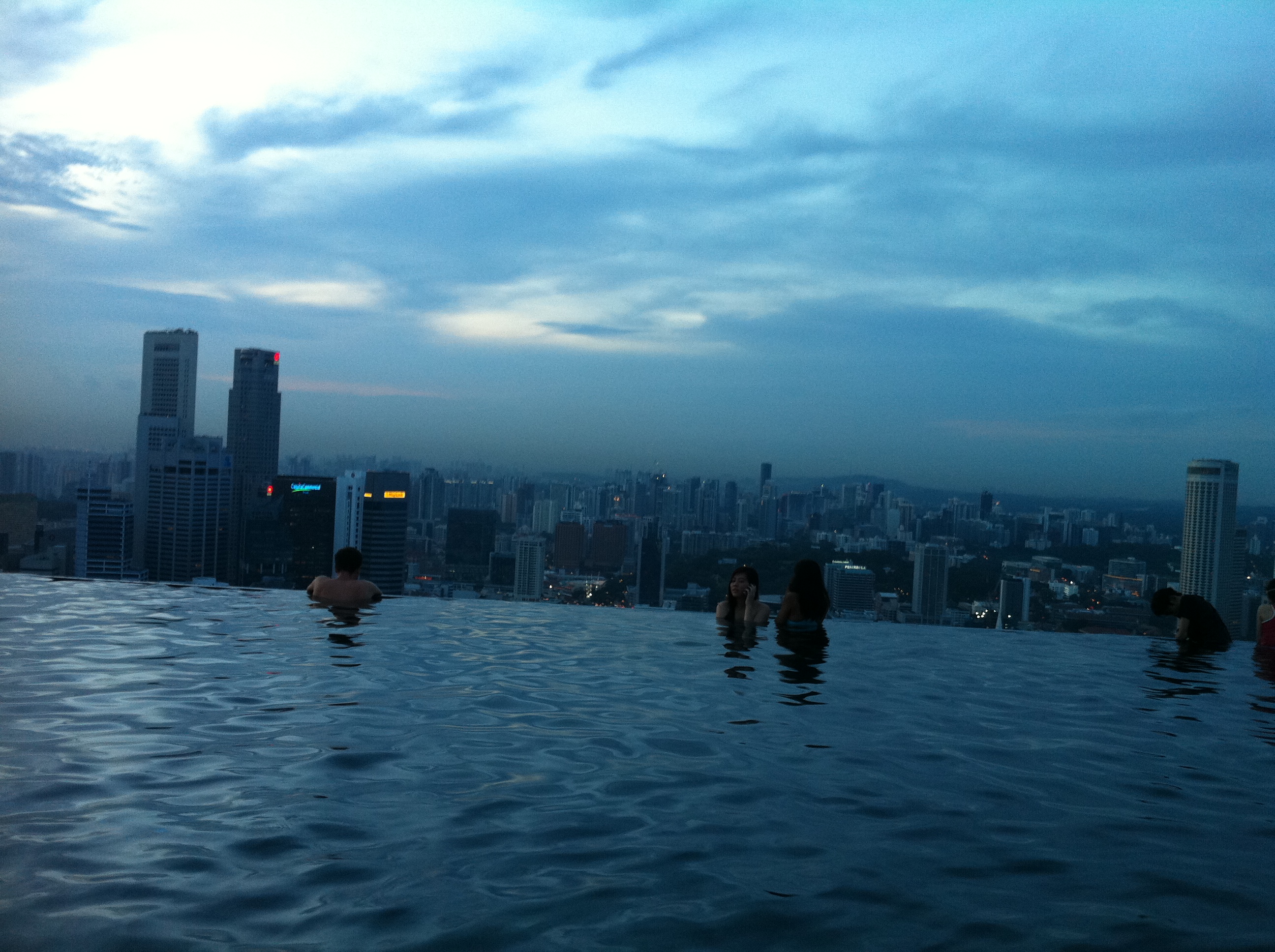
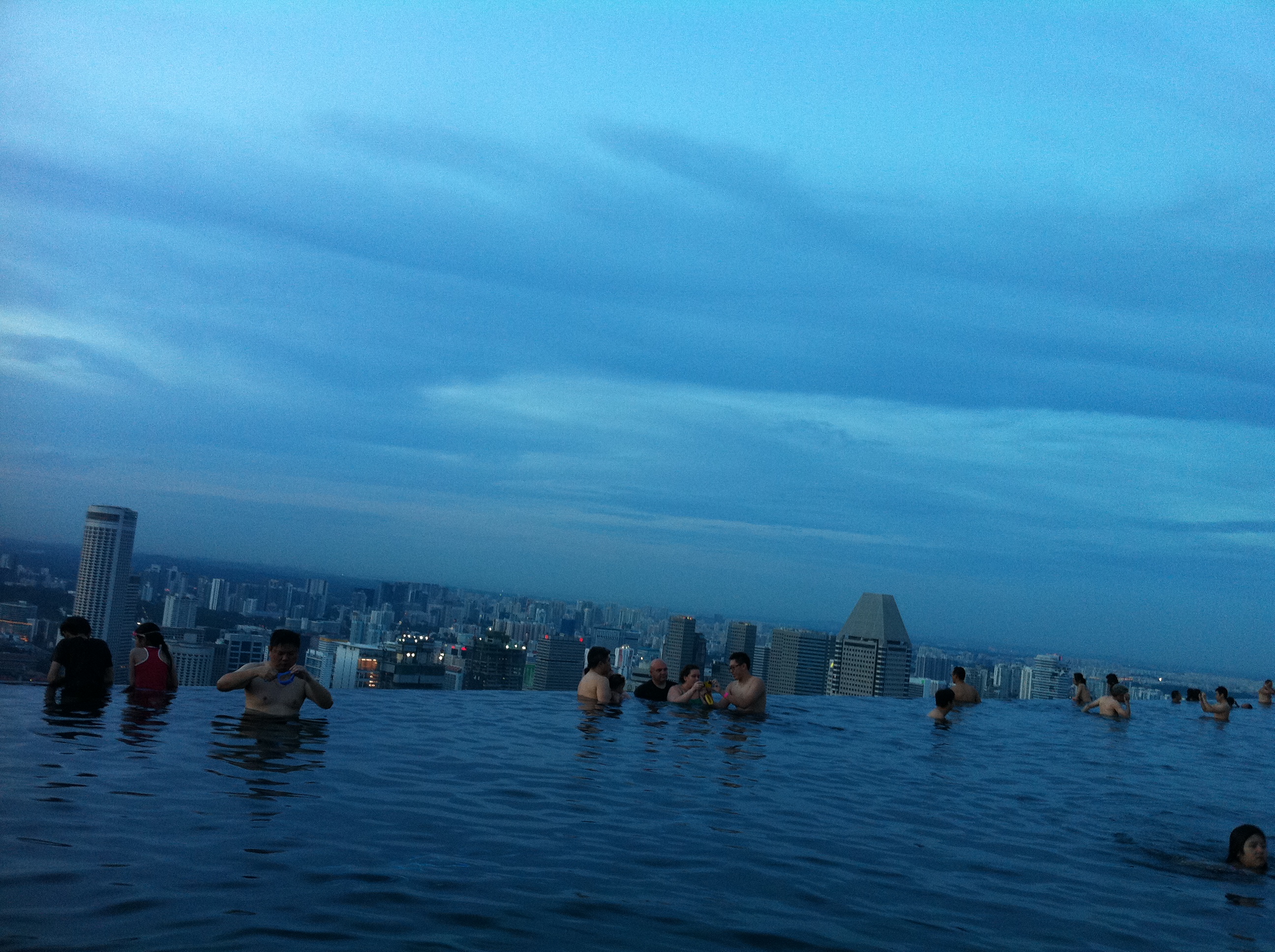
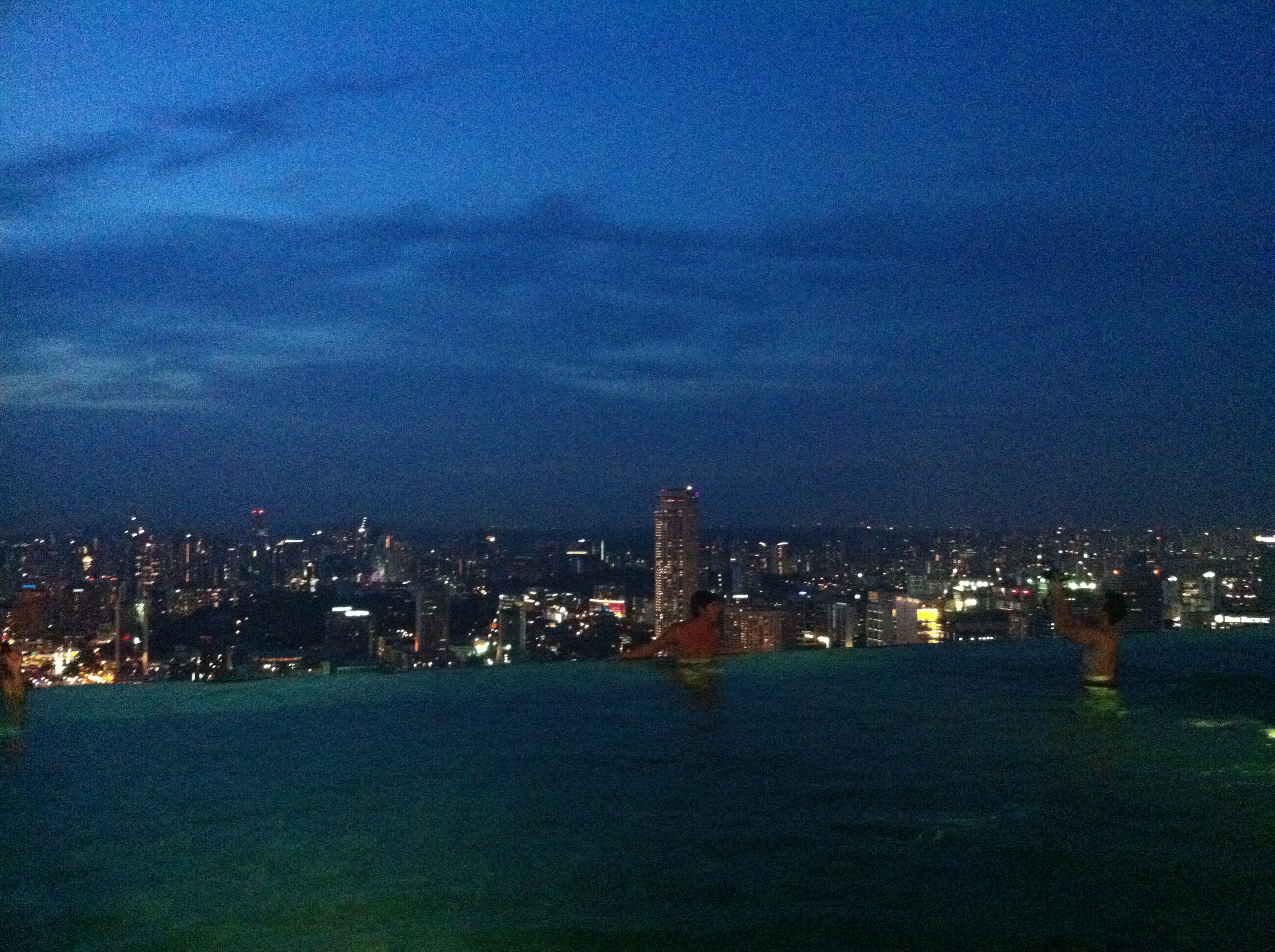
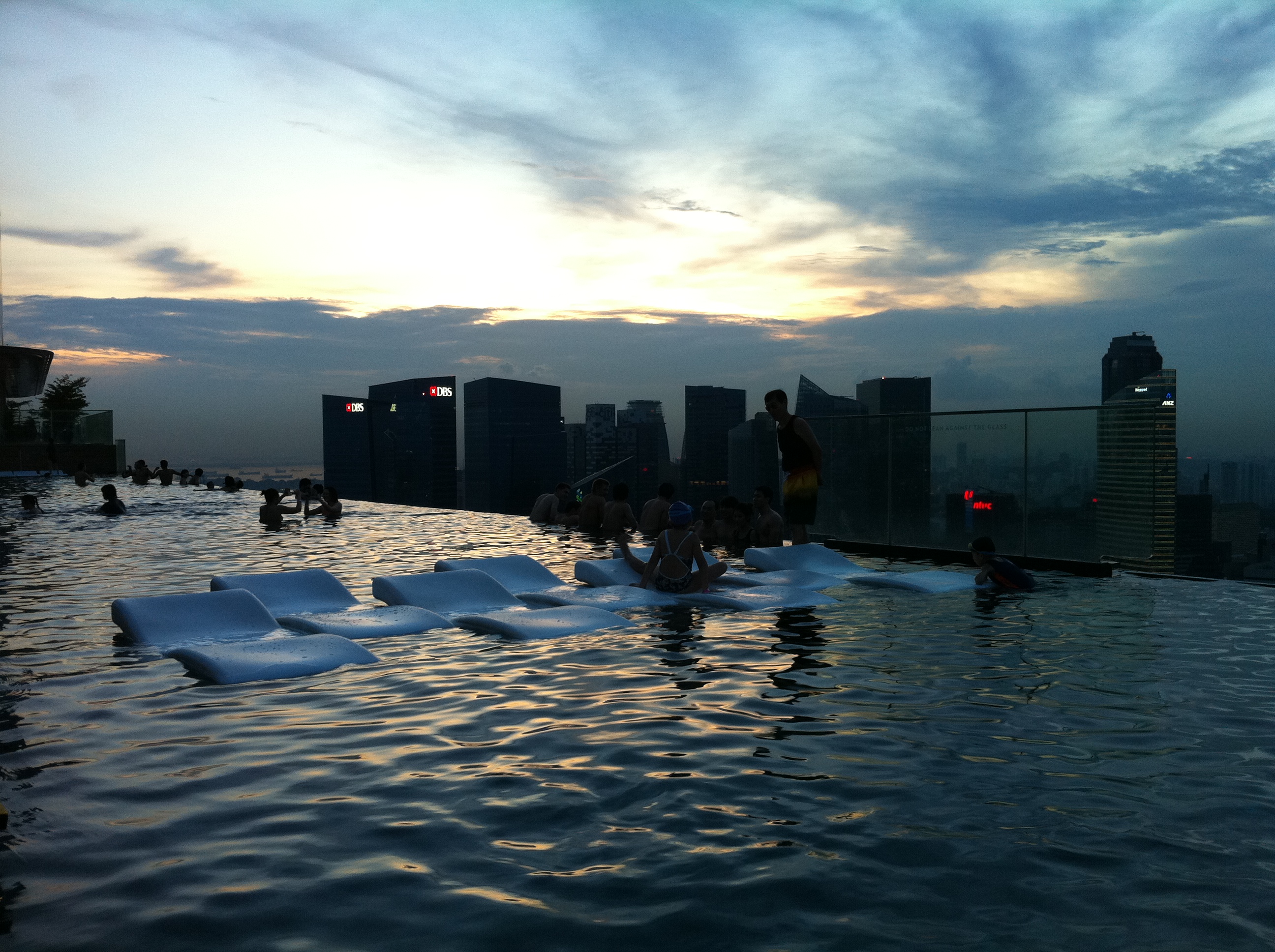
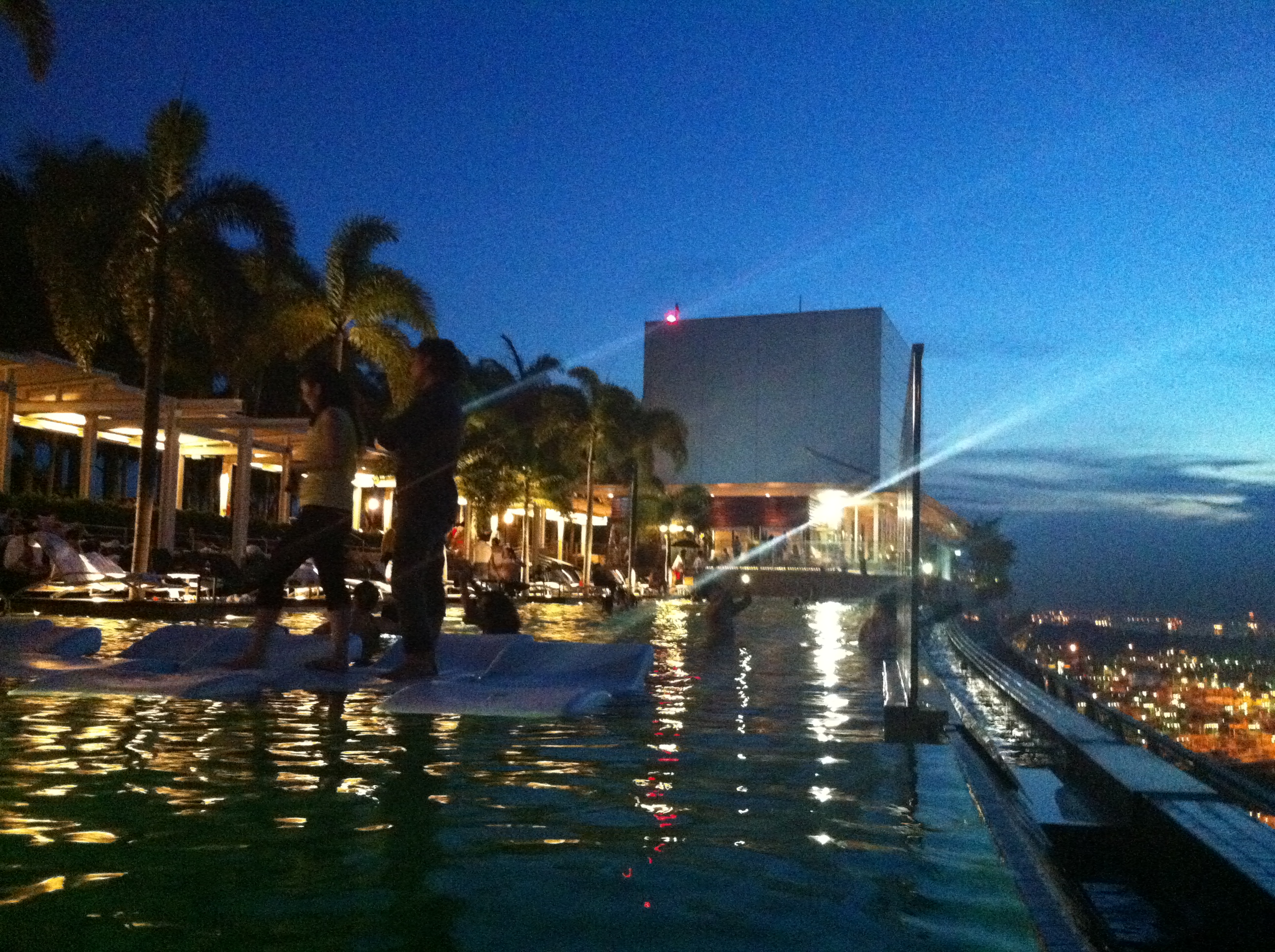
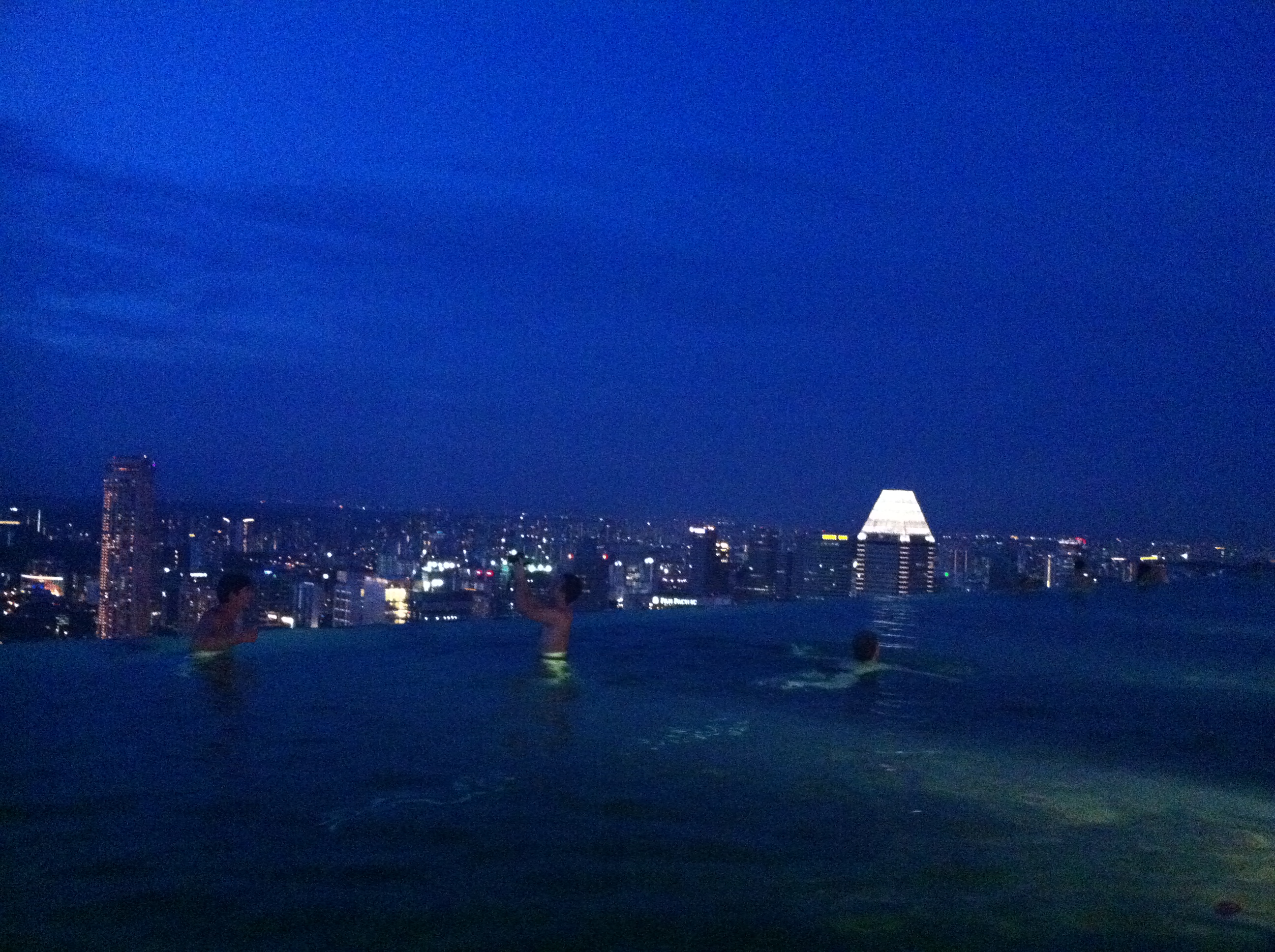
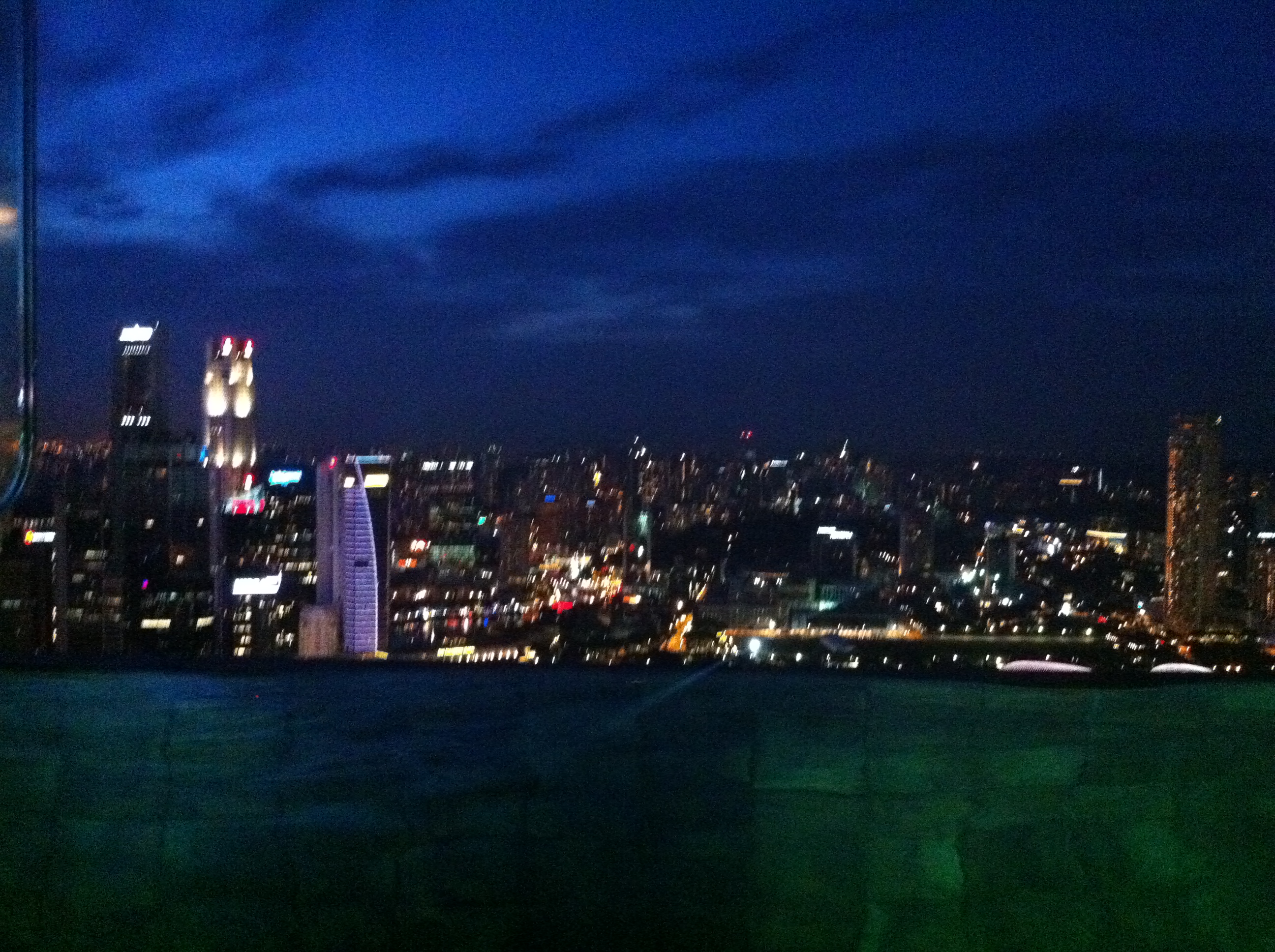
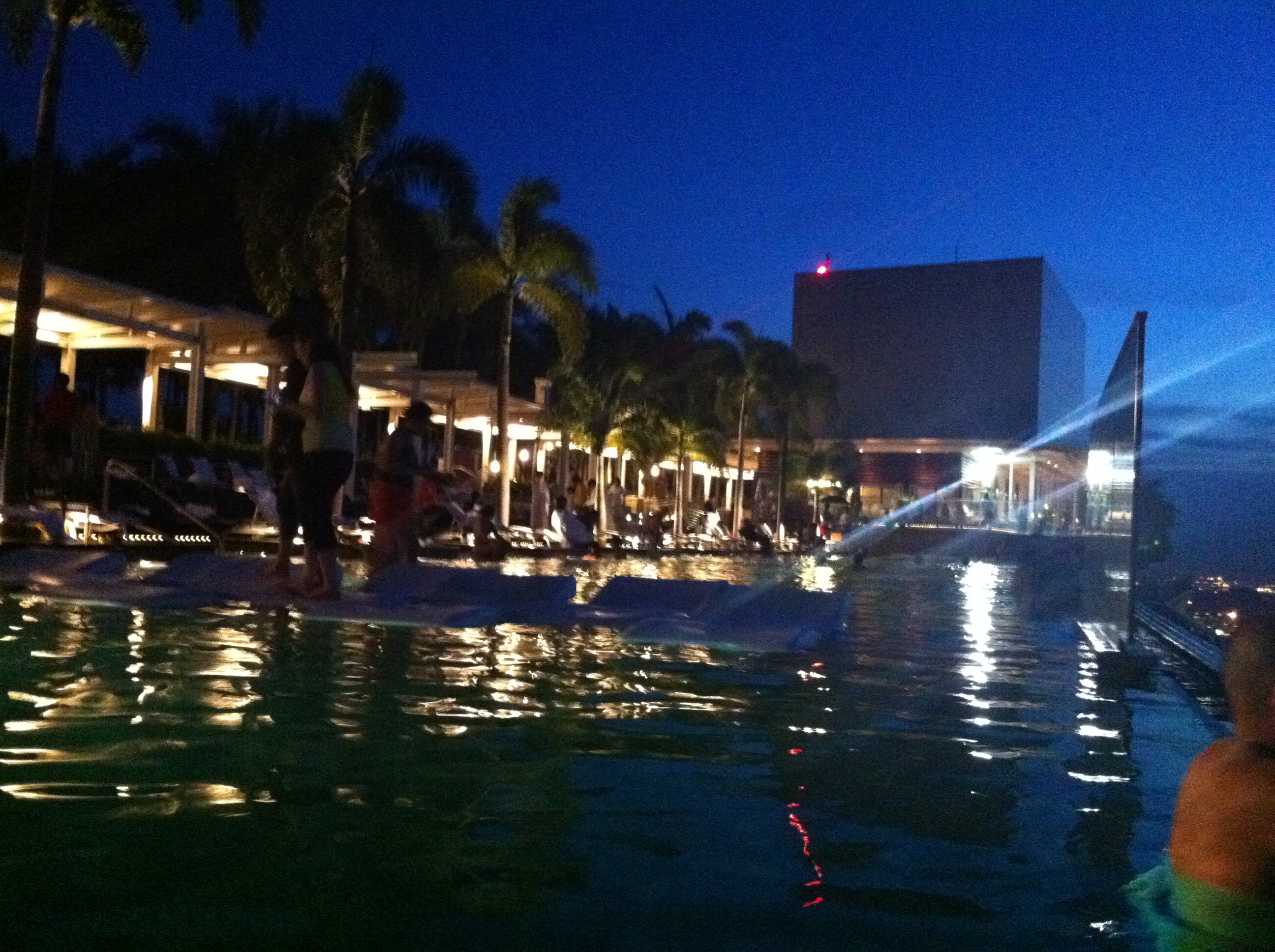
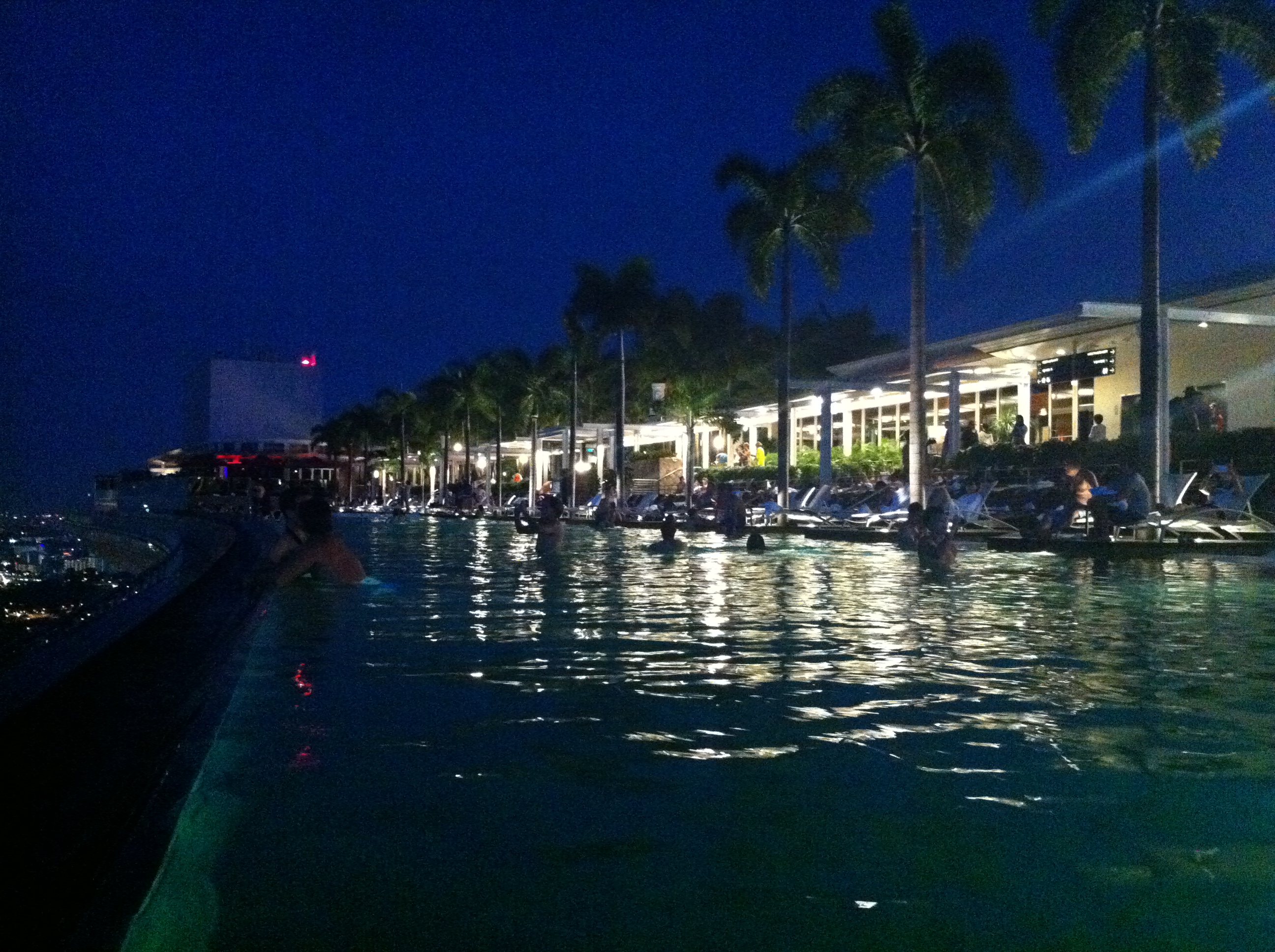
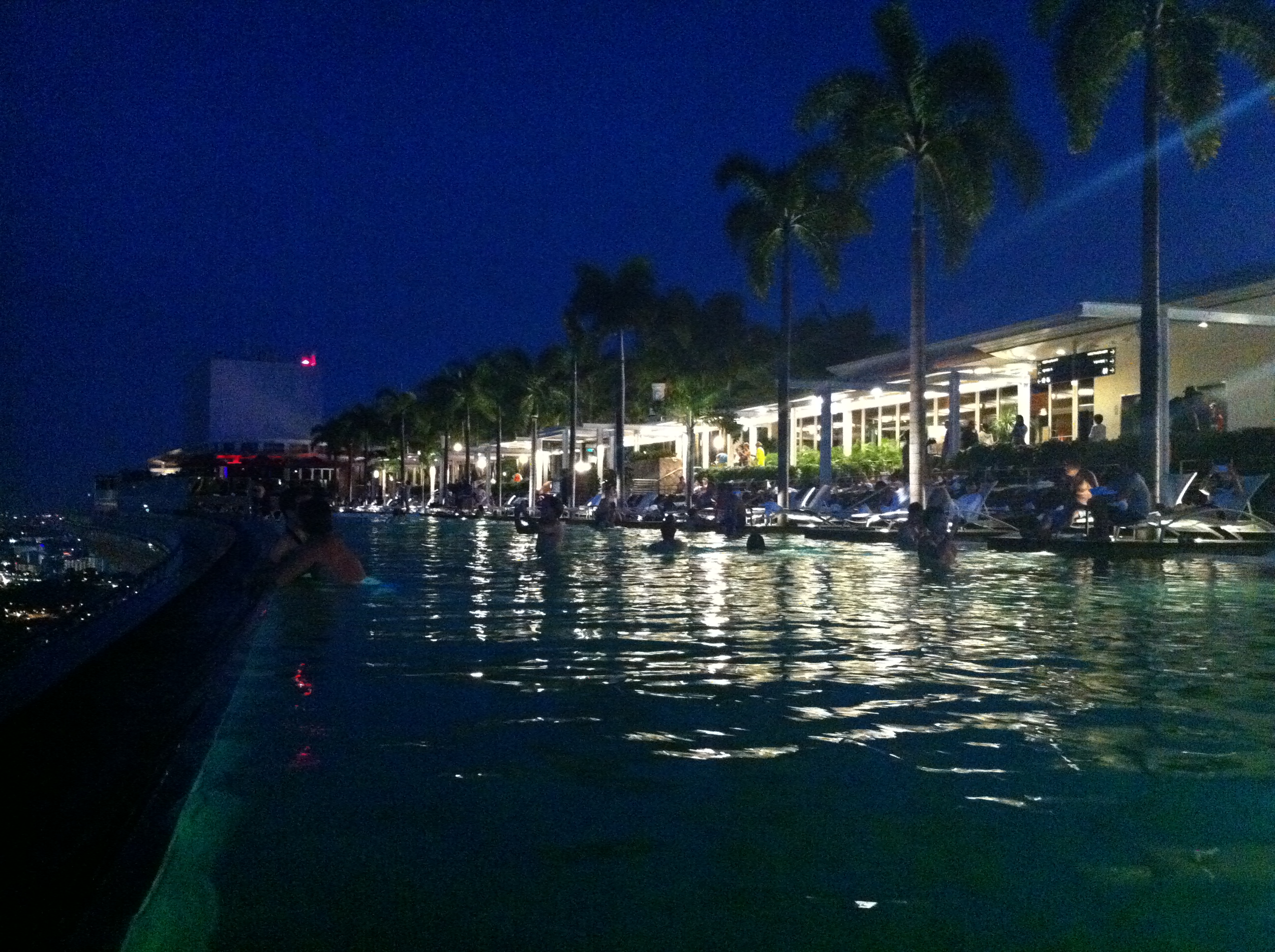
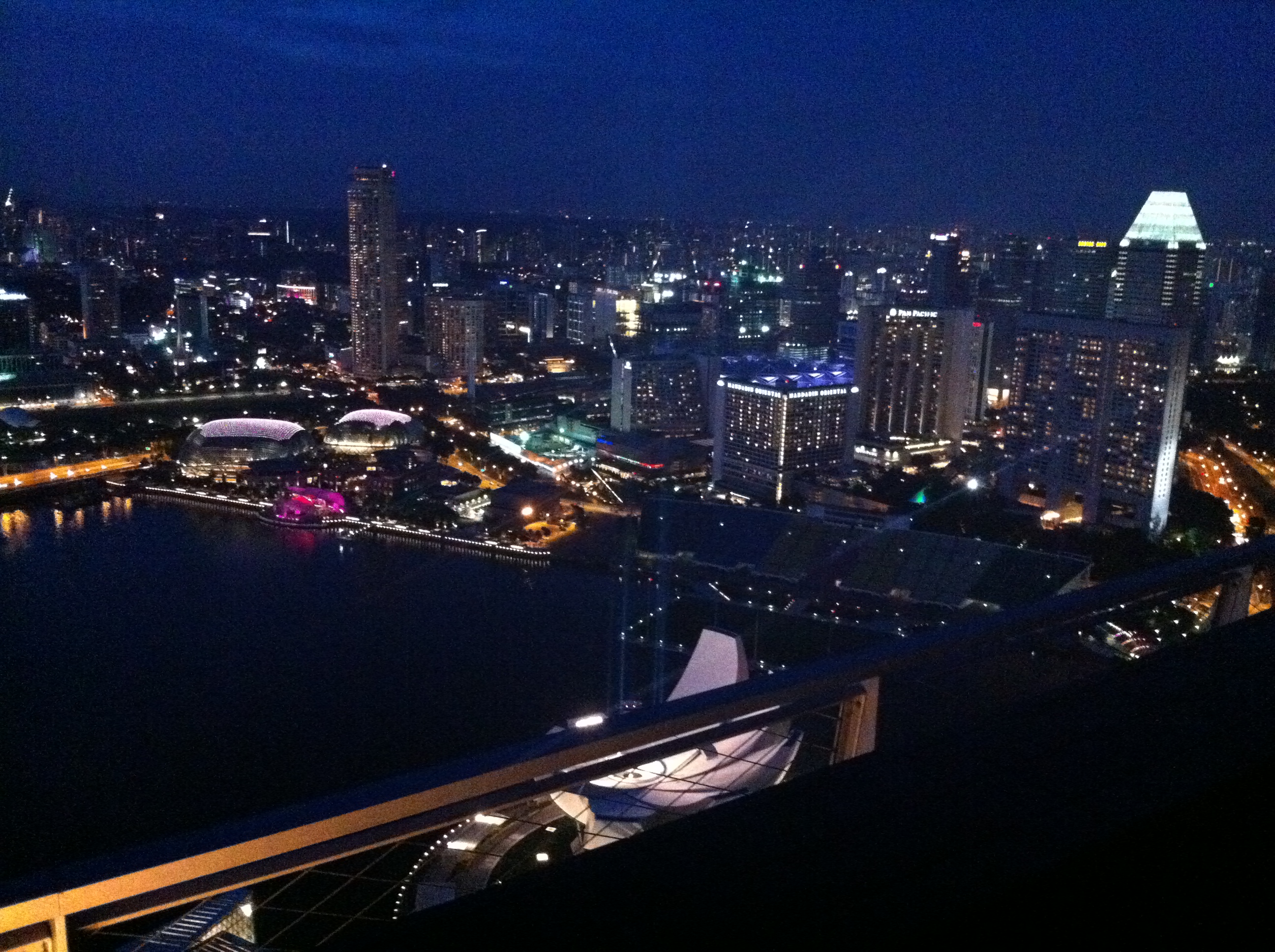
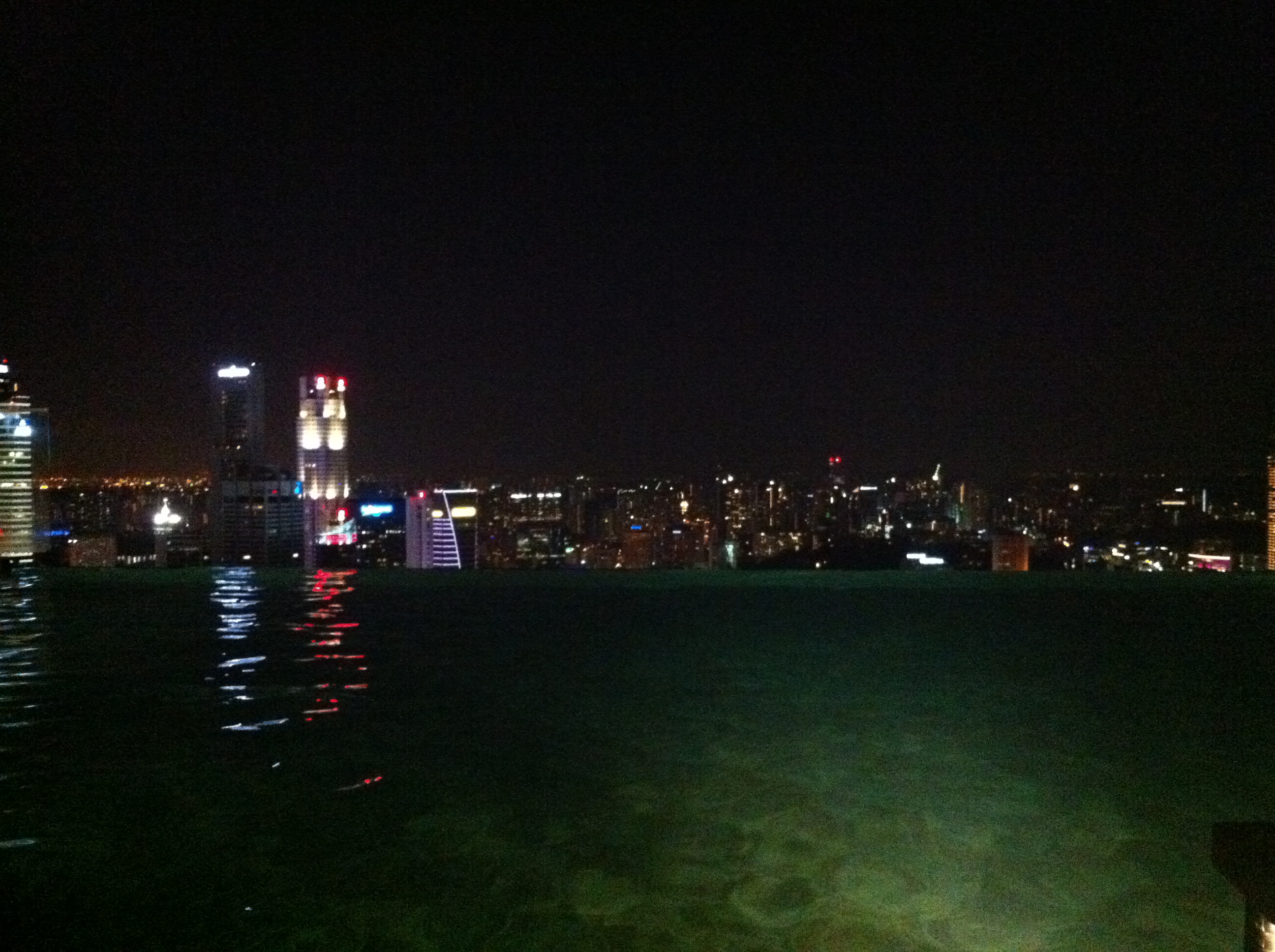
2013年11月16日,去传说中的金沙酒店游泳池逛了一圈。为了同时看到白天的景色和晚上的景色,选择了从下午4点到晚上8点。如果入住金沙酒店的话,可以提前45天左右预定,貌似打折不少。只要入住了金沙酒店,就可以去上面的游泳池,并且在游泳的同时观光。游泳池位于55楼层高的塔楼楼顶,长度大概198米。

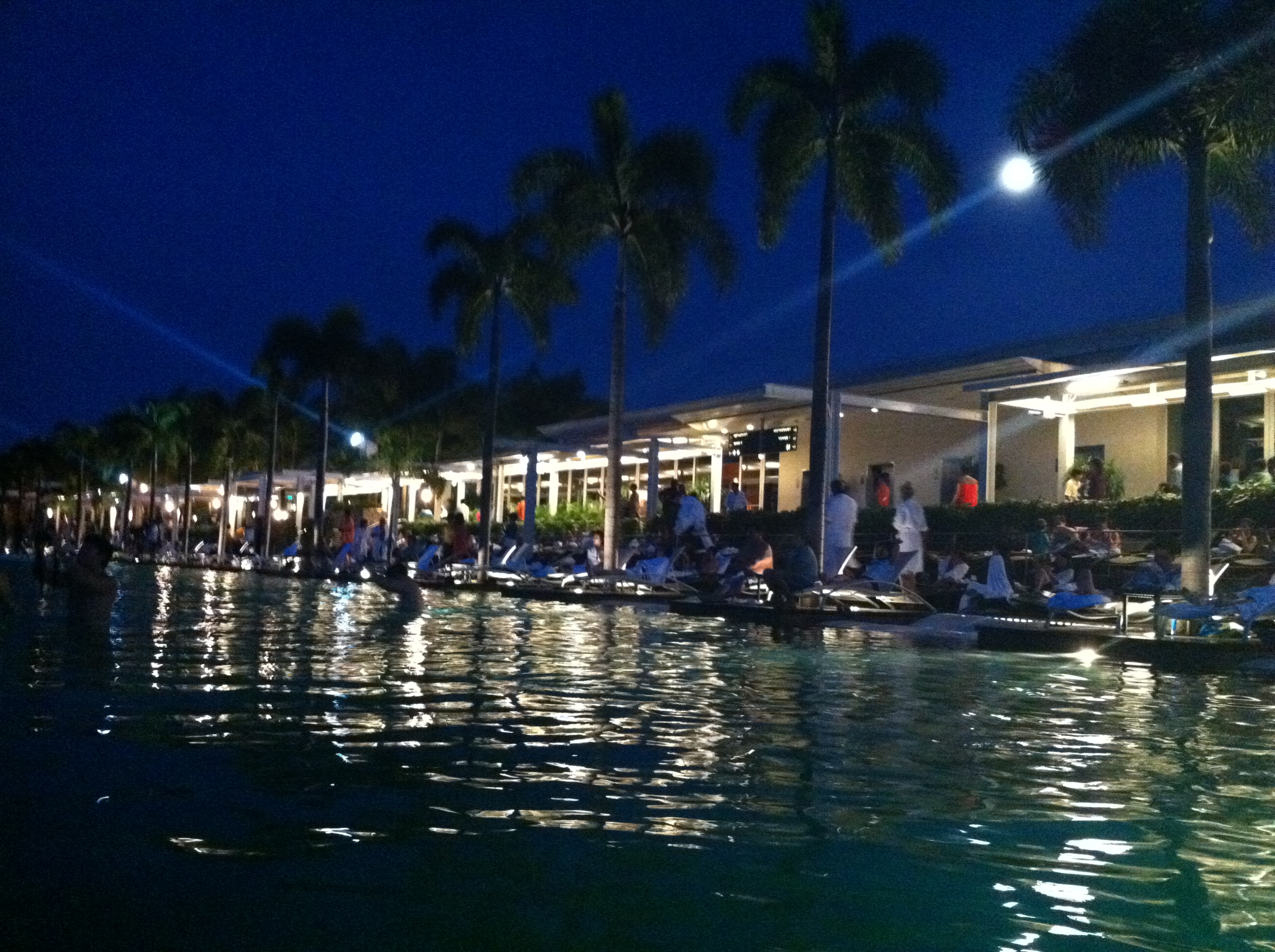
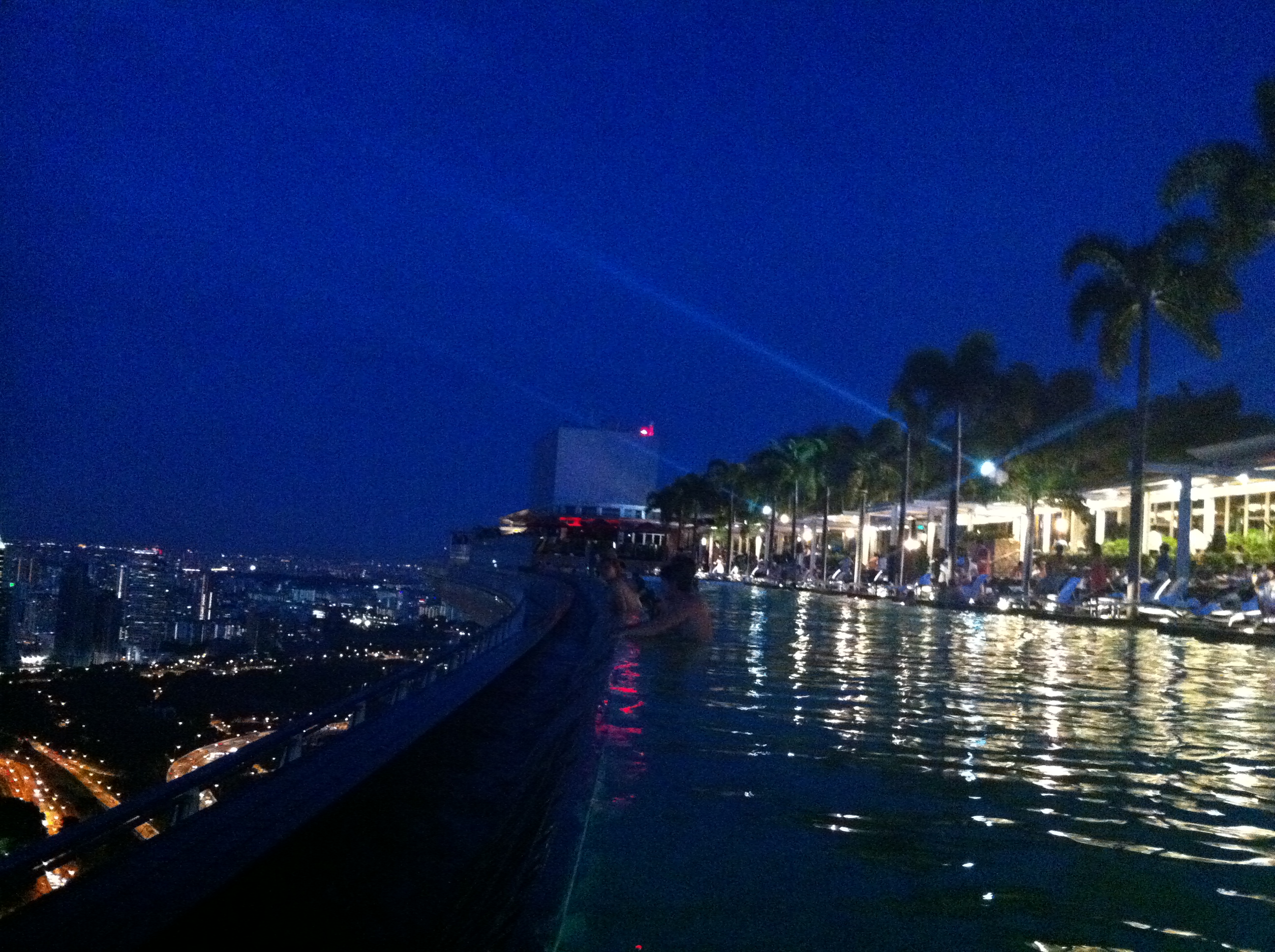
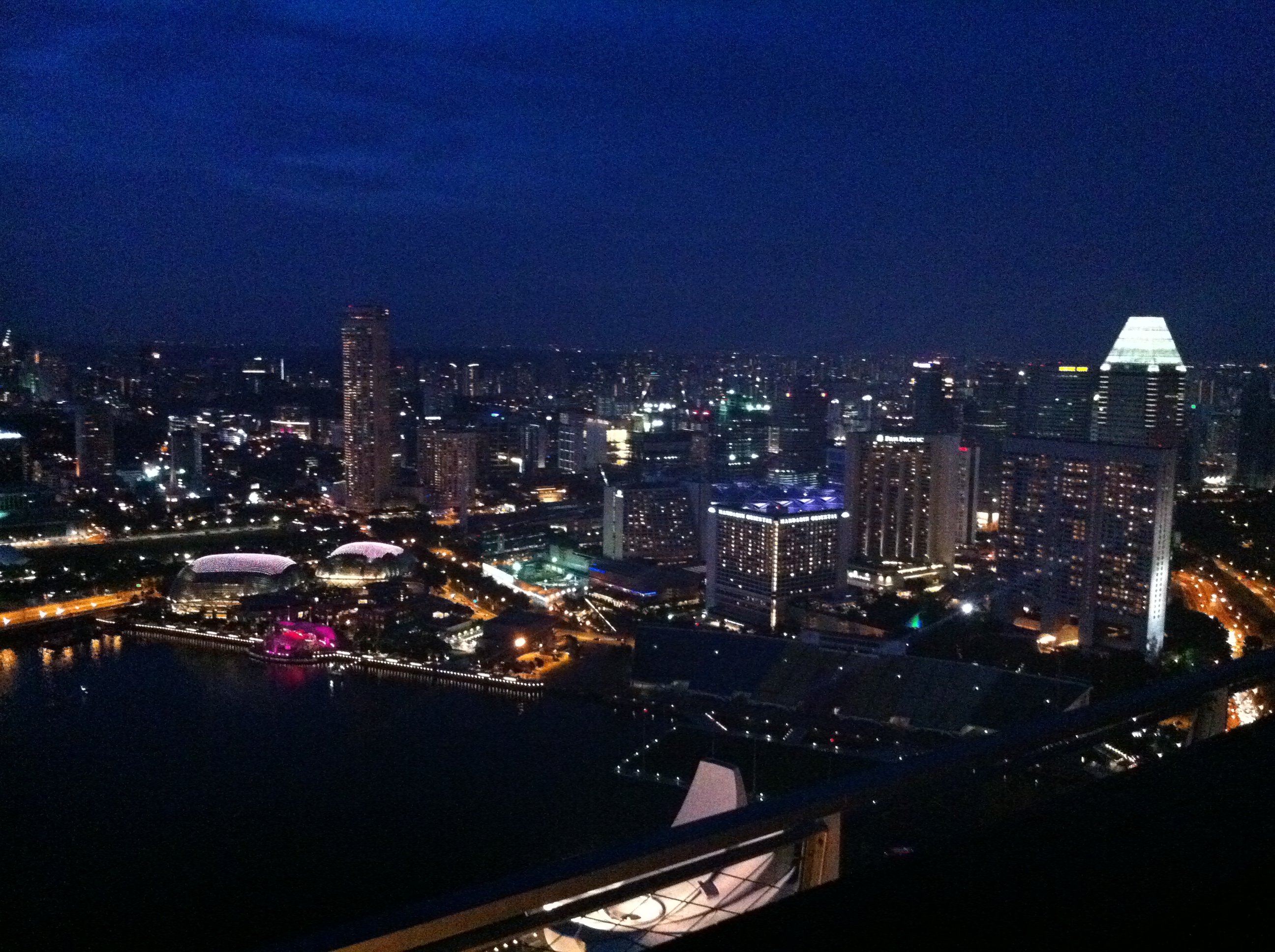
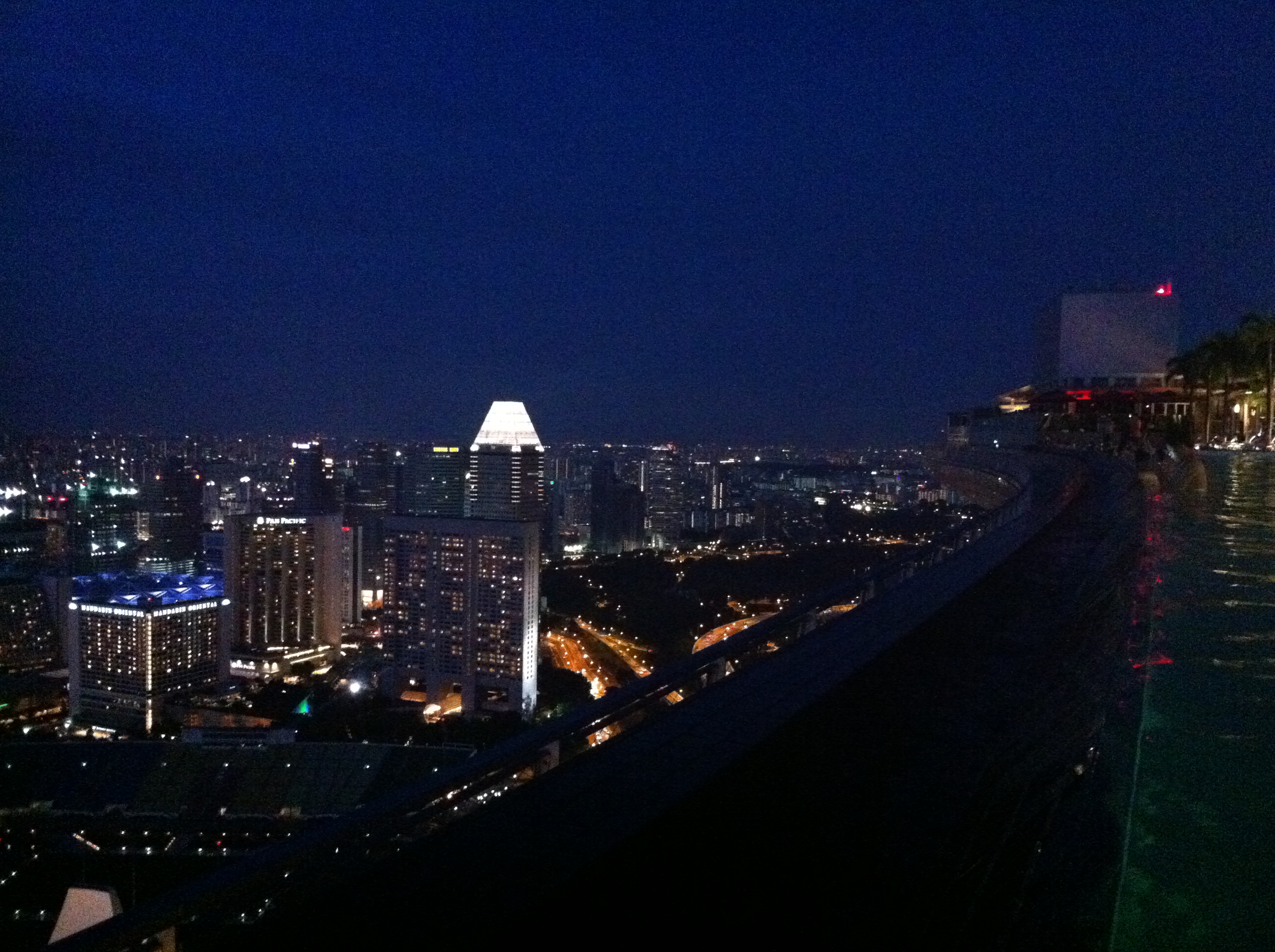
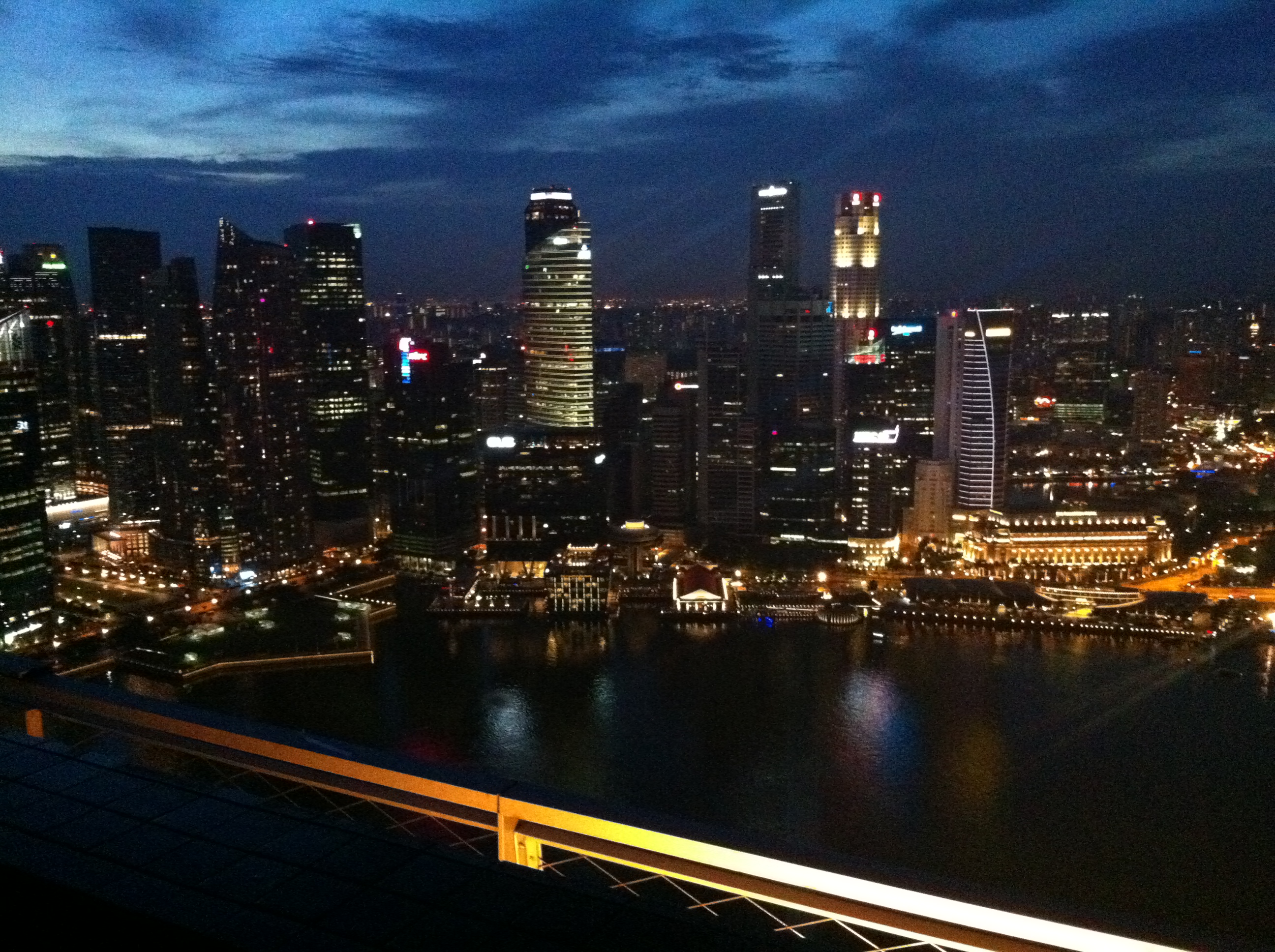
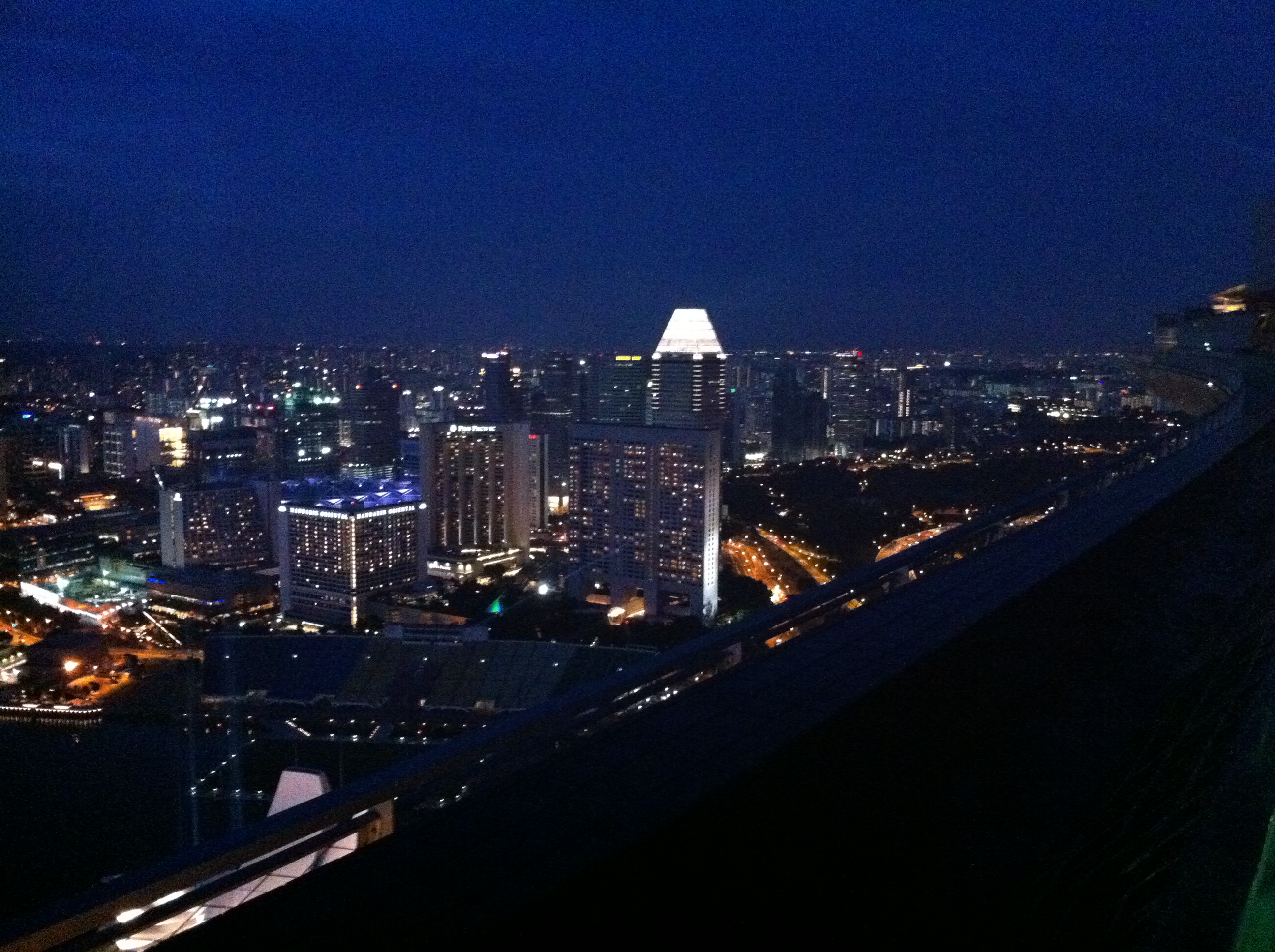
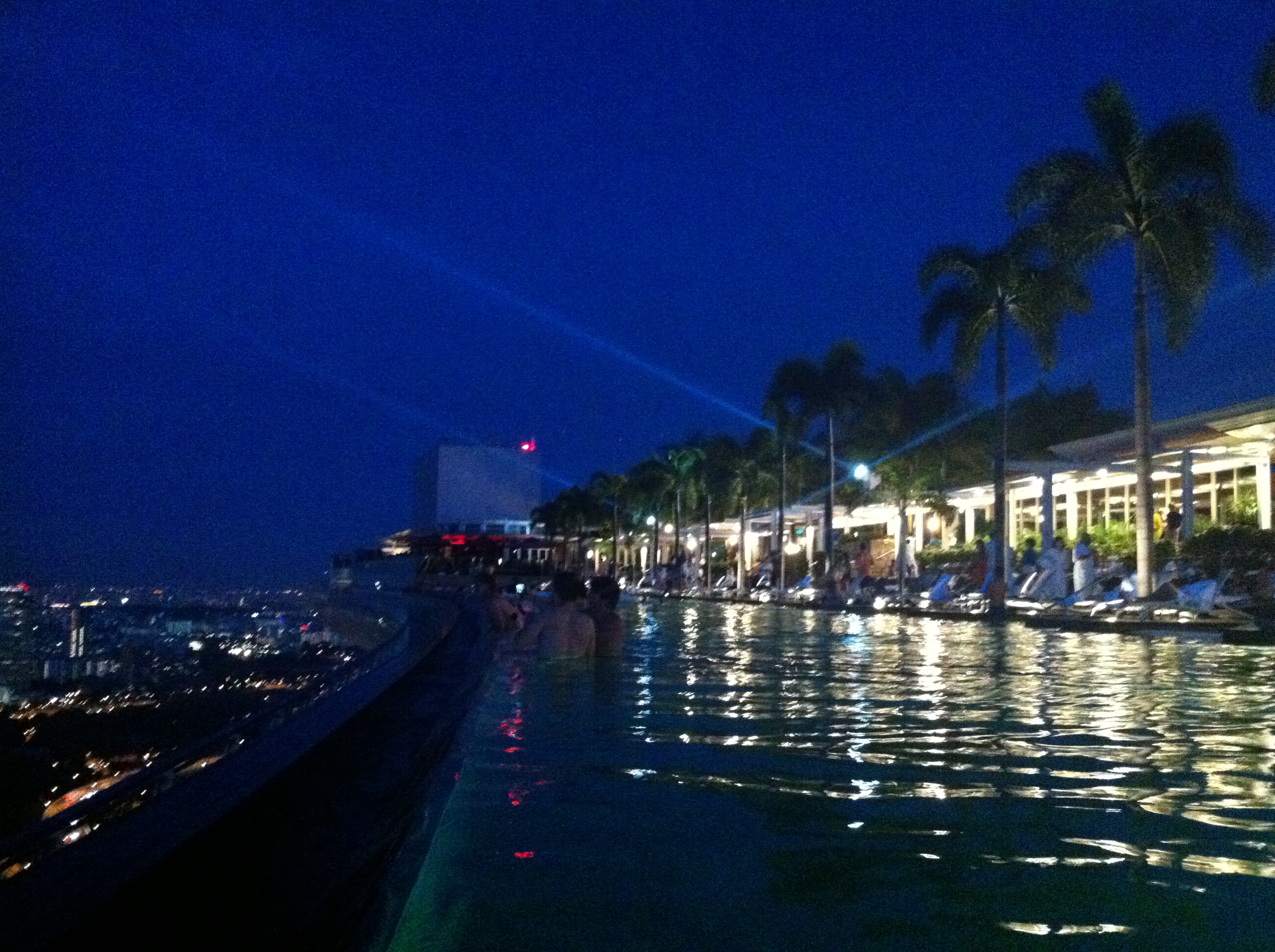
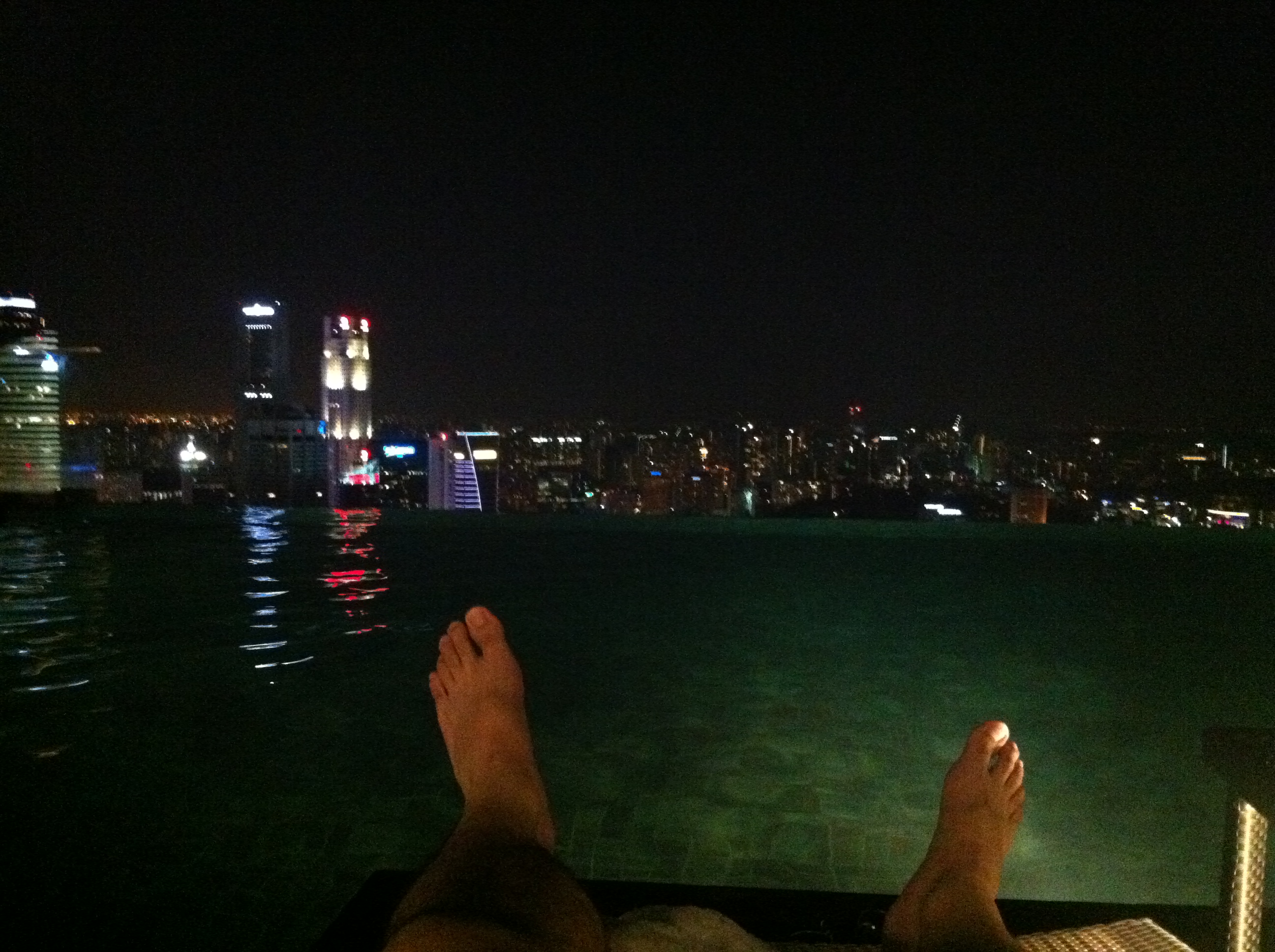
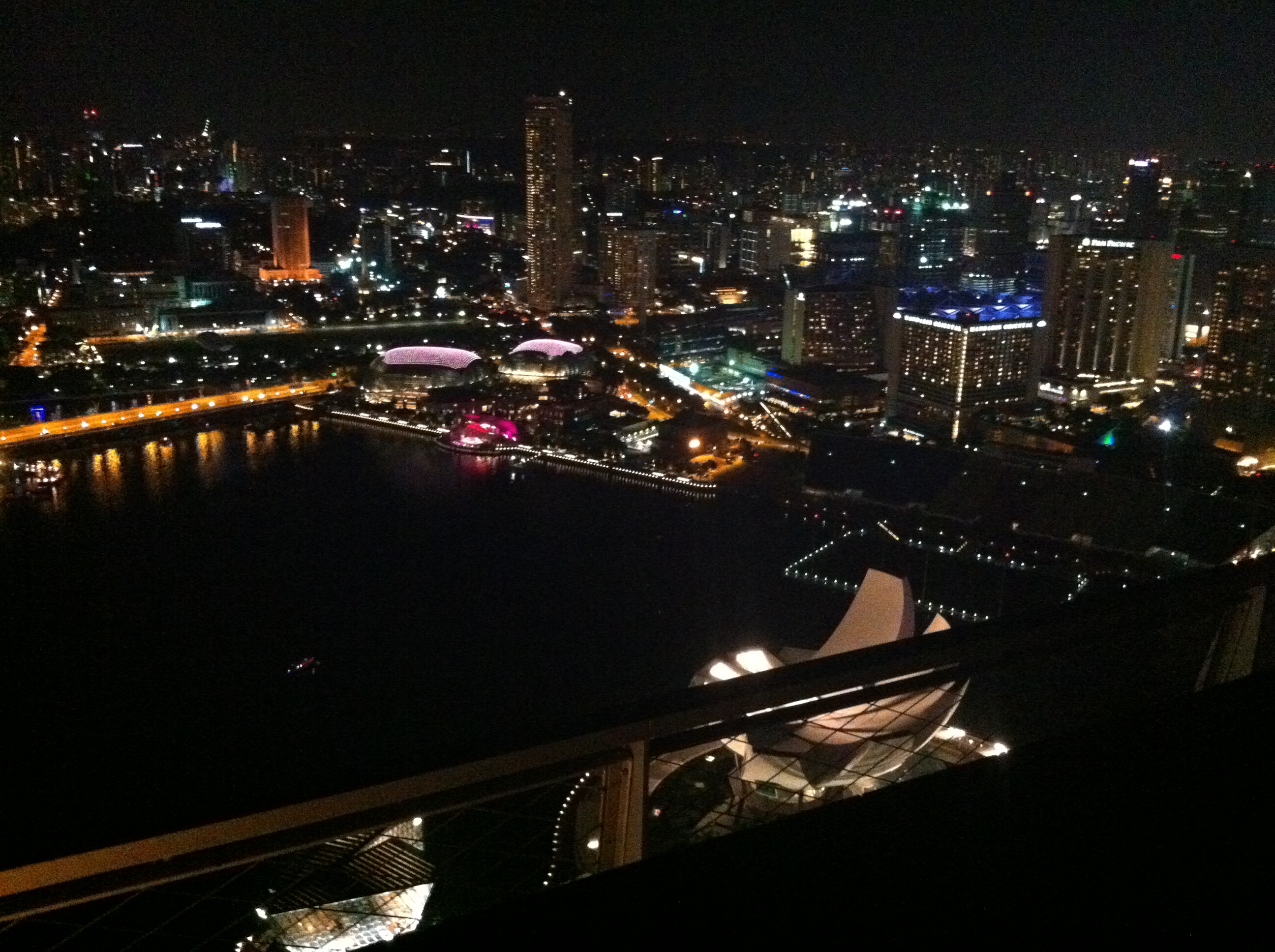
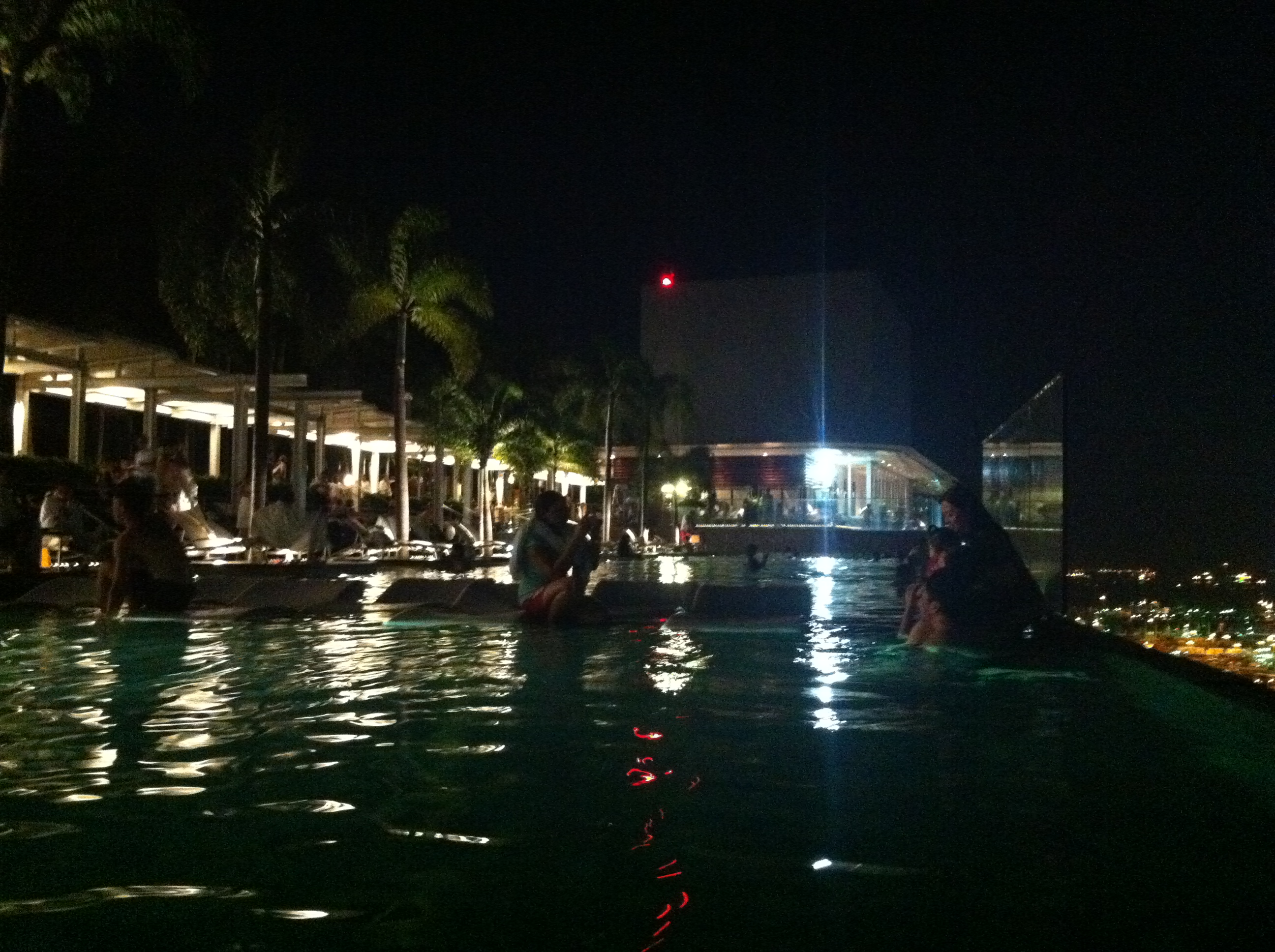
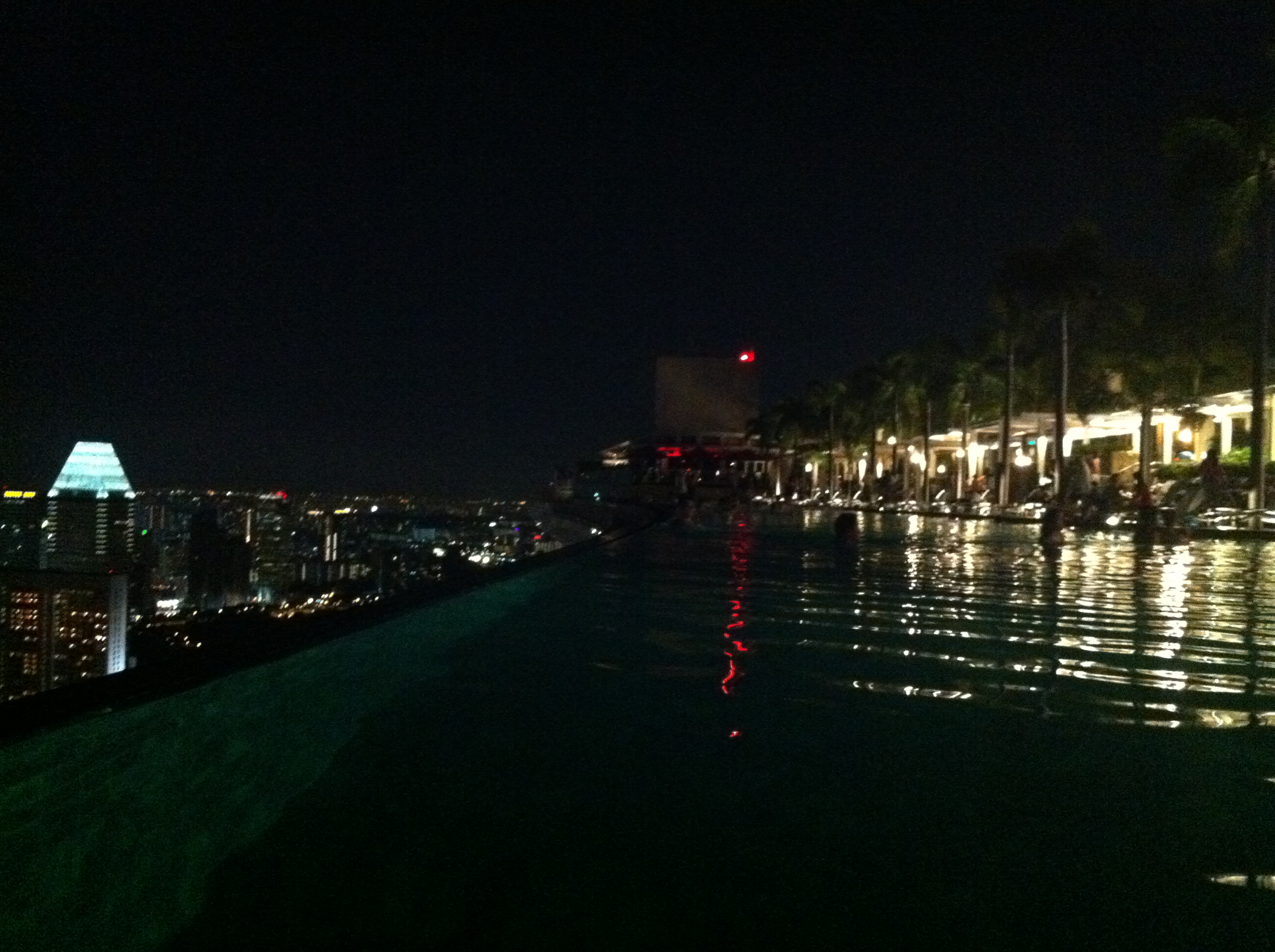
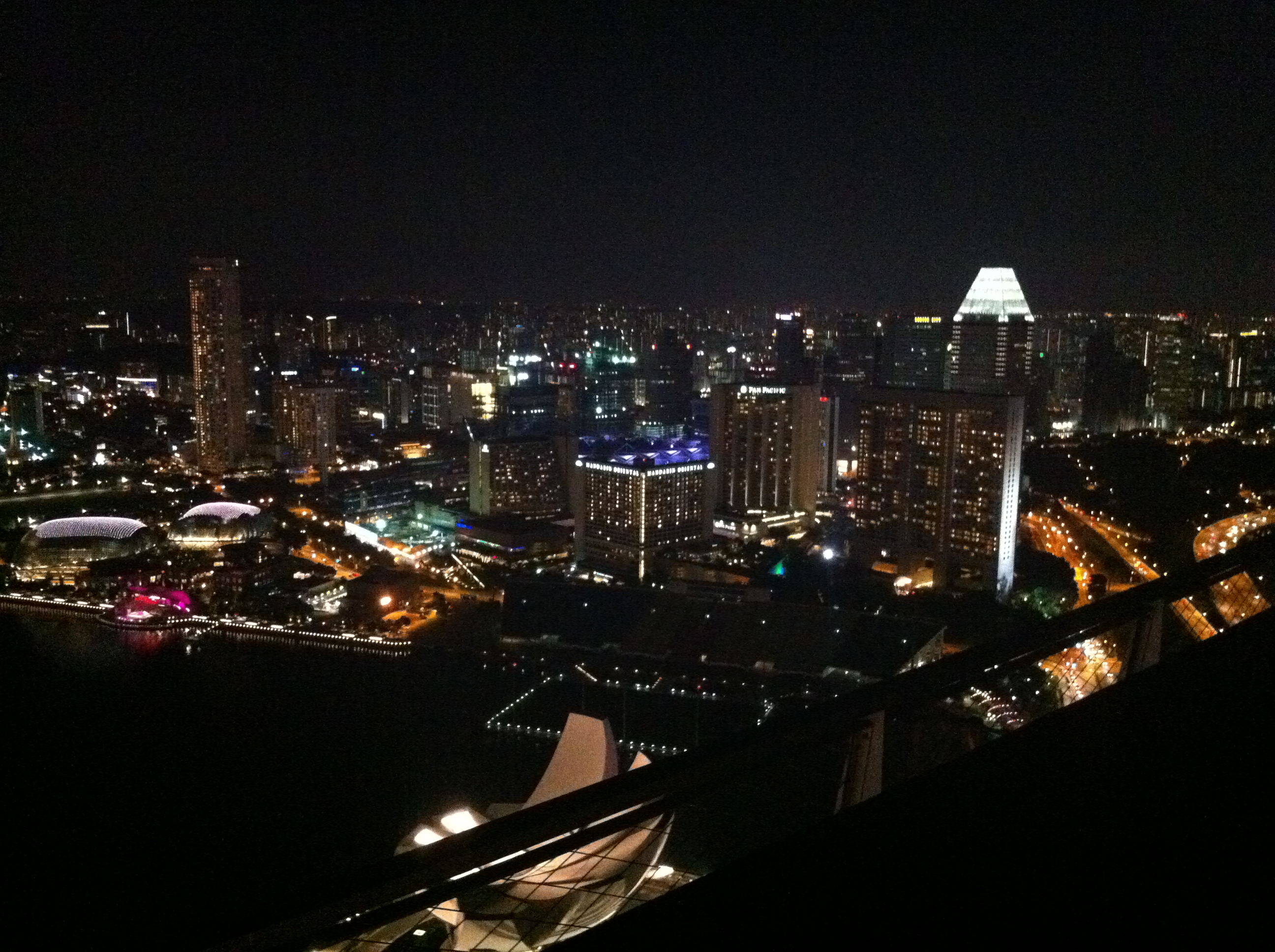
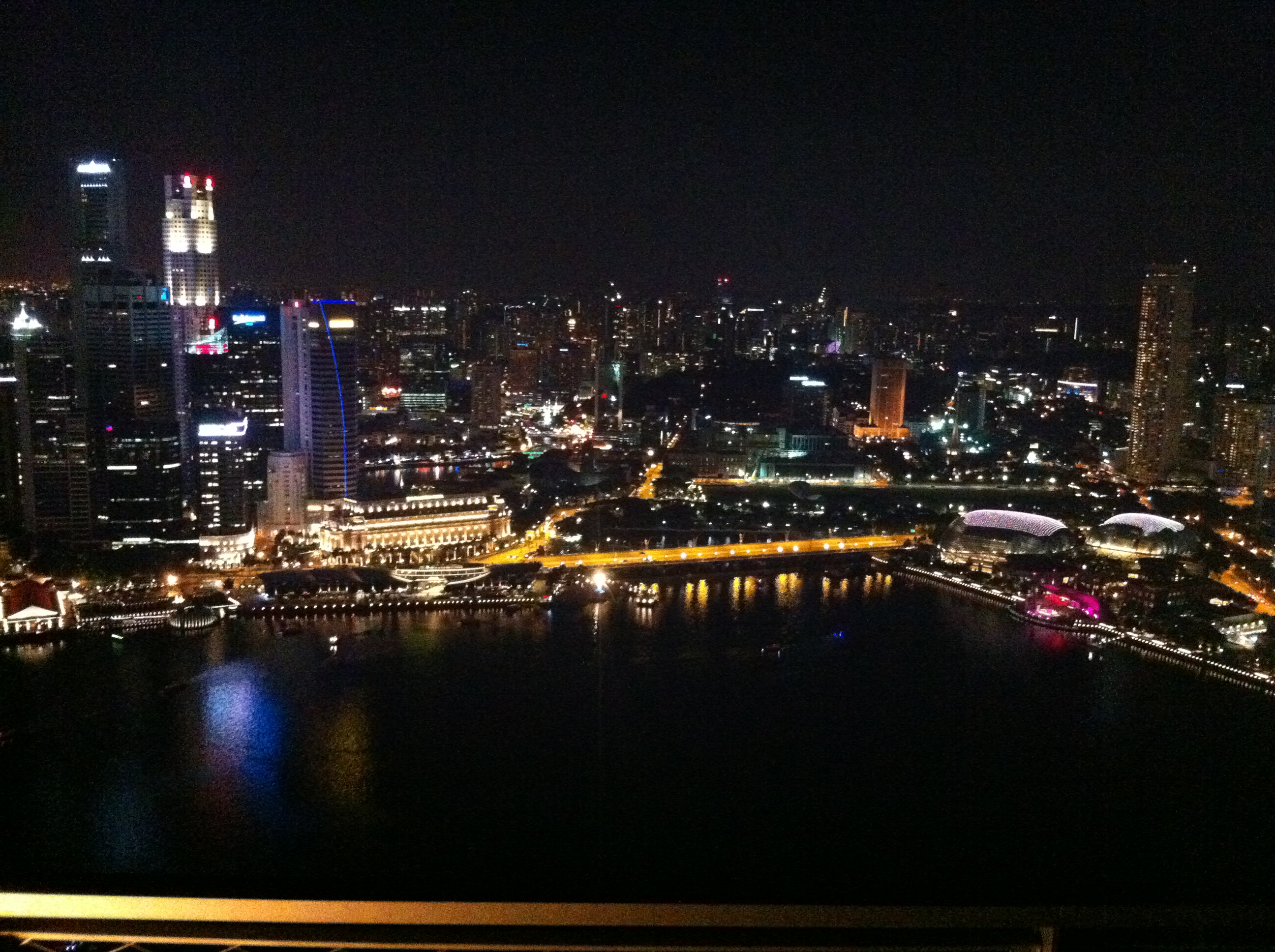
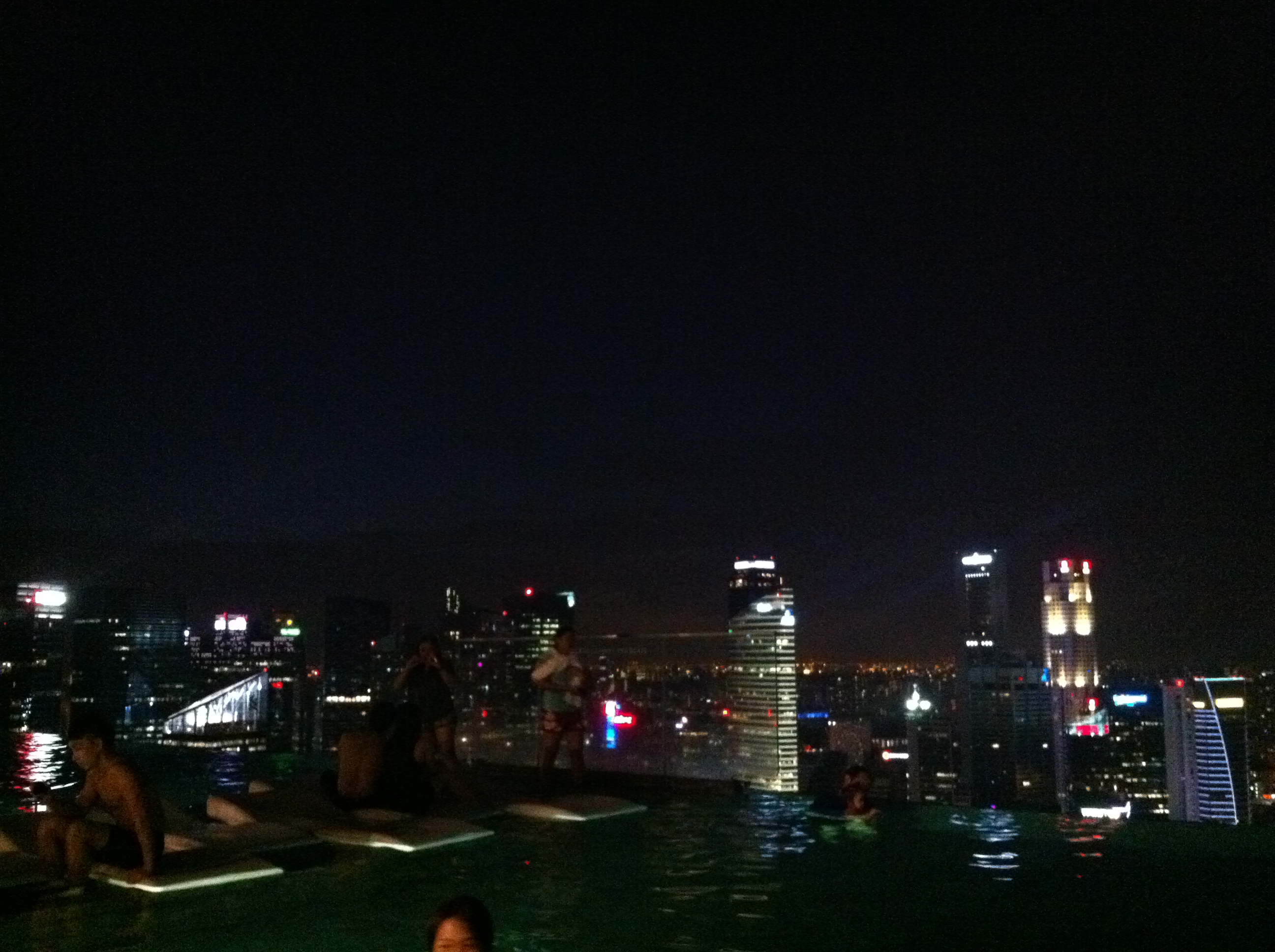
进门的时候,用房卡里面的游泳券就可以入场,工作人员会在你的手上缠着一个防水胶带,表示你今天随时都可以进入游泳池。进场之后,可以向工作人员要一块免费的浴巾,然后就去卫生间里面换衣服。换了衣服之后,就可以出来在外面找一个免费的躺椅,把自己的随身物品放在上面,然后就可以下水游泳。为了保证大家能够观光,游泳池的水深才1.2米,都可以站在池子里面走到游泳池的边缘看外面的景色。下午去的时候人还比较多,椅子几乎都被占满了,好不容易才找到一个位置。Photo 13-11-16 17 30 07 游泳池的边缘看上去是无边的,其实在外侧有栏杆和水槽,用来接游泳池的水。外面一栋栋高楼就是市中心的各种银行,大剧院什么的。新加坡河上面还会有观光的船舶。Photo 13-11-16 18 15 41 Photo 13-11-16 18 15 02 Photo 13-11-16 18 14 58 最右侧是一个足球的看台,那个足球场是修在水面上的,看台没有遮阳的。Photo 13-11-16 18 14 55 Photo 13-11-16 18 14 43 Photo 13-11-16 18 14 38游泳池的风景,大家都会在游泳池里面各种拍照,从这个角度看上去,确实是一个无边的游泳池。Photo 13-11-16 18 14 16 Photo 13-11-16 18 12 31 不管游客会不会游泳,都会离开客房上来坐一会,享受下午空闲的时光。Photo 13-11-16 18 12 28 Photo 13-11-16 18 12 21 Photo 13-11-16 17 58 21 Photo 13-11-16 17 58 10 Photo 13-11-16 17 30 52 Photo 13-11-16 17 30 21 Photo 13-11-16 17 30 16天色逐渐暗下来了,这个时候新加坡的夜景很美。Photo 13-11-16 18 45 08 Photo 13-11-16 18 55 48 Photo 13-11-16 19 12 32 Photo 13-11-16 18 51 52 Photo 13-11-16 18 51 56 Photo 13-11-16 19 12 36 传说中的晚霞吻着夕阳?Photo 13-11-16 18 51 44 Photo 13-11-16 19 14 10夜晚的时候,游泳池上面的灯光就会打开,并且水里面也会有灯光,安装在游泳池的两侧。Photo 13-11-16 19 14 06 Photo 13-11-16 19 14 01 Photo 13-11-16 19 13 56 Photo 13-11-16 19 12 39

Photo 13-11-16 19 14 06 Photo 13-11-16 19 17 14 Photo 13-11-16 19 16 18 Photo 13-11-16 19 16 08 Photo 13-11-16 19 16 08 天色彻底暗了下来,新加坡的夜景真的很美。除了Marina Bay Sands上面,从摩天轮上面往下看也是不错的景色。Photo 13-11-16 19 15 22 Photo 13-11-16 19 15 14 Photo 13-11-16 19 14 41 Photo 13-11-16 19 14 36 Photo 13-11-16 19 14 27 Photo 13-11-16 19 14 21 游泳池旁边就是一些餐厅之类的,饿了可以点一些饮料或者食物。Photo 13-11-16 19 14 16 Photo 13-11-16 19 14 10夜晚躺在这里的躺椅上看夜景很赞。水里面有照明灯。Photo 13-11-16 19 51 27Photo 13-11-16 19 50 41Photo 13-11-16 19 36 22Photo 13-11-16 19 35 44Photo 13-11-16 19 35 37Photo 13-11-16 19 35 05Photo 13-11-16 19 34 23Photo 13-11-16 19 33 03Photo 13-11-16 19 32 59Photo 13-11-16 19 32 51Photo 13-11-16 19 32 47Photo 13-11-16 19 32 42Photo 13-11-16 19 17 21Photo 13-11-16 19 17 14Photo 13-11-16 19 16 18Photo 13-11-16 19 16 08


zr9558's Blog