Let  be intervals and let l, r be the components of
  . Then the Cross Ratio is defined as

Assume g is a  monotone function on the interval t, and g(t)=T, g(j)=J, g(l)=L, g(r)=R. Then define

Define the Schwarzian Derivative for function g,

Proposition 1. Assume f and g are functions, then


Proposition 2. If  for some
  and
and  , then
  for all
  .
.
Proposition 3. Minimum Principle.
Assume ![I=[a,b]](https://s0.wp.com/latex.php?latex=I%3D%5Ba%2Cb%5D&bg=ffffff&fg=2b2b2b&s=0&c=20201002) ,
,  is a diffeomorphism with negative schwarzian derivative, then

Theorem 1. Real Koebe Principle.
Let Sf<0. Then for any intervals  and any n for which
  is a diffeomorphism one has the following. If
  contains a
  scaled neighbourhood of
  , then

Moreover, there exists a universal function  which does not depend on f, n, and t such that


Theorem 2. Complex Koebe Principle
Suppose that  contains a scaled neighbourhood of the disc
  . Then for any univalent function
  one has a universal function which only depends on
  such that

Theorem 3. Schwarz Lemma (Original Form)
Assume  is the unit disc on the complex plane
  ,
,  is a holomorphic function with
  . Then
  for all
  and
and  Moreover, if
  for some
  or
or  then
then  for some
Corollary 1.
Assume  is the unit disc on the complex plane , and
  is a holomorphic function, then


Corollary 2.
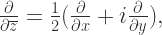
Assume  is the upper half plane of the complex plane ,
  is a holomorphic map. Then


Corollary 3. Pick Theorem
The hyperbolic metric on is  , assume
  denotes the hyperbolic distance between
  and
and  on . Assume is a holomorphic function, then

Moreover, if  for some points
  , then
  , where

Background in hyperbolic geometry
Define

where  is an interval. It is easy to show that
  is conformally equivalent to the upper half plane and define
  as
as

k is determined by the external angle  at which the discs intersect the real line. Moreover,
  Define

Corollary 4. (NS) Schwarz Lemma
(1) Assume  is a holomorphic map, then
(2) Assume  is a real polynomial map, its critical points are on the real line. Assume
  is a diffeomorphism, then there exists a set
  such that
  and
and
 is a conformal map.
Corollary 5.
Assume is a univalent map and D contains scaled neighbourhood of  and assume f maps the real line to the real line. For each
  there exists
  such that if J is a real interval in
  , then

The Hyperbolic Metric On the Real Interval and Cross Ratio
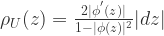
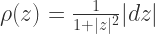
As far as we know, the hyperbolic metric on the unit disc  is
is

Then the restriction to the real line is

Moreover, from it, we can deduce the hyperbolic metric on the real interval  is
is

If  , then the hyperbolic length of the interval
  on the total interval
  is
is

where 
Theorem 4. Assume  is a diffeomorphism with negative schwarzian derivative. Assume
  , then

That means f expands the hyperbolic metric on the real interval.
Proof. Since the schwarzian derivative of f is negative, 
Therefore, That means f expands the hyperbolic metric on the real interval.
Remark. From Schwarz-Pick Theorem, for a holomorphic map ,  contracts the hyperbolic distance in the unit disc . Conversely, from above, for a diffeomorphism with negative schwarzian derivative, expands the hyperbolic distance in the real interval.
Exercise 1. “Mathematical Tools for One Dimensional Dynamics” Exercise 6.5, Chapter 6
Let  be a diffeomorphism without fixed points (
  being a closed interval on the real line). If for all
  , then there exists a unique
  such that
  for all .
Proof. If is a decreasing map, then the right boundary of the real interval I is the  . Therefore, assume that is an increasing map on the real interval I.
Since  has no fixed points on the real interval I, then
  or
or  for all . Without lost of generality, assume for all
  . Since
  is a continuous function on the closed interval I, there exists such that for all .
By contradiction, there exist two distinct points 
 such that and
  for all . From here, we know that
  .
.
From Langrange’s mean value theorem, there exists  such that
  . Since the schwarzian derivative of is negative, from the minimal principle, we get

i.e.  . However, from the definition of and
  , we get


This is a contradiction. Therefore, the existence of is unique.
Assume is a diffeomorphism, define the non-linearity of as

Proposition 4. 
Proposition 5. 
Theorem 5. Koebe Non-linearity Principle.
Given  , there exists
  such that, if
 ![f: [-\tau, 1+\tau] \rightarrow \mathbb{R}](https://s0.wp.com/latex.php?latex=f%3A+%5B-%5Ctau%2C+1%2B%5Ctau%5D+%5Crightarrow+%5Cmathbb%7BR%7D&bg=ffffff&fg=2b2b2b&s=0&c=20201002) is a diffeomorphism into the reals and
is a diffeomorphism into the reals and  for all
 ![t\in [-\tau,1+\tau],](https://s0.wp.com/latex.php?latex=t%5Cin+%5B-%5Ctau%2C1%2B%5Ctau%5D%2C&bg=ffffff&fg=2b2b2b&s=0&c=20201002) then we have
then we have
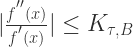
for all  Show that
  as
as  (This recovers the classical Koebe non-linearity principle).


























 Hello World!


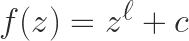 ,
, ,
, ,
,  ,
,  ,
, 
 ZHANG RONG