Category Archives: Computer Science

如何在 Kaggle 首战中进入前 10%

Introduction

Kaggle 是目前最大的 Data Scientist 聚集地。很多公司会拿出自家的数据并提供奖金,在 Kaggle 上组织数据竞赛。我最近完成了第一次比赛,在 2125 个参赛队伍中排名第 98 位(~ 5%)。因为是第一次参赛,所以对这个成绩我已经很满意了。在 Kaggle 上一次比赛的结果除了排名以外,还会显示的就是 Prize Winner,10% 或是 25% 这三档。所以刚刚接触 Kaggle 的人很多都会以 25% 或是 10% 为目标。在本文中,我试图根据自己第一次比赛的经验和从其他 Kaggler 那里学到的知识,为刚刚听说 Kaggle 想要参赛的新手提供一些切实可行的冲刺 10% 的指导。

本文的英文版见这里

Kaggle Profile

Kaggler 绝大多数都是用 Python 和 R 这两门语言的。因为我主要使用 Python,所以本文提到的例子都会根据 Python 来。不过 R 的用户应该也能不费力地了解到工具背后的思想。

首先简单介绍一些关于 Kaggle 比赛的知识:

  • 不同比赛有不同的任务,分类、回归、推荐、排序等。比赛开始后训练集和测试集就会开放下载。
  • 比赛通常持续 2 ~ 3 个月,每个队伍每天可以提交的次数有限,通常为 5 次。
  • 比赛结束前一周是一个 Deadline,在这之后不能再组队,也不能再新加入比赛。所以想要参加比赛请务必在这一 Deadline 之前有过至少一次有效的提交
  • 一般情况下在提交后会立刻得到得分的反馈。不同比赛会采取不同的评分基准,可以在分数栏最上方看到使用的评分方法。
  • 反馈的分数是基于测试集的一部分计算的,剩下的另一部分会被用于计算最终的结果。所以最后排名会变动。
  • LB 指的就是在 Leaderboard 得到的分数,由上,有 Public LBPrivate LB 之分。
  • 自己做的 Cross Validation 得到的分数一般称为 CV 或是 Local CV。一般来说 CV 的结果比 LB 要可靠。
  • 新手可以从比赛的 ForumScripts 中找到许多有用的经验和洞见。不要吝啬提问,Kaggler 都很热情。

那么就开始吧!

P.S. 本文假设读者对 Machine Learning 的基本概念和常见模型已经有一定了解。 Enjoy Reading!

General Approach

在这一节中我会讲述一次 Kaggle 比赛的大致流程。

Data Exploration

在这一步要做的基本就是 EDA (Exploratory Data Analysis),也就是对数据进行探索性的分析,从而为之后的处理和建模提供必要的结论。

通常我们会用 pandas 来载入数据,并做一些简单的可视化来理解数据。

Visualization

通常来说 matplotlibseaborn 提供的绘图功能就可以满足需求了。

比较常用的图表有:

  • 查看目标变量的分布。当分布不平衡时,根据评分标准和具体模型的使用不同,可能会严重影响性能。
  • Numerical Variable,可以用 Box Plot 来直观地查看它的分布。
  • 对于坐标类数据,可以用 Scatter Plot 来查看它们的分布趋势和是否有离群点的存在。
  • 对于分类问题,将数据根据 Label 的不同着不同的颜色绘制出来,这对 Feature 的构造很有帮助。
  • 绘制变量之间两两的分布和相关度图表。

这里有一个在著名的 Iris 数据集上做了一系列可视化的例子,非常有启发性。

Statistical Tests

我们可以对数据进行一些统计上的测试来验证一些假设的显著性。虽然大部分情况下靠可视化就能得到比较明确的结论,但有一些定量结果总是更理想的。不过,在实际数据中经常会遇到非 i.i.d. 的分布。所以要注意测试类型的的选择和对显著性的解释。

在某些比赛中,由于数据分布比较奇葩或是噪声过强,Public LB 的分数可能会跟Local CV 的结果相去甚远。可以根据一些统计测试的结果来粗略地建立一个阈值,用来衡量一次分数的提高究竟是实质的提高还是由于数据的随机性导致的。

Data Preprocessing

大部分情况下,在构造 Feature 之前,我们需要对比赛提供的数据集进行一些处理。通常的步骤有:

  • 有时数据会分散在几个不同的文件中,需要 Join 起来。
  • 处理 Missing Data
  • 处理 Outlier
  • 必要时转换某些 Categorical Variable 的表示方式。
  • 有些 Float 变量可能是从未知的 Int 变量转换得到的,这个过程中发生精度损失会在数据中产生不必要的 Noise,即两个数值原本是相同的却在小数点后某一位开始有不同。这对 Model 可能会产生很负面的影响,需要设法去除或者减弱 Noise。

这一部分的处理策略多半依赖于在前一步中探索数据集所得到的结论以及创建的可视化图表。在实践中,我建议使用 iPython Notebook 进行对数据的操作,并熟练掌握常用的 pandas 函数。这样做的好处是可以随时得到结果的反馈和进行修改,也方便跟其他人进行交流(在 Data Science 中 Reproducible Results 是很重要的)。

下面给两个例子。

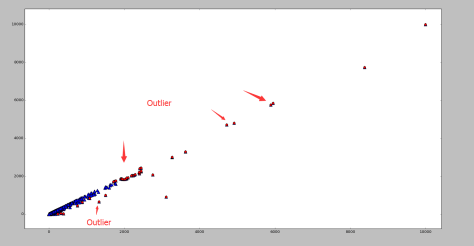
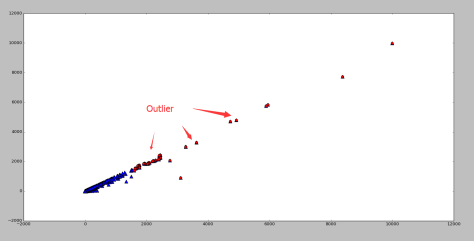
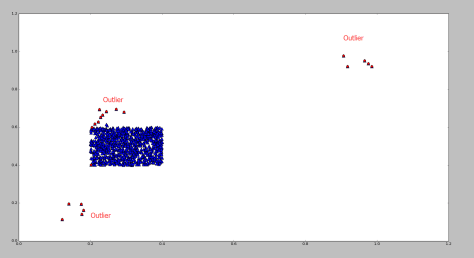
Outlier

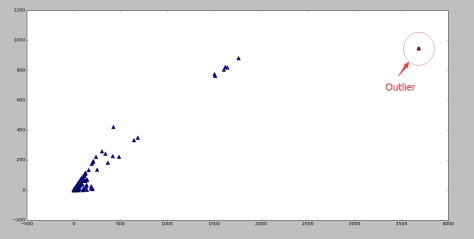
Outlier Example

这是经过 Scaling 的坐标数据。可以发现右上角存在一些离群点,去除以后分布比较正常。

Dummy Variables

对于 Categorical Variable,常用的做法就是 One-hot encoding。即对这一变量创建一组新的伪变量,对应其所有可能的取值。这些变量中只有这条数据对应的取值为 1,其他都为 0。

如下,将原本有 7 种可能取值的 Weekdays 变量转换成 7 个 Dummy Variables。

Dummies Example

要注意,当变量可能取值的范围很大(比如一共有成百上千类)时,这种简单的方法就不太适用了。这时没有有一个普适的方法,但我会在下一小节描述其中一种。

Feature Engineering

有人总结 Kaggle 比赛是 “Feature 为主,调参和 Ensemble 为辅”,我觉得很有道理。Feature Engineering 能做到什么程度,取决于对数据领域的了解程度。比如在数据包含大量文本的比赛中,常用的 NLP 特征就是必须的。怎么构造有用的 Feature,是一个不断学习和提高的过程。

一般来说,当一个变量从直觉上来说对所要完成的目标有帮助,就可以将其作为 Feature。至于它是否有效,最简单的方式就是通过图表来直观感受。比如:

Checking Feature Validity

Feature Selection

总的来说,我们应该生成尽量多的 Feature,相信 Model 能够挑出最有用的 Feature。但有时先做一遍 Feature Selection 也能带来一些好处:

  • Feature 越少,训练越快。
  • 有些 Feature 之间可能存在线性关系,影响 Model 的性能。
  • 通过挑选出最重要的 Feature,可以将它们之间进行各种运算和操作的结果作为新的 Feature,可能带来意外的提高。

Feature Selection 最实用的方法也就是看 Random Forest 训练完以后得到的Feature Importance 了。其他有一些更复杂的算法在理论上更加 Robust,但是缺乏实用高效的实现,比如这个。从原理上来讲,增加 Random Forest 中树的数量可以在一定程度上加强其对于 Noisy Data 的 Robustness。

看 Feature Importance 对于某些数据经过脱敏处理的比赛尤其重要。这可以免得你浪费大把时间在琢磨一个不重要的变量的意义上。

Feature Encoding

这里用一个例子来说明在一些情况下 Raw Feature 可能需要经过一些转换才能起到比较好的效果。

假设有一个 Categorical Variable 一共有几万个取值可能,那么创建 Dummy Variables 的方法就不可行了。这时一个比较好的方法是根据 Feature Importance 或是这些取值本身在数据中的出现频率,为最重要(比如说前 95% 的 Importance)那些取值(有很大可能只有几个或是十几个)创建 Dummy Variables,而所有其他取值都归到一个“其他”类里面。

Model Selection

准备好 Feature 以后,就可以开始选用一些常见的模型进行训练了。Kaggle 上最常用的模型基本都是基于树的模型:

  • Gradient Boosting
  • Random Forest
  • Extra Randomized Trees

以下模型往往在性能上稍逊一筹,但是很适合作为 Ensemble 的 Base Model。这一点之后再详细解释。(当然,在跟图像有关的比赛中神经网络的重要性还是不能小觑的。)

  • SVM
  • Linear Regression
  • Logistic Regression
  • Neural Networks

以上这些模型基本都可以通过 sklearn 来使用。

当然,这里不能不提一下 XgboostGradient Boosting 本身优秀的性能加上Xgboost 高效的实现,使得它在 Kaggle 上广为使用。几乎每场比赛的获奖者都会用 Xgboost 作为最终 Model 的重要组成部分。在实战中,我们往往会以 Xgboost 为主来建立我们的模型并且验证 Feature 的有效性。顺带一提,在 Windows 上安装 Xgboost 很容易遇到问题,目前已知最简单、成功率最高的方案可以参考我在这篇帖子中的描述

Model Training

在训练时,我们主要希望通过调整参数来得到一个性能不错的模型。一个模型往往有很多参数,但其中比较重要的一般不会太多。比如对 sklearnRandomForestClassifier 来说,比较重要的就是随机森林中树的数量 n_estimators 以及在训练每棵树时最多选择的特征数量 max_features。所以我们需要对自己使用的模型有足够的了解,知道每个参数对性能的影响是怎样的

通常我们会通过一个叫做 Grid Search 的过程来确定一组最佳的参数。其实这个过程说白了就是根据给定的参数候选对所有的组合进行暴力搜索。

1
2
3
param_grid = {‘n_estimators’: [300, 500], ‘max_features’: [10, 12, 14]}
model = grid_search.GridSearchCV(estimator=rfr, param_grid=param_grid, n_jobs=1, cv=10, verbose=20, scoring=RMSE)
model.fit(X_train, y_train)

顺带一提,Random Forest 一般在 max_features 设为 Feature 数量的平方根附近得到最佳结果。

这里要重点讲一下 Xgboost 的调参。通常认为对它性能影响较大的参数有:

  • eta:每次迭代完成后更新权重时的步长。越小训练越慢。
  • num_round:总共迭代的次数。
  • subsample:训练每棵树时用来训练的数据占全部的比例。用于防止 Overfitting。
  • colsample_bytree:训练每棵树时用来训练的特征的比例,类似 RandomForestClassifiermax_features
  • max_depth:每棵树的最大深度限制。与 Random Forest 不同,Gradient Boosting 如果不对深度加以限制,最终是会 Overfit 的
  • early_stopping_rounds:用于控制在 Out Of Sample 的验证集上连续多少个迭代的分数都没有提高后就提前终止训练。用于防止 Overfitting。

一般的调参步骤是:

  1. 将训练数据的一部分划出来作为验证集。
  2. 先将 eta 设得比较高(比如 0.1),num_round 设为 300 ~ 500。
  3. 用 Grid Search 对其他参数进行搜索
  4. 逐步将 eta 降低,找到最佳值。
  5. 以验证集为 watchlist,用找到的最佳参数组合重新在训练集上训练。注意观察算法的输出,看每次迭代后在验证集上分数的变化情况,从而得到最佳的 early_stopping_rounds
1
2
3
4
5
6
7
8
9
10
11
12
13
14
15
16
17
X_dtrain, X_deval, y_dtrain, y_deval = cross_validation.train_test_split(X_train, y_train, random_state=1026, test_size=0.3)
dtrain = xgb.DMatrix(X_dtrain, y_dtrain)
deval = xgb.DMatrix(X_deval, y_deval)
watchlist = [(deval, ‘eval’)]
params = {
‘booster’: ‘gbtree’,
‘objective’: ‘reg:linear’,
‘subsample’: 0.8,
‘colsample_bytree’: 0.85,
‘eta’: 0.05,
‘max_depth’: 7,
‘seed’: 2016,
‘silent’: 0,
‘eval_metric’: ‘rmse’
}
clf = xgb.train(params, dtrain, 500, watchlist, early_stopping_rounds=50)
pred = clf.predict(xgb.DMatrix(df_test))

最后要提一点,所有具有随机性的 Model 一般都会有一个 seed 或是 random_state 参数用于控制随机种子。得到一个好的 Model 后,在记录参数时务必也记录下这个值,从而能够在之后重现 Model。

Cross Validation

Cross Validation 是非常重要的一个环节。它让你知道你的 Model 有没有 Overfit,是不是真的能够 Generalize 到测试集上。在很多比赛中 Public LB 都会因为这样那样的原因而不可靠。当你改进了 Feature 或是 Model 得到了一个更高的 CV 结果,提交之后得到的 LB 结果却变差了,一般认为这时应该相信 CV 的结果。当然,最理想的情况是多种不同的 CV 方法得到的结果和 LB 同时提高,但这样的比赛并不是太多。

在数据的分布比较随机均衡的情况下,5-Fold CV 一般就足够了。如果不放心,可以提到 10-Fold但是 Fold 越多训练也就会越慢,需要根据实际情况进行取舍。

很多时候简单的 CV 得到的分数会不大靠谱,Kaggle 上也有很多关于如何做 CV 的讨论。比如这个。但总的来说,靠谱的 CV 方法是 Case By Case 的,需要在实际比赛中进行尝试和学习,这里就不再(也不能)叙述了。

Ensemble Generation

Ensemble Learning 是指将多个不同的 Base Model 组合成一个 Ensemble Model 的方法。它可以同时降低最终模型的 Bias 和 Variance(证明可以参考这篇论文,我最近在研究类似的理论,可能之后会写新文章详述),从而在提高分数的同时又降低 Overfitting 的风险。在现在的 Kaggle 比赛中要不用 Ensemble 就拿到奖金几乎是不可能的。

常见的 Ensemble 方法有这么几种:

  • Bagging:使用训练数据的不同随机子集来训练每个 Base Model,最后进行每个 Base Model 权重相同的 Vote。也即 Random Forest 的原理。
  • Boosting:迭代地训练 Base Model,每次根据上一个迭代中预测错误的情况修改训练样本的权重。也即 Gradient Boosting 的原理。比 Bagging 效果好,但更容易 Overfit。
  • Blending:用不相交的数据训练不同的 Base Model,将它们的输出取(加权)平均。实现简单,但对训练数据利用少了。
  • Stacking:接下来会详细介绍。

从理论上讲,Ensemble 要成功,有两个要素:

  • Base Model 之间的相关性要尽可能的小。这就是为什么非 Tree-based Model 往往表现不是最好但还是要将它们包括在 Ensemble 里面的原因。Ensemble 的 Diversity 越大,最终 Model 的 Bias 就越低。
  • Base Model 之间的性能表现不能差距太大。这其实是一个 Trade-off,在实际中很有可能表现相近的 Model 只有寥寥几个而且它们之间相关性还不低。但是实践告诉我们即使在这种情况下 Ensemble 还是能大幅提高成绩。

Stacking

相比 Blending,Stacking 能更好地利用训练数据。以 5-Fold Stacking 为例,它的基本原理如图所示:

Stacking

整个过程很像 Cross Validation。首先将训练数据分为 5 份,接下来一共 5 个迭代,每次迭代时,将 4 份数据作为 Training Set 对每个 Base Model 进行训练,然后在剩下一份 Hold-out Set 上进行预测。同时也要将其在测试数据上的预测保存下来。这样,每个 Base Model 在每次迭代时会对训练数据的其中 1 份做出预测,对测试数据的全部做出预测。5 个迭代都完成以后我们就获得了一个 #训练数据行数 x #Base Model 数量 的矩阵,这个矩阵接下来就作为第二层的 Model 的训练数据。当第二层的 Model 训练完以后,将之前保存的 Base Model 对测试数据的预测(因为每个 Base Model 被训练了 5 次,对测试数据的全体做了 5 次预测,所以对这 5 次求一个平均值,从而得到一个形状与第二层训练数据相同的矩阵)拿出来让它进行预测,就得到最后的输出。

这里给出我的实现代码:

1
2
3
4
5
6
7
8
9
10
11
12
13
14
15
16
17
18
19
20
21
22
23
24
25
26
27
28
29
30
31
32
33
34
class Ensemble(object):
def __init__(self, n_folds, stacker, base_models):
self.n_folds = n_folds
self.stacker = stacker
self.base_models = base_models
def fit_predict(self, X, y, T):
X = np.array(X)
y = np.array(y)
T = np.array(T)
folds = list(KFold(len(y), n_folds=self.n_folds, shuffle=True, random_state=2016))
S_train = np.zeros((X.shape[0], len(self.base_models)))
S_test = np.zeros((T.shape[0], len(self.base_models)))
for i, clf in enumerate(self.base_models):
S_test_i = np.zeros((T.shape[0], len(folds)))
for j, (train_idx, test_idx) in enumerate(folds):
X_train = X[train_idx]
y_train = y[train_idx]
X_holdout = X[test_idx]
# y_holdout = y[test_idx]
clf.fit(X_train, y_train)
y_pred = clf.predict(X_holdout)[:]
S_train[test_idx, i] = y_pred
S_test_i[:, j] = clf.predict(T)[:]
S_test[:, i] = S_test_i.mean(1)
self.stacker.fit(S_train, y)
y_pred = self.stacker.predict(S_test)[:]
return y_pred

获奖选手往往会使用比这复杂得多的 Ensemble,会出现三层、四层甚至五层,不同的层数之间有各种交互,还有将经过不同的 Preprocessing 和不同的 Feature Engineering 的数据用 Ensemble 组合起来的做法。但对于新手来说,稳稳当当地实现一个正确的 5-Fold Stacking 已经足够了。

*Pipeline

可以看出 Kaggle 比赛的 Workflow 还是比较复杂的。尤其是 Model Selection 和 Ensemble。理想情况下,我们需要搭建一个高自动化的 Pipeline,它可以做到:

  • 模块化 Feature Transform,只需写很少的代码就能将新的 Feature 更新到训练集中。
  • 自动化 Grid Search,只要预先设定好使用的 Model 和参数的候选,就能自动搜索并记录最佳的 Model。
  • 自动化 Ensemble Generation,每个一段时间将现有最好的 K 个 Model 拿来做 Ensemble。

对新手来说,第一点可能意义还不是太大,因为 Feature 的数量总是人脑管理的过来的;第三点问题也不大,因为往往就是在最后做几次 Ensemble。但是第二点还是很有意义的,手工记录每个 Model 的表现不仅浪费时间而且容易产生混乱。

Crowdflower Search Results Relevance 的第一名获得者 Chenglong Chen 将他在比赛中使用的 Pipeline 公开了,非常具有参考和借鉴意义。只不过看懂他的代码并将其中的逻辑抽离出来搭建这样一个框架,还是比较困难的一件事。可能在参加过几次比赛以后专门抽时间出来做会比较好。

Home Depot Search Relevance

在这一节中我会具体分享我在 Home Depot Search Relevance 比赛中是怎么做的,以及比赛结束后从排名靠前的队伍那边学到的做法。

首先简单介绍这个比赛。Task 是判断用户搜索的关键词和网站返回的结果之间的相关度有多高。相关度是由 3 个人类打分取平均得到的,每个人可能打 1 ~ 3 分,所以这是一个回归问题。数据中包含用户的搜索词,返回的产品的标题和介绍,以及产品相关的一些属性比如品牌、尺寸、颜色等。使用的评分基准是 RMSE

这个比赛非常像 Crowdflower Search Results Relevance 那场比赛。不过那边用的评分基准是 Quadratic Weighted Kappa,把 1 误判成 4 的惩罚会比把 1 判成 2 的惩罚大得多,所以在最后 Decode Prediction 的时候会更麻烦一点。除此以外那次比赛没有提供产品的属性。

EDA

由于加入比赛比较晚,当时已经有相当不错的 EDA 了。尤其是这个。从中我得到的启发有:

  • 同一个搜索词/产品都出现了多次,数据分布显然不 i.i.d.
  • 文本之间的相似度很有用。
  • 产品中有相当大一部分缺失属性,要考虑这会不会使得从属性中得到的 Feature 反而难以利用。
  • 产品的 ID 对预测相关度很有帮助,但是考虑到训练集和测试集之间的重叠度并不太高,利用它会不会导致 Overfitting?

Preprocessing

这次比赛中我的 Preprocessing 和 Feature Engineering 的具体做法都可以在这里看到。我只简单总结一下和指出重要的点。

  1. 利用 Forum 上的 Typo Dictionary 修正搜索词中的错误。
  2. 统计属性的出现次数,将其中出现次数多又容易利用的记录下来。
  3. 将训练集和测试集合并,并与产品描述和属性 Join 起来。这是考虑到后面有一系列操作,如果不合并的话就要重复写两次了。
  4. 对所有文本能做 StemmingTokenizing,同时手工做了一部分格式统一化(比如涉及到数字和单位的)同义词替换

Feature

  • *Attribute Features
    • 是否包含某个特定的属性(品牌、尺寸、颜色、重量、内用/外用、是否有能源之星认证等)
    • 这个特定的属性是否匹配
  • Meta Features
    • 各个文本域的长度
    • 是否包含属性域
    • 品牌(将所有的品牌做数值离散化)
    • 产品 ID
  • 简单匹配
    • 搜索词是否在产品标题、产品介绍或是产品属性中出现
    • 搜索词在产品标题、产品介绍或是产品属性中出现的数量和比例
    • *搜索词中的第 i 个词是否在产品标题、产品介绍或是产品属性中出现
  • 搜索词和产品标题、产品介绍以及产品属性之间的文本相似度
  • Latent Semantic Indexing:通过将 BOW/TF-IDF Vectorization 得到的矩阵进行 SVD 分解,我们可以得到不同搜索词/产品组合的 Latent 标识。这个 Feature 使得 Model 能够在一定程度上对不同的组合做出区别,从而解决某些产品缺失某些 Feature 的问题。

值得一提的是,上面打了 * 的 Feature 都是我在最后一批加上去的。问题是,使用这批 Feature 训练得到的 Model 反而比之前的要差,而且还差不少。我一开始是以为因为 Feature 的数量变多了所以一些参数需要重新调优,但在浪费了很多时间做 Grid Search 以后却发现还是没法超过之前的分数。这可能就是之前提到的 Feature 之间的相互作用导致的问题。当时我设想过一个看到过好几次的解决方案,就是将使用不同版本 Feature 的 Model 通过 Ensemble 组合起来。但最终因为时间关系没有实现。事实上排名靠前的队伍分享的解法里面基本都提到了将不同的 Preprocessing 和 Feature Engineering 做 Ensemble 是获胜的关键。

Model

我一开始用的是 RandomForestRegressor,后来在 Windows 上折腾 Xgboost 成功了就开始用 XGBRegressorXGB 的优势非常明显,同样的数据它只需要不到一半的时间就能跑完,节约了很多时间。

比赛中后期我基本上就是一边台式机上跑 Grid Search,一边在笔记本上继续研究 Feature。

这次比赛数据分布很不独立,所以期间多次遇到改进的 Feature 或是 Grid Search新得到的参数训练出来的模型反而 LB 分数下降了。由于被很多前辈教导过要相信自己的 CV,我的决定是将 5-Fold 提到 10-Fold,然后以 CV 为标准继续前进。

Ensemble

最终我的 Ensemble 的 Base Model 有以下四个:

  • RandomForestRegressor
  • ExtraTreesRegressor
  • GradientBoostingRegressor
  • XGBRegressor

第二层的 Model 还是用的 XGB

因为 Base Model 之间的相关都都太高了(最低的一对也有 0.9),我原本还想引入使用 gblinearXGBRegressor 以及 SVR,但前者的 RMSE 比其他几个 Model 高了 0.02(这在 LB 上有几百名的差距),而后者的训练实在太慢了。最后还是只用了这四个。

值得一提的是,在开始做 Stacking 以后,我的 CV 和 LB 成绩的提高就是完全同步的了。

在比赛最后两天,因为身心疲惫加上想不到还能有什么显著的改进,我做了一件事情:用 20 个不同的随机种子来生成 Ensemble,最后取 Weighted Average。这个其实算是一种变相的 Bagging。其意义在于按我实现 Stacking 的方式,我在训练 Base Model 时只用了 80% 的训练数据,而训练第二层的 Model 时用了 100% 的数据,这在一定程度上增大了 Overfitting 的风险。而每次更改随机种子可以确保每次用的是不同的 80%,这样在多次训练取平均以后就相当于逼近了使用 100% 数据的效果。这给我带来了大约 0.0004 的提高,也很难受说是真的有效还是随机性了。

比赛结束后我发现我最好的单个 Model 在 Private LB 上的得分是 0.46378,而最终 Stacking 的得分是 0.45849。这是 174 名和 98 名的差距。也就是说,我单靠 Feature 和调参进到了 前 10%,而 Stacking 使我进入了前 5%。

Lessons Learned

比赛结束后一些队伍分享了他们的解法,从中我学到了一些我没有做或是做的不够好的地方:

  • 产品标题的组织方式是有 Pattern 的,比如一个产品是否带有某附件一定会用With/Without XXX 的格式放在标题最后。
  • 使用外部数据,比如 WordNetReddit 评论数据集等来训练同义词和上位词(在一定程度上替代 Word2Vec)词典。
  • 基于字母而不是单词的 NLP Feature。这一点我让我十分费解,但请教以后发现非常有道理。举例说,排名第三的队伍在计算匹配度时,将搜索词和内容中相匹配的单词的长度也考虑进去了。这是因为他们发现越长的单词约具体,所以越容易被用户认为相关度高。此外他们还使用了逐字符的序列比较(difflib.SequenceMatcher),因为这个相似度能够衡量视觉上的相似度。像这样的 Feature 的确不是每个人都能想到的。
  • 标注单词的词性,找出中心词,计算基于中心词的各种匹配度和距离。这一点我想到了,但没有时间尝试。
  • 将产品标题/介绍中 TF-IDF 最高的一些 Trigram 拿出来,计算搜索词中出现在这些 Trigram 中的比例;反过来以搜索词为基底也做一遍。这相当于是从另一个角度抽取了一些 Latent 标识。
  • 一些新颖的距离尺度,比如 Word Movers Distance
  • 除了 SVD 以外还可以用上 NMF
  • 最重要的 Feature 之间的 Pairwise Polynomial Interaction
  • 针对数据不 i.i.d. 的问题,在 CV 时手动构造测试集与验证集之间产品 ID 不重叠和重叠的两种不同分割,并以与实际训练集/测试集的分割相同的比例来做 CV 以逼近 LB 的得分分布

至于 Ensemble 的方法,我暂时还没有办法学到什么,因为自己只有最简单的 Stacking 经验。

Summary

Takeaways

  1. 比较早的时候就开始做 Ensemble 是对的,这次比赛到倒数第三天我还在纠结 Feature。
  2. 很有必要搭建一个 Pipeline,至少要能够自动训练并记录最佳参数。
  3. Feature 为王。我花在 Feature 上的时间还是太少。
  4. 可能的话,多花点时间去手动查看原始数据中的 Pattern。

Issues Raised

我认为在这次比赛中遇到的一些问题是很有研究价值的:

  1. 在数据分布并不 i.i.d. 甚至有 Dependency 时如何做靠谱的 CV
  2. 如何量化 Ensemble 中 Diversity vs. Accuracy 的 Trade-off。
  3. 如何处理 Feature 之间互相影响导致性能反而下降。

Beginner Tips

给新手的一些建议:

  1. 选择一个感兴趣的比赛。如果你对相关领域原本就有一些洞见那就更理想了。
  2. 根据我描述的方法开始探索、理解数据并进行建模。
  3. 通过 Forum 和 Scripts 学习其他人对数据的理解和构建 Feature 的方式。
  4. 如果之前有过类似的比赛,可以去找当时获奖者的 Interview 和 Blog Post 作为参考,往往很有用。
  5. 在得到一个比较不错的 LB 分数(比如已经接近前 10%)以后可以开始尝试做 Ensemble。
  6. 如果觉得自己有希望拿到奖金,开始找人组队吧!
  7. 到比赛结束为止要绷紧一口气不能断,尽量每天做一些新尝试。
  8. 比赛结束后学习排名靠前的队伍的方法,思考自己这次比赛中的不足和发现的问题,可能的话再花点时间将学到的新东西用实验进行确认,为下一次比赛做准备
  9. 好好休息!

Reference

  1. Beating Kaggle the Easy Way – Dong Ying
  2. Solution for Prudential Life Insurance Assessment – Nutastray
  3. Search Results Relevance Winner’s Interview: 1st place, Chenglong Chen


Introduction

Kaggle is the best place for learning from other data scientists. Many companies provide data and prize money to set up data science competitions on Kaggle. Recently I had my first shot on Kaggle and ranked 98th (~ 5%) among 2125 teams. Since this is my Kaggle debut, I feel quite satisfied. Because many Kaggle beginners set 10% as their first goal, here I want to share my experience in achieving that goal.

This post is also available in Chinese.

Kaggle Profile

Most Kagglers use Python and R. I prefer Python, but R users should have no difficulty in understanding the ideas behind tools and languages.

First let’s go through some facts about Kaggle competitions in case you are not very familiar with them.

  • Different competitions have different tasks: classification, regression, recommendation, ordering… Training set and testing set will be open for download after the competition launches.
  • A competition typically lasts for 2 ~ 3 months. Each team can submit for a limited amount of times a day. Usually it’s 5 times a day.
  • There will be a deadline one week before the end of the competition, after which you cannot merge teams or enter the competition. Therefore be sure to have at least one valid submission before that.
  • You will get you score immediately after the submission. Different competitions use different scoring metrics, which are explained by the question mark on the leaderboard.
  • The score you get is calculated on a subset of testing set, which is commonly referred to as a Public LB score. Whereas the final result will use the remaining data in the testing set, which is referred to as Private LB score.
  • The score you get by local cross validation is commonly referred to as a CVscore. Generally speaking, CV scores are more reliable than LB scores.
  • Beginners can learn a lot from Forum and Scripts. Do not hesitate to ask, Kagglers are very kind and helpful.

I assume that readers are familiar with basic concepts and models of machine learning. Enjoy reading!

General Approach

In this section, I will walk you through the whole process of a Kaggle competition.

Data Exploration

What we do at this stage is called EDA (Exploratory Data Analysis), which means analytically exploring data in order to provide some insights for subsequent processing and modeling.

Usually we would load the data using Pandas and make some visualizations to understand the data.

Visualization

For plotting, Matplotlib and Seaborn should suffice.

Some common practices:

  • Inspect the distribution of target variable. Depending on what scoring metric is used, an imbalanced distribution of target variable might harm the model’s performance.
  • For numerical variables, use box plot to inspect their distributions.
  • For coordinates-like data, use scatter plot to inspect the distribution and check for outliers.
  • For classification tasks, plot the data with points colored according to their labels. This can help with feature engineering.
  • Make pairwise distribution plots and examine correlations between pairs of variables.

Be sure to read this very inspiring tutorial of exploratory visualization before you go on.

Statistical Tests

We can perform some statistical tests to confirm our hypotheses. Sometimes we can get enough intuition from visualization, but quantitative results are always good to have. Note that we will always encounter non-i.i.d. data in real world. So we have to be careful about the choice of tests and how we interpret the findings.

In many competitions public LB scores are not very consistent with local CV scores due to noise or non-i.id. distribution. You can use test results to roughly set a threshold for determining whether an increase of score is an genuine one or due to randomness.

Data Preprocessing

In most cases, we need to preprocess the dataset before constructing features. Some common steps are:

  • Sometimes several files are provided and we need to join them.
  • Deal with missing data.
  • Deal with outliers.
  • Encode categorical variables if necessary.
  • Deal with noise. For example you may have some floats derived from unknown integers. The loss of precision during floating-point operations can bring much noise into the data: two seemingly different values might be the same before conversion. Sometimes noise harms model and we would want to avoid that.

How we choose to perform preprocessing largely depends on what we learn about the data in the previous stage. In practice, I recommend using iPython Notebook for data manipulating and mastering usages of frequently used Pandas operations. The advantage is that you get to see the results immediately and are able to modify or rerun operations. Also this makes it very convenient to share your approaches with others. After all reproducible results are very important in data science.

Let’s have some examples.

Outlier

Outlier Example

The plot shows some scaled coordinates data. We can see that there are some outliers in the top-right corner. Exclude them and the distribution looks good.

Dummy Variables

For categorical variables, a common practice is One-hot Encoding. For a categorical variable with n possible values, we create a group of n dummy variables. Suppose a record in the data takes one value for this variable, then the corresponding dummy variable is set to 1 while other dummies in the same group are all set to 0.

Dummies Example

Like this, we transform DayOfWeek into 7 dummy variables.

Note that when the categorical variable can takes many values (hundreds or more), this might not work well. It’s difficult to find a general solution to that, but I’ll discuss one scenario in the next section.

Feature Engineering

Some describe the essence of Kaggle competitions as feature engineering supplemented by model tuning and ensemble learning. Yes, that makes a lot of sense. Feature engineering gets your very far. Yet it is how well you know about the domain of given data that decides how far you can go. For example, in a competition where data is mainly consisted of texts, common NLP features are a must. The approach of constructing useful features is something we all have to continuously learn in order to do better.

Basically, when you feel that a variable is intuitively useful for the task, you can include it as a feature. But how do you know it actually works? The simplest way is to check by plotting it against the target variable like this:

Checking Feature Validity

Feature Selection

Generally speaking, we should try to craft as many features as we can and have faith in the model’s ability to pick up the most significant features. Yet there’s still something to gain from feature selection beforehand:

  • Less features mean faster training
  • Some features are linearly related to others. This might put a strain on the model.
  • By picking up the most important features, we can use interactions between them as new features. Sometimes this gives surprising improvement.

The simplest way to inspect feature importance is by fitting a random forest model. There exist more robust feature selection algorithms (e.g. this) which are theoretically superior but not practicable due to the absence of efficient implementation. You can combat noisy data (to an extent) simply by increasing number of trees used in random forest.

This is important for competitions in which data is anonymized because you won’t waste time trying to figure out the meaning of a variable that’s of no significance.

Feature Encoding

Sometimes raw features have to be converted to some other formats for them to be work properly.

For example, suppose we have a categorical variable which can take more than 10K different values. Then naively creating dummy variables is not a feasible option. An acceptable solution is to create dummy variables for only a subset of the values (e.g. values that constitute 95% of the feature importance) and assign everything else to an ‘others’ class.

Model Selection

With the features set, we can start training models. Kaggle competitions usually favor tree-based models:

  • Gradient Boosted Trees
  • Random Forest
  • Extra Randomized Trees

These models are slightly worse in terms of performance, but are suitable as base models in ensemble learning (will be discussed later):

  • SVM
  • Linear Regression
  • Logistic Regression
  • Neural Networks

Of course, neural networks are very important in image-related competitions.

All these models can be accessed using Sklearn.

Here I want to emphasize the greatness of Xgboost. The outstanding performance of gradient boosted trees and Xgboost’s efficient implementation makes it very popular in Kaggle competitions. Nowadays almost every winner uses Xgboost in one way or another.

BTW, installing Xgboost on Windows could be a painstaking process. You can refer to this post by me if you run into problems.

Model Training

We can obtain a good model by tuning its parameters. A model usually have many parameters, but only a few of them are important to its performance. For example, the most important parameters for random forset is the number of trees in the forest and the maximum number of features used in developing each tree. We need to understand how models work and what impact does each of the parameters have to the model’s performance, be it accuracy, robustness or speed.

Normally we would find the best set of parameters by a process called grid search. Actually what it does is simply iterating through all the possible combinations and find the best one.

1
2
3
4
5
param_grid = {‘n_estimators’: [300, 500], ‘max_features’: [10, 12, 14]}
model = grid_search.GridSearchCV(
estimator=rfr, param_grid=param_grid, n_jobs=1, cv=10, verbose=20, scoring=RMSE
)
model.fit(X_train, y_train)

By the way, random forest usually reach optimum when max_features is set to the square root of the total number of features.

Here I’d like to stress some points about tuning XGB. These parameters are generally considered to have real impacts on its performance:

  • eta: Step size used in updating weights. Lower eta means slower training.
  • num_round: Total round of iterations.
  • subsample: The ratio of training data used in each iteration. This is to combat overfitting.
  • colsample_bytree: The ratio of features used in each iteration. This is like max_features of RandomForestClassifier.
  • max_depth: The maximum depth of each tree. Unlike random forest,gradient boosting would eventually overfit if we do not limit its depth.
  • early_stopping_rounds: Controls how many iterations that do not show a increase of score on validation set are needed for the algorithm to stop early. This is to combat overfitting, too.

Usual tuning steps:

  1. Reserve a portion of training set as the validation set.
  2. Set eta to a relatively high value (e.g. 0.1), num_round to 300 ~ 500.
  3. Use grid search to find best combination of other parameters.
  4. Gradually lower eta to find the optimum.
  5. Use the validation set as watch_list to re-train the model with the best parameters. Observe how score changes on validation set in each iteration. Find the optimal value for early_stopping_rounds.
1
2
3
4
5
6
7
8
9
10
11
12
13
14
15
16
17
18
X_dtrain, X_deval, y_dtrain, y_deval = \
cross_validation.train_test_split(X_train, y_train, random_state=1026, test_size=0.3)
dtrain = xgb.DMatrix(X_dtrain, y_dtrain)
deval = xgb.DMatrix(X_deval, y_deval)
watchlist = [(deval, ‘eval’)]
params = {
‘booster’: ‘gbtree’,
‘objective’: ‘reg:linear’,
‘subsample’: 0.8,
‘colsample_bytree’: 0.85,
‘eta’: 0.05,
‘max_depth’: 7,
‘seed’: 2016,
‘silent’: 0,
‘eval_metric’: ‘rmse’
}
clf = xgb.train(params, dtrain, 500, watchlist, early_stopping_rounds=50)
pred = clf.predict(xgb.DMatrix(df_test))

Finally, note that models with randomness all have a parameter like seed or random_state to control the random seed. You must record this with all other parameters when you get a good model. Otherwise you wouldn’t be able to reproduce it.

Cross Validation

Cross validation is an essential step. It tells us whether our model is at high risk of overfitting. In many competitions, public LB scores are not very reliable. Often when we improve the model and get a better local CV score, the LB score becomes worse. It is widely believed that we should trust our CV scores under such situation. Ideally we would want CV scores obtained by different approaches to improve in sync with each other and with the LB score, but this is not always possible.

Usually 5-fold CV is good enough. If we use more folds, the CV score would become more reliable, but the training takes longer to finish as well.

How to do CV properly is not a trivial problem. It requires constant experiment and case-by-case discussion. Many Kagglers share their CV approaches (like this one) after competitions where it’s not easy to do reliable CV.

Ensemble Generation

Ensemble Learning refers to ways of combining different models. It reduces both bias and variance of the final model (you can find a proof here), thusincreasing the score and reducing the risk of overfitting. Recently it became virtually impossible to win prize without using ensemble in Kaggle competitions.

Common approaches of ensemble learning are:

  • Bagging: Use different random subsets of training data to train each base model. Then base models vote to generate the final predictions. This is how random forest works.
  • Boosting: Train base models iteratively, modify the weights of training samples according to the last iteration. This is how gradient boosted trees work. It performs better than bagging but is more prone to overfitting.
  • Blending: Use non-overlapping data to train different base models and take a weighted average of them to obtain the final predictions. This is easy to implement but uses less data.
  • Stacking: To be discussed next.

In theory, for the ensemble to perform well, two elements matter:

  • Base models should be as unrelated as possibly. This is why we tend to include non-tree-base models in the ensemble even though they don’t perform as well. The math says that the greater the diversity, and less bias in the final ensemble.
  • Performance of base models shouldn’t differ to much.

Actually we have a trade-off here. In practice we may end up with highly related models of comparable performances. Yet we ensemble them anyway because it usually increase performance even under this circumstance.

Stacking

Compared with blending, stacking makes better use of training data. Here’s a diagram of how it works:

Stacking

(Taken from Faron. Many thanks!)

It’s much like cross validation. Take 5-fold stacking as an example. First we split the training data into 5 folds. Next we will do 5 iterations. In each iteration, train every base model on 4 folds and predict on the hold-out fold. You have to keep the predictions on the testing data as well. This way, in each iteration every base model will make predictions on 1 fold of the training data and all of the testing data. After 5 iterations we will obtain a matrix of shape #(rows in training data) X #(base models). This matrix is then fed to the stacker in the second level. After the stacker is fitted, use the predictions on testing data by base models (each base model is trained 5 times, therefore we have to take an average to obtain a matrix of the same shape) as the input for the stacker and obtain our final predictions.

Maybe it’s better to just show the codes:

1
2
3
4
5
6
7
8
9
10
11
12
13
14
15
16
17
18
19
20
21
22
23
24
25
26
27
28
29
30
31
32
33
34
class Ensemble(object):
def __init__(self, n_folds, stacker, base_models):
self.n_folds = n_folds
self.stacker = stacker
self.base_models = base_models
def fit_predict(self, X, y, T):
X = np.array(X)
y = np.array(y)
T = np.array(T)
folds = list(KFold(len(y), n_folds=self.n_folds, shuffle=True, random_state=2016))
S_train = np.zeros((X.shape[0], len(self.base_models)))
S_test = np.zeros((T.shape[0], len(self.base_models)))
for i, clf in enumerate(self.base_models):
S_test_i = np.zeros((T.shape[0], len(folds)))
for j, (train_idx, test_idx) in enumerate(folds):
X_train = X[train_idx]
y_train = y[train_idx]
X_holdout = X[test_idx]
# y_holdout = y[test_idx]
clf.fit(X_train, y_train)
y_pred = clf.predict(X_holdout)[:]
S_train[test_idx, i] = y_pred
S_test_i[:, j] = clf.predict(T)[:]
S_test[:, i] = S_test_i.mean(1)
self.stacker.fit(S_train, y)
y_pred = self.stacker.predict(S_test)[:]
return y_pred

Prize winners usually have larger and much more complicated ensembles. For beginner, implementing a correct 5-fold stacking is good enough.

*Pipeline

We can see that the workflow for a Kaggle competition is quite complex, especially for model selection and ensemble. Ideally, we need a highly automated pipeline capable of:

  • Modularized feature transform. We only need to write a few lines of codes and the new feature is added to the training set.
  • Automated grid search. We only need to set up models and parameter grid, the search will be run and best parameters are recorded.
  • Automated ensemble generation. Use best K models for ensemble as soon as last generation is done.

For beginners, the first one is not very important because the number of features is quite manageable; the third one is not important either because typically we only do several ensembles at the end of the competition. But the second one is good to have because manually recording the performance and parameters of each model is time-consuming and error-prone.

Chenglong Chen, the winner of Crowdflower Search Results Relevance, once released his pipeline on GitHub. It’s very complete and efficient. Yet it’s still very hard to understand and extract all his logic to build a general framework. This is something you might want to do when you have plenty of time.

Home Depot Search Relevance

In this section I will share my solution in Home Depot Search Relevance and what I learned from top teams after the competition.

The task in this competitions is to predict how relevant a result is for a search term on Home Depot website. The relevance score is an average of three human evaluators and ranges between 1 ~ 3. Therefore it’s a regression task. The datasets contains search terms, product titles / descriptions and some attributes like brand, size and color. The metric is RMSE.

This is much like Crowdflower Search Results Relevance. The difference is thatQuadratic Weighted Kappa is used in that competition and therefore complicated the final cutoff of regression scores. Also there were no attributes provided in that competition.

EDA

There were several quite good EDAs by the time I joined the competition, especially this one. I learned that:

  • Many search terms / products appeared several times.
  • Text similarities are great features.
  • Many products don’t have attributes features. Would this be a problem?
  • Product ID seems to have strong predictive power. However the overlap of product ID between the training set and the testing set is not very high. Would this contribute to overfitting?

Preprocessing

You can find how I did preprocessing and feature engineering on GitHub. I’ll only give a brief summary here:

  1. Use typo dictionary posted in forum to correct typos in search terms.
  2. Count attributes. Find those frequent and easily exploited ones.
  3. Join the training set with the testing set. This is important because otherwise you’ll have to do feature transform twice.
  4. Do stemming and tokenizing for all the text fields. Some normalization(with digits and units) and synonym substitutions are performed manually.

Feature

  • *Attribute Features
    • Whether the product contains a certain attribute (brand, size, color, weight, indoor/outdoor, energy star certified …)
    • Whether a certain attribute matches with search term
  • Meta Features
    • Length of each text field
    • Whether the product contains attribute fields
    • Brand (encoded as integers)
    • Product ID
  • Matching
    • Whether search term appears in product title / description / attributes
    • Count and ratio of search term’s appearance in product title / description / attributes
    • *Whether the i-th word of search term appears in product title / description / attributes
  • Text similarities between search term and product title/description/attributes
  • Latent Semantic Indexing: By performing SVD decomposition to the matrix obtained from BOW/TF-IDF Vectorization, we get the latent descriptions of different search term / product groups. This enables our model to distinguish between groups and assign different weights to features, therefore solving the issue of dependent data and products lacking some features (to an extent).

Note that features listed above with * are the last batch of features I added. The problem is that the model trained on data that included these features performed worse than the previous ones. At first I thought that the increase in number of features would require re-tuning of model parameters. However, after wasting much CPU time on grid search, I still could not beat the old model. I think it might be the issue of feature correlation mentioned above. I actually knew a solution that might work, which is to combine models trained on different version of features by stacking. Unfortunately I didn’t have enough time to try it. As a matter of fact, most of top teams regard the ensemble of models trained with different preprocessing and feature engineering pipelines as a key to success.

Model

At first I was using RandomForestRegressor to build my model. Then I triedXgboost and it turned out to be more than twice as fast as Sklearn. From that on what I do everyday is basically running grid search on my PC while working on features on my laptop.

Dataset in this competition is not trivial to validate. It’s not i.i.d. and many records are dependent. Many times I used better features / parameters only to end with worse LB scores. As repeatedly stated by many accomplished Kagglers, you have to trust your own CV score under such situation. Therefore I decided to use 10-fold instead of 5-fold in cross validation and ignore the LB score in the following attempts.

Ensemble

My final model is an ensemble consisting of 4 base models:

  • RandomForestRegressor
  • ExtraTreesRegressor
  • GradientBoostingRegressor
  • XGBRegressor

The stacker (L2 model) is also a XGBRegressor.

The problem is that all my base models are highly correlated (with a lowest correlation of 0.9). I thought of including linear regression, SVM regression and XGBRegressor with linear booster into the ensemble, but these models had RMSE scores that are 0.02 higher (this accounts for a gap of hundreds of places on the leaderboard) than the 4 models I finally used. Therefore I decided not to use more models although they would have brought much more diversity.

The good news is that, despite base models being highly correlated, stacking really bumps up my score. What’s more, my CV score and LB score are in complete sync after I started stacking.

During the last two days of the competition, I did one more thing: use 20 or so different random seeds to generate the ensemble and take a weighted average of them as the final submission. This is actually a kind of bagging. It makes sense in theory because in stacking I used 80% of the data to train base models in each iteration, whereas 100% of the data is used to train the stacker. Therefore it’s less clean. Making multiple runs with different seeds makes sure that different 80% of the data are used each time, thus reducing the risk of information leak. Yet by doing this I only achieved an increase of 0.0004, which might be just due to randomness.

After the competition, I found out that my best single model scores 0.46378 on the private leaderboard, whereas my best stacking ensemble scores 0.45849. That was the difference between the 174th place and the 98th place. In other words, feature engineering and model tuning got me into 10%, whereas stacking got me into 5%.

Lessons Learned

There’s much to learn from the solutions shared by top teams:

  • There’s a pattern in the product title. For example, whether a product is accompanied by a certain accessory will be indicated by With/Without XXXat the end of the title.
  • Use external data. For example use WordNet or Reddit Comments Dataset to train synonyms and hypernyms.
  • Some features based on letters instead of words. At first I was rather confused by this. But it makes perfect sense if you consider it. For example, the team that won the 3rd place took the number of letters matched into consideration when computing text similarity. They argued that longer words are more specific and thus more likely to be assigned high relevance scores by human. They also used char-by-char sequence comparison (difflib.SequenceMatcher) to measure visual similarity, which they claimed to be important for human.
  • POS-tag words and find anchor words. Use anchor words for computing various distances.
  • Extract top-ranking trigrams from the TF-IDF of product title / description field and compute the ratio of word from search terms that appear in these trigrams. Vice versa. This is like computing latent indexes from another point of view.
  • Some novel distance metrics like Word Movers Distance
  • Apart from SVD, some used NMF.
  • Generate pairwise polynomial interactions between top-ranking features.
  • For CV, construct splits in which product IDs do not overlap between training set and testing set, and splits in which IDs do. Then we can use these with corresponding ratio to approximate the impact of public/private LB split in our local CV.

Summary

Takeaways

  1. It was a good call to start doing ensembles early in the competition. As it turned out, I was still playing with features during the very last days.
  2. It’s of high priority that I build a pipeline capable of automatic model training and recording best parameters.
  3. Features matter the most! I didn’t spend enough time on features in this competition.
  4. If possible, spend some time to manually inspect raw data for patterns.

Issues Raised

Several issues I encountered in this competitions are of high research values.

  1. How to do reliable CV with dependent data.
  2. How to quantify the trade-off between diversity and accuracy in ensemble learning.
  3. How to deal with feature interaction which harms the model’s performance. And how to determine whether new features are effective in such situation.

Beginner Tips

  1. Choose a competition you’re interested in. It would be better if you’ve already have some insights about the problem domain.
  2. Following my approach or somebody else’s, start exploring, understanding and modeling data.
  3. Learn from forum and scripts. See how other interpret data and construct features.
  4. Find winner interviews / blog post of previous competitions. They’re very helpful.
  5. Start doing ensemble after you have reached a pretty good score (e.g. ~ 10%) or you feel that there isn’t much room for new features (which, sadly, always turns out to be false).
  6. If you think you may have a chance to win the prize, try teaming up!
  7. Don’t give up until the end of the competition. At least try something new every day.
  8. Learn from the sharings of top teams after the competition. Reflect on your approaches. If possible, spend some time verifying what you learn.
  9. Get some rest!

Reference

  1. Beating Kaggle the Easy Way – Dong Ying
  2. Search Results Relevance Winner’s Interview: 1st place, Chenglong Chen
  3. (Chinese) Solution for Prudential Life Insurance Assessment – Nutastray


机器学习正在安全领域挂起一阵小旋风,但这里面有BUG

如今,安全领域是机器学习(Machine learning)正在大力进军的一个方向。

| 把机器学习应用到安全领域,老板们跃跃欲试

如果你亲自参加了 2016 RSA 大会,就会发现几乎没有哪家公司在说自家安全领域的产品时,不提及机器学习。这是为什么呢?

可能对外行人来说,机器学习就像一种魔法,能解决所有的安全问题:你把一堆未标识的数据统统塞进会机器学习的系统中,它就能分辨出连人类专家都分辨不出的数据规律,并且还可以学习新的行为指令和适应环境威胁。不仅如此,就连为规则加密也劳烦不到你,因为系统已经自动为你搞定这一切。

要真是像这样的话,那机器学习可真就是今年的重头戏了!但讽刺的是,每个人都兴师动众说要在这个领域搞出点名堂来,但真正理解什么是机器学习,或明白机器学习到底能用来做什么的人,却是凤毛麟角。可想而知,在这种大环境下机器学习大多是被滥用的,尤其在安全领域

| 用机器学习有效解决安全问题,正确的方法是?

把机器学习应用到安全领域,大多会涉及到一种技术——异常检测(anomaly detection),它可以识别哪些部分和预期模式或数据集不匹配。但技术销售方要注意,这种技术只在某些条件下有效——不过显然,他们还不知道自己已经犯下错误:他们会告诉你,分析过你公司的网络流量后,就可以用机器学习 揪出暗藏在网络中的黑客。但事实上,机器学习根本就做不到。这时候,你要立刻对这个销售商保持一丝怀疑。

那到底什么情况下才有效?答案是,只有为低维度的问题也配备上高质量的标识数据,这样的机器学习才是有效的。但很不幸,企业在实施过程并没有做到这一点。如果要检测新型的攻击方式,你得有很清晰并且经过标识的攻击案例。这就是说,如果没有透彻理解正常的网络行为,机器学习是不可能发现黑客的。再说,所有的黑客都很狡猾,他们一定会把自己伪装的天衣无缝。

| 机器学习和异常检测,用在哪里价值最大?

机器学习和异常检测真正有用的地方,在于它们能将人类行为分类。

事实证明,人类的预测能力非常强,他们也有能力建立非常精确的个体用户行为模型,让模型探测到异常情况。

其实,人们在这方面已小有成就,比如隐式认证( Implicit Authentication)。隐式认证采用生物特征识别技术,基于击键力度、节奏和打字模式等技术对用户身份进行认证。不管是改善用户体验还是增强安全性,这个技术的优势都相当明显。最起码,它免除了用户记忆密码的负担和输入密码的麻烦。由于隐式认证所需元素大多是低维的, 机器学习就只需处理少量几个参数,这也使得收集用户的高品质标识数据变得很方便。所以,即使有行为差异或信号干扰, 机器学习还是能正确为计算机视觉进行图形搭配。同理,机器学习也能通过识别出个体的独特行为而进行身份验证,这当然也不在话下。

不过,它是怎么做到的呢?

其实,你走路、站立等所有动作,是由众多因素共同决定的,比如生理状况,年龄,性别,肌肉记忆等等。并且对个体来说,这些动作不会有太大改变。因此,不经意间,你口袋中的手机就通过内置传感器精确捕捉到了这些信息,并记录下来。而想要通过运动行为来识别一个人, 4 秒的运动信息就已足够。另外,通过对比用户的历史和当下的定位记录也可以进行身份识别。人们总是生活在各种各样的习惯当中,通过观察他们什么时候从哪出发,就能预测被测者到底是不是用户本人。

我们的手机和电脑上已有大量的传感器,以后随着可穿戴设备的普及和物联网的发展,传感器的数量更会暴增。用户大量的行为数据和环境数据就这样被收集起来,提供给机器学习,让它为用户建立个体模型,并找到各个因素之间的相互关系。

| 让机器学习进行安全防护,你需要做哪些功课?

想进行安全防护,就必须让你的系统提前知道都存在哪些威胁模型。

首先,也是最重要的事——收集数据。这些数据必须非常精确,才能用来训练系统,起到抵抗威胁的作用。不过身份认证系统要真是遭到攻击,你也不用过于担心。因为行为变化还是比较好检测的,系统很快就能识别出异常情况。比如,如果一个设备不小心被偷,那么这个设备被偷之后所记录的运动状态,地理位置和用法就会和之前的记录有明显不同。不过,系统是接受这种可能存在的异常情况的,这时候用户就需要在系统上以另外的方式确认身份,调整系统,以使假阳性最小化。而一旦我们在不同设备上连接起 4 个因素,那么隐式认证的假阳性就会低于 0.001% 。

这个世界上并没有哪一种机器学习真的神奇到能解决所有的安全问题。设计者想用机器学习创建一个有用的安全防卫产品,就需要对底层系统有深刻理解,并且承认很多问题并不适合用机器学习来解决。不过不用担心,那些处在浪潮之巅的科技公司会将这些问题一步步消灭掉。

机器学习正在安全领域酝酿着一股势不可挡的市场狂潮。

未来的网络安全,离不开机器学习

信息安全一直就是猫与老鼠的游戏。好家伙新建一堵墙,坏家伙便想方设法通过或绕过它。但最近,坏家伙们似乎越来越轻易地就可以通过这堵墙。要想阻止他们,我们的能力需要有一个巨大的提升,这可能意味着我们需要更广泛地使用机器学习技术。

这可能会惊到行业外的旁观者,但机器学习目前并没有广泛地影响到IT安全领域。安全专家认为,尽管信用卡欺诈侦查系统和网络设备制造商正在使用先进的分析方法,但实际上每个大型公司常见的自动化安全行动——比如检测个人电脑上的恶意软件或者识别网络中的恶意活动——大部分都要依靠人类适时地对这些行动进行代码编写和配置。

尽管机器学习技术在网络安全领域的应用已经有了广泛的学术研究,但我们现在才刚开始了解这项技术对安全工具的影响。一些创业公司(如Invincea, Cylance, Exabeam和Argyle Data)正在利用机器学习驱动安全工具,使得它们比目前主要的安全软件供应商提供的工具更快捷和精准。

用数据摧毁恶意软件

Invincea是美国弗吉尼亚州一家专门检测恶意软件和维护网络安全的公司。这家公司的首席研究工程师Josh Saxe认为,是时候摒弃上世纪90年代的基于特征码和文件哈希值的分析技术了。

Saxe说:「我了解到,一些反病毒公司已经涉足机器学习领域,但是他们赖以生存的仍然是特征码检测。他们基于文件哈希值或者模式匹配来检测恶意软件,这是人类研究员想出来的检测给定样品的分析技术。」

Invincea先进的恶意软件检测系统有一部分是基于 DARPA 的网络基因组项目。

他说:「他们在检测过去常见的恶意软件上很成功,但是他们并不擅长检测新的恶意软件,这也是当下网络犯罪大行其道的原因之一。即使你安装了杀毒系统,其他人还是能成功侵入你的电脑,因为特征码检测的方法根本不起作用。」

在Invincea,Saxe正带领团队用机器学习建立更完善的恶意软件检测系统。这个项目是DARPA网络基因组项目的一部分,主要是使用机器学习来摧毁检测到的恶意软件,包括反向还原恶意软件的运行方式、在代码中进行社交网络分析、使用机器学习系统快速摧毁自然网络环境中出现的恶意软件新样本。

「我们已经证明,我们开发的基于机器学习的方法比传统反病毒系统更有效。机器学习系统能够自动完成人类分析员所做的工作,甚至能做得更好。把机器学习系统与大量的训练数据结合,就能击败基于特征码的传统检测系统。」

Invincea采用深度学习方法来加快算法的训练。目前,Saxe有大约150万个良性或恶意软件样品用来训练算法,这些都在使用 Python 工具的GPU中进行。他希望,随着样本数据增加到3000万,机器学习系统的性能优势会有一个线性增长。

「我们拥有的训练数据越多,用来训练机器学习系统的恶意软件的数量越多,那机器学习系统在检测恶意软件上的性能优势就会越明显,」他说。

Saxe说Invincea目前的计划是在2016年的终端安全产品上加载更多基于深度学习的功能。具体来说,就是把这种能力添加到已经使用机器学习技术的终端安全产品Cynomix上。

恶意用户检测

机器学习还有助于IT安全的其他方面:检测恶意的内部用户和识别损坏的账户。

正如主要的反病毒产品依赖特征码来识别恶意软件一样,监测用户活动的工具也是倚赖特征码。基于特征码的检测方法在恶意软件检测上开始失效,同样的,它在检测用户活动领域的效果也不尽如人意。

「过去,企业的安全人员严重倚赖特征码方法——比如IP地址黑名单。」用户行为分析工具提供商Exabeam的首席数据科学家Derek Lin说到。

他说:「这种方法寻找的是已经发生的事情。基于特征码的方法存在的问题是,只有事件发生过后,他们才能看到留下的特征码。而现在,安全人员非常聚焦于检测没有特征码的恶意事件。」

Exabeam通过追踪用户的远程连接信息、设备、IP地址和凭证建立了一张用户活动图。

如今,精明的犯罪分子知道稍微改变一下他们的路径就能战胜特征码检测。所以,如果被侵入的检测系统中存有一个IP黑名单,网络犯罪分子可以通过在他处理下的大面积网域中不断来回跳动来打破这个IP黑名单。

Exabeam并没有固守昔日的防御策略,而是基于Gartner的UBA( User Behavior Analytics,用户行为分析)概念采取了主动出击的方法。UBA背后的思路是你没法事先知道机器或用户的好坏,所以先假设他们是恶意的,你的网络是缺乏抵抗力的,所以你时刻对每个人的行为进行监测和制作模型,从而找到恶意行为者。

这就是用到机器学习算法的地方。Lin和他的团队获取了多种多样的资源(如服务器日志、虚拟私人网络日志和VPN日志等),使用各种监督和非监督式机器学习算法来检测用户行为的异常模式。

Lin说:「以上都是描绘用户行为的画像,问题是这是如何做到的。对于网络上每个用户或实体,我们尝试建立一个正常的简略图——这里涉及到统计学分析。然后,我们在概念水平上寻找与正常值的偏差……我们使用基于行为的方法来寻找系统中的异常,让他们浮现出来,方便安全分析员查看。」

机器学习在安全领域的未来

「想一想我们经历过的几次主要的网络安全浪潮,网络犯罪分子正寻找有效地方法来打破安全系统,我们也要回以反击。机器学习会成为反击武器中的中流砥柱吗?答案是肯定的。」安全软件供应商Townsend Security创始人兼CEO Patrick Townsend说到。

他说:「现在我们正开始获得能够有效处理大量未结构化数据和检测模式的系统,我希望下一波网络安全浪潮中的产品是基于认知计算的。看看Watson,既然它可以赢得危险边缘(Jeopardy)游戏,那为什么它不可以用来广泛地分析和理解网络安全事件呢?我认为我们正处于用基于认知的计算来帮助处理安全问题的萌芽阶段。」

Invincea的Saxe希望可以成为弄潮儿。他说:「我并不惊讶该领域的公司没有抓住这次浪潮,生产出基于新的深度学习的算法。对机器学习的训练才刚实现不久。这在10年前是没法有效完成的。」

Machine learning and big data know it wasn’t you who just swiped your credit card

You’re sitting at home minding your own business when you get a call from your credit card’s fraud detection unit asking if you’ve just made a purchase at a department store in your city. It wasn’t you who bought expensive electronics using your credit card – in fact, it’s been in your pocket all afternoon. So how did the bank know to flag this single purchase as most likely fraudulent?

Credit card companies have a vested interest in identifying financial transactions that are illegitimate and criminal in nature. The stakes are high. According to the Federal Reserve Payments Study, Americans used credit cards to pay for 26.2 billion purchases in 2012. The estimated loss due to unauthorized transactions that year was US$6.1 billion. The federal Fair Credit Billing Act limits the maximum liability of a credit card owner to $50 for unauthorized transactions, leaving credit card companies on the hook for the balance. Obviously fraudulent payments can have a big effect on the companies’ bottom lines. The industry requires any vendors that process credit cards to go through security audits every year. But that doesn’t stop all fraud.

In the banking industry, measuring risk is critical. The overall goal is to figure out what’s fraudulent and what’s not as quickly as possible, before too much financial damage has been done. So how does it all work? And who’s winning in the arms race between the thieves and the financial institutions?

Gathering the troops

From the consumer perspective, fraud detection can seem magical. The process appears instantaneous, with no human beings in sight. This apparently seamless and instant action involves a number of sophisticated technologies in areas ranging from finance and economics to law to information sciences.

Of course, there are some relatively straightforward and simple detection mechanisms that don’t require advanced reasoning. For example, one good indicator of fraud can be an inability to provide the correct zip code affiliated with a credit card when it’s used at an unusual location. But fraudsters are adept at bypassing this kind of routine check – after all, finding out a victim’s zip code could be as simple as doing a Google search.

Traditionally, detecting fraud relied on data analysis techniques that required significant human involvement. An algorithm would flag suspicious cases to be closely reviewed ultimately by human investigators who may even have called the affected cardholders to ask if they’d actually made the charges. Nowadays the companies are dealing with a constant deluge of so many transactions that they need to rely on big data analytics for help. Emerging technologies such as machine learning and cloud computing are stepping up the detection game.

Learning what’s legit, what’s shady

Simply put, machine learning refers to self-improving algorithms, which are predefined processes conforming to specific rules, performed by a computer. A computer starts with a model and then trains it through trial and error. It can then make predictions such as the risks associated with a financial transaction.

A machine learning algorithm for fraud detection needs to be trained first by being fed the normal transaction data of lots and lots of cardholders. Transaction sequences are an example of this kind of training data. A person may typically pump gas one time a week, go grocery shopping every two weeks and so on. The algorithm learns that this is a normal transaction sequence.

After this fine-tuning process, credit card transactions are run through the algorithm, ideally in real time. It then produces a probability number indicating the possibility of a transaction being fraudulent (for instance, 97%). If the fraud detection system is configured to block any transactions whose score is above, say, 95%, this assessment could immediately trigger a card rejection at the point of sale.

The algorithm considers many factors to qualify a transaction as fraudulent: trustworthiness of the vendor, a cardholder’s purchasing behavior including time and location, IP addresses, etc. The more data points there are, the more accurate the decision becomes.

This process makes just-in-time or real-time fraud detection possible. No person can evaluate thousands of data points simultaneously and make a decision in a split second.

Here’s a typical scenario. When you go to a cashier to check out at the grocery store, you swipe your card. Transaction details such as time stamp, amount, merchant identifier and membership tenure go to the card issuer. These data are fed to the algorithm that’s learned your purchasing patterns. Does this particular transaction fit your behavioral profile, consisting of many historic purchasing scenarios and data points?


The algorithm knows right away if your card is being used at the restaurant you go to every Saturday morning – or at a gas station two time zones away at an odd time such as 3:00 a.m. It also checks if your transaction sequence is out of the ordinary. If the card is suddenly used for cash-advance services twice on the same day when the historic data show no such use, this behavior is going to up the fraud probability score. If the transaction’s fraud score is above a certain threshold, often after a quick human review, the algorithm will communicate with the point-of-sale system and ask it to reject the transaction. Online purchases go through the same process.

In this type of system, heavy human interventions are becoming a thing of the past. In fact, they could actually be in the way since the reaction time will be much longer if a human being is too heavily involved in the fraud-detection cycle. However, people can still play a role – either when validating a fraud or following up with a rejected transaction. When a card is being denied for multiple transactions, a person can call the cardholder before canceling the card permanently.

Computer detectives, in the cloud

The sheer number of financial transactions to process is overwhelming, truly, in the realm of big data. But machine learning thrives on mountains of data – more information actually increases the accuracy of the algorithm, helping to eliminate false positives. These can be triggered by suspicious transactions that are really legitimate (for instance, a card used at an unexpected location). Too many alerts are as bad as none at all.

It takes a lot of computing power to churn through this volume of data. For instance, PayPal processes more than 1.1 petabytes of data for 169 million customer accounts at any given moment. This abundance of data – one petabyte, for instance, is more than 200,000 DVDs’ worth – has a positive influence on the algorithms’ machine learning, but can also be a burden on an organization’s computing infrastructure.

Enter cloud computing. Off-site computing resources can play an important role here. Cloud computing is scalable and not limited by the company’s own computing power.

Fraud detection is an arms race between good guys and bad guys. At the moment, the good guys seem to be gaining ground, with emerging innovations in IT technologies such as chip and pin technologies, combined with encryption capabilities, machine learning, big data and, of course, cloud computing.

Fraudsters will surely continue trying to outwit the good guys and challenge the limits of the fraud detection system. Drastic changes in the payment paradigms themselves are another hurdle. Your phone is now capable of storing credit card information and can be used to make payments wirelessly – introducing new vulnerabilities. Luckily, the current generation of fraud detection technology is largely neutral to the payment system technologies.

当朋友圈更新多到看不完时,来看看Facebook是怎么优化信息流的

【编者按】本文是FREES互联网团队成员覃超与徐万鸿进行的一场 Ask Me Anything。徐是前 Facebook 新闻流排序组的资深工程师,在今年9月回国出任神州专车 CTO。本文中他们聊的是关于 Facebook 的 Growth Hacking 策略、反垃圾信息系统、信息流排序,以及为什么选择回国参与创业。雷锋网(公众号:雷锋网)做了不修改原意的编辑。


所谓新闻流排序(news feed ranking),指的是 Facebook 的一项看家本领:用户每天会收到两三千条新鲜事,却只会阅读前 50 至 100 条。利用机器学习将用户最想看的内容排到最前面,从而提高粘性和日活。

这固然是一篇着重技术的文章,所在公司 Facebook 更是世界上最大的互联网公司之一。但这并不妨碍创业者从中得到经验。利用 A/B 测试作为迭代方法,借助 Growth Hacking 的核心——数据来驱动开发,新员工的入职宣讲……这些做法都体现了这位社交之王不同维度的文化所在:精神层面注重实现梦想,统一目标;而这一目标下放到微观层面,就是对于数据的尊重。

Facebook利用Sigma 系统做了什么?

我第一次去Facebook工作的时候,当时专注于用户增长的 VP 负责宣讲。他说将来全球所有人都会使用 Facebook,这家公司将来会成为万亿美元的公司,这让我印象很深刻。公司的所有人都很兴奋,对设定的目标有非常大的信心。他们的工作使命感非常强,非常专注。

这是Facebook给我印象深刻的一件事。

在 Facebook 的 site-integrity (站点完整性) 组工作了两年。当时 Facebook 有很多的垃圾私信、垃圾信息,就像人人、微博上有各种广告、垃圾链接。有些用户的账号被盗用了,会使用个人页面发送垃圾短信、广告、病毒,还有一些不受欢迎的朋友请求。我会处理所有类似这些涉及到影响用户体验的东西。

Facebook 使用了一个叫做 sigma 的系统来抵制这些垃圾信息。这个系统安装在 2000 多台机器上面,Facebook 用户做的任何事情,都会经过 sigma 系统分析处理,比如评论、链接、朋友请求,都会被这个系统进行判断,是正常行为、滥用行为还是有问题的行为。

利用 Sigma 系统,Facebook 会对垃圾信息进行过滤和清理。

举个例子说,比如发送朋友请求,Facebook 的系统会自动判断一下:如果这个人的朋友请求都被别人拒绝了,他再发送朋友请求是不会被批准的。如果一个人发送的朋友请求十个有九个都被拒绝了,那么他下一次的朋友请求就会被系统拒绝。

当然这个系统还有其他的判断信号。

它是一个机器学习系统,通过你之前发的朋友请求拒绝概率高低来判断你被拒绝的概率有多高。

如果这个比率很高,Facebook 会让你进行手机短信或其他方式认证,来验证是软件还是真人发送的,以此判断你是不是真的要发送朋友请求,比如你发出的朋友请求对象与你没有任何共同好友,那就可能是一个不合理的请求。

基本上,你在 Facebook 上做的任何事情,都会经过这个系统来分析、预测、决定是否允许你发出信息,借此希望会减少生态圈中的骚扰行为。当时 Facebook 每天有上百亿次的信息发生要通过这个系统进行判断。

机器学习是Sigma 系统的核心

Sigma 系统中有些是人为规则也有机器算法,请求通过和拒绝就是一个迅捷数据组(Scrum)。任务通过,则说明这个任务是一个对机器学习来说的正样本,被拒绝则是一个负样本,很像 0 和 1。

比如发送朋友请求如果被接受,y 值是 1,如果被拒绝就是 0。如果是评论和点赞,系统就能寻找 y 值,用户发送的不当信息就会被删除。

而机器学习是整个 Sigma 系统的核心。

另外一个方法是通过一些异常行为的分析、数据挖掘的方法来分析用户的异常行为。

比如一个人发的同样类型评论非常多,所有评论里都有一个相似链接,这就非常有问题。正常操作不会在不同人的主页上留同样的评论,这显然属于异常行为,我们不会允许。

新闻流是Facebook最重要的产品

我工作两年之后选择去了这个组。

“排序” 指的是信息流的顺序。它决定了打开你的 Facebook 朋友圈,你的信息流是个什么样子,信息的位置。每个人产生的内容、新闻会有两三千个,用户只能看到 50-100 个。你需要把两三千个最好地展示出来。有些我们不给用户显示,比如你喜欢游戏,你的朋友不喜欢。

我 2012 年刚去的时候,新闻流排序组只有五六个人,尽管这可能是公司最大的机器学习系统,最核心的产品。每天有十亿多人上线,每个用户花 40 分钟在 Facebook 上,其中一半时间都花在新闻流上。Facebook 大部分收入来自新闻流广告。比如说,移动广告收入占所有广告的 70%,而其中所有的移动的广告都来自新闻流。不管是从用户的停留时间,还是收入来说,新闻流都是最重要的产品。

新闻流是 Facebook 最重要的产品,直接决定了用户所看到的内容。

做好新闻流排序是很难的问题,因为用户在新闻流上的行为有很多种,不只是传统广告点击或者不点击这一种操作,用户可以在新闻流里赞、评论、分享或者隐藏这个新闻流,也可以播放视频。我需要理解用户喜欢什么东西,评论、分享什么东西,想看什么样的视频。理解用户的兴趣所在,根据我们的讯息把最好的东西放在新闻流的最前面。

以国内的社交媒体作对比来说,微信的朋友圈是所有内容全部显示,它不需要排序,是因为朋友圈容量不是特别多,大家可以看完所有的内容。朋友越来越多的话,没有时间把分享看完,排序是必然的事情。你会很容易漏掉很重要人的图片,它们迅速埋没在大部分你不感兴趣的内容了。

Facebook 之前也是全部显示,慢慢到后来用户是看不完所有的信息的。如果不做排序,把最好的服务挑出来的话,用户不会愿意访问新闻流,因为他看到很多不感兴趣的东西,感兴趣的部分他已经没有时间找出来了。从不排序到排序是必然的过程,你的朋友越来越多,公众页面越来越多,排序是必然的。

比如说新浪微博没有做排序,有些细节杂乱无章,他们测试过,但是做得不太好。所以放弃了。微信的朋友圈也会到要做排序的阶段。Facebook 不只是排序,还会隐藏用户不感兴趣的内容,比如你的朋友玩过 Candy Crush 游戏,但可能你本身不玩任何游戏,关于这方面的信息就没有意义。Facebook 就不会给你显示这些内容——“朋友们在玩什么游戏”。

社交媒体的碎片化已成事实。只有采取更好的排序手段,推送给用户更精准的内容,才能提高平台停留时间,加强粘性。

新闻流排序的工作原理是什么?

基本上,新闻流是从两三千条内容里面,挑出了 四五十 个。按照每个内容打分,分高的内容排在最前面。每个内容、照片、分享或者状态,我们会预测一些概率值,比如你点赞的概率,评论、分享的概率。每个用户的行为,比如点赞、分享、评论,系统都会给权值。评这些用户行为概率是通过机器学习来系统计算的。如果用户对某个内容点赞、评论或者分享,说明用户愿意看到这个内容,对内容产生了反馈。

举个例子来说,比如你是我的好友,你上传了 100 张照片,我点赞了 20 次,那么点赞概率就是 20%。我们知道每个用户以前对哪些内容点赞、评论,这些都是我们的训练样本。我们通过学习用户的历史行为,进行相同类型、相同个人的未来行为预测,因为用户短期行为不会大幅变化,过去对哪些东西进行评论,将来也很有可能对相似内容进行评论。

对用户内容的预测

很多人关心,是否可以针对用户内容来进行预测?比如分析用户发了什么样的文字或者图片?这是可以的。如果是图片我们可以抽取图片特点,对图片进行模式识别,分析图片的主题,打上相应的标签,用机器来识别这些图片。现在在做相应的工作。Facebook 有 AI 实验室,可以对图片进行内容识别。

那么,Facebook 该如何检测这套算法的有效性呢?该如何进行更新迭代?

其实,这可以通过 A/B 测试来实现。我们会抽取 1% 用户进行新的算法,1%进行旧的算法。如果新的算法下用户每天点赞、评论或者分享次数增长了,那说明新的算法更好。我们就把新的算法发布给所有的用户。我们主要的核心目标是:让日活跃用户更多,停留时间更长,访问 Facebook 更频繁。

A/B 测试是很好的迭代方法。建立起核心指标,进行 A/B 测试,看新的改动能否提高核心指标,提高就发布,没有提高就不用发布。这很像 Growth hacking,当然最终目的还是提高 DAU。如果用户喜欢你的新闻流,就会更频繁访问,最终目的还是在线时长和日活跃用户。

A/B 测试是 Facebook 用来测试迭代可行性的手段,目前峰瑞资本所投资的吆喝科技,想让初创企业也能使用到这一技术。

“我已经没法看完所有朋友圈的内容”

我已经没法看完所有朋友圈内容了。一种改进方法是排序,把最好的内容放最前面,通过你以前点赞的内容,来学习你关心的内容,比如你女朋友发的东西你都会点赞。另外一种改进方法叫做 “内容置顶”(Story bumped)。有时候我早上起来刷微信,会看不完,只看了一小部分。过一会儿再刷的时候,已经没有什么新的内容了。

Facebook 的内容置顶功能会把你没有看完的东西再放到上面去再次推送给你。

微信是知道哪些内容你没看过的,我有很多在美国的朋友,朋友圈会有很多内容,上班前看不完只看了一部分。再刷新的时候就已经没有新的东西出来了,我也没有关心没看完的东西,朋友发的照片。Facebook 的 “内容置顶” 把很重要的、还没看的、有点旧的内容放在朋友圈前面,让你再看一眼,怕你漏掉重要的内容。

在九月份的时候我加入神州专车担任 CTO,从事业角度来说,我希望把从 Facebook 学到的公司文化、技术带回中国。中国在计算机行业上有很大的潜力。现在国内的产品质量上和美国产品已经相当了,比如微信,Facebook 的产品经理也学习了微信里面的功能。再往后面看几年的话,中国有机会赶上美国。

计算机学科已经成熟,创造力在慢慢变好。很多初创企业尝试不同的想法,中国的创业者是美国的好多倍,都在尝试不同的想法,会诞生出成功的公司。技术上,中国正在逼近美国,甚至会超越美国。长远来看,中国的计算机行业、互联网行业,应该是有潜力成为世界上互联网行业最好的国家。

Fighting spam with Haskell

One of our weapons in the fight against spam, malware, and other abuse on Facebook is a system called Sigma. Its job is to proactively identify malicious actions on Facebook, such as spam, phishing attacks, posting links to malware, etc. Bad content detected by Sigma is removed automatically so that it doesn’t show up in your News Feed.

We recently completed a two-year-long major redesign of Sigma, which involved replacing the in-house FXL language previously used to program Sigma with Haskell. The Haskell-powered Sigma now runs in production, serving more than one million requests per second.

Haskell isn’t a common choice for large production systems like Sigma, and in this post, we’ll explain some of the thinking that led to that decision. We also wanted to share the experiences and lessons we learned along the way. We made several improvements to GHC (the Haskell compiler) and fed them back upstream, and we were able to achieve better performance from Haskell compared with the previous implementation.

How does Sigma work?

Sigma is a rule engine, which means it runs a set of rules, called policies. Every interaction on Facebook — from posting a status update to clicking “like” — results in Sigma evaluating a set of policies specific to that type of interaction. These policies make it possible for us to identify and block malicious interactions before they affect people on Facebook.

Policies are continuously deployed. At all times, the source code in the repository is the code running in Sigma, allowing us to move quickly to deploy policies in response to new abuses. This also means that safety in the language we write policies in is important. We don’t allow code to be checked into the repository unless it is type-correct.

Louis Brandy of Facebook’s Site Integrity team discusses scalable spam fighting and the anti-abuse structure at Facebook and Instagram in a 2014 @Scale talk.

Why Haskell?

The original language we designed for writing policies, FXL, was not ideal for expressing the growing scale and complexity of Facebook policies. It lacked certain abstraction facilities, such as user-defined data types and modules, and its implementation, based on an interpreter, was slower than we wanted. We wanted the performance and expressivity of a fully fledged programming language. Thus, we decided to migrate to an existing language rather than try to improve FXL.

The following features were at the top of our list when we were choosing a replacement:

1. Purely functional and strongly typed. This ensures that policies can’t inadvertently interact with each other, they can’t crash Sigma, and they are easy to test in isolation. Strong types help eliminate many bugs before putting policies into production.

2. Automatically batch and overlap data fetches. Policies typically fetch data from other systems at Facebook, so we want to employ concurrency wherever possible for efficiency. We want concurrency to be implicit, so that engineers writing policies can concentrate on fighting spam and not worry about concurrency. Implicit concurrency also prevents the code from being cluttered with efficiency-related details that would obscure the functionality, and make the code harder to understand and modify.

3. Push code changes to production in minutes. This enables us to deploy new or updated policies quickly.

4. Performance. FXL’s slower performance meant that we were writing anything performance-critical in C++ and putting it in Sigma itself. This had a number of drawbacks, particularly the time required to roll out changes.

5. Support for interactive development. Developers working on policies want to be able to experiment and test their code interactively, and to see the results immediately.

Haskell measures up quite well: It is a purely functional and strongly typed language, and it has a mature optimizing compiler and an interactive environment (GHCi). It also has all the abstraction facilities we would need, it has a rich set of libraries available, and it’s backed by an active developer community.

That left us with two features from our list to address: (1) automatic batching and concurrency, and (2) hot-swapping of compiled code.

Automatic batching and concurrency: The Haxl framework

All the existing concurrency abstractions in Haskell are explicit, meaning that the user needs to say which things should happen concurrently. For data-fetching, which can be considered a purely functional operation, we wanted a programming model in which the system just exploits whatever concurrency is available, without the programmer having to use explicit concurrency constructs. We developed the Haxl framework to address this issue: Haxl enables multiple data-fetching operations to be automatically batched and executed concurrently.

We discussed Haxl in an earlier blog post, and we published a paper on Haxl at the ICFP 2014 conference. Haxl is open source and available on GitHub.

In addition to the Haxl framework, we needed help from the Haskell compiler in the form of theApplicative do-notation. This allows programmers to write sequences of statements that the compiler automatically rearranges to exploit concurrency. We also designed and implemented Applicative do-notation in GHC.

Hot-swapping of compiled code

Every time someone checks new code into the repository of policies, we want to have that code running on every machine in the Sigma fleet as quickly as possible. Haskell is a compiled language, so that involves compiling the code and distributing the new compiled code to all the machines running Sigma.

We want to update the compiled rules in a running Sigma process on the fly, while it is serving requests. Changing the code of a running program is a tricky problem in general, and it has been the subject of a great deal of research in the academic community. In our case, fortunately, the problem is simpler: Requests to Sigma are short-lived, so we don’t need to switch a running request to new code. We can serve new requests on the new code and let the existing requests finish before we discard the old code. We’re careful to ensure that we don’t change any code associated with persistent state in Sigma.

Loading and unloading code currently uses GHC’s built-in runtime linker, although in principle, we could use the system dynamic linker. To unload the old version of the code, the garbage collector gets involved. The garbage collector detects when old code is no longer being used by a running request, so we know when it is safe to unload it from the running process.

How Haskell fits in

Haskell is sandwiched between two layers of C++ in Sigma. At the top, we use the C++ thrift server. In principle, Haskell can act as a thrift server, but the C++ thrift server is more mature and performant. It also supports more features. Furthermore, it can work seamlessly with the Haskell layers below because we can call into Haskell from C++. For these reasons, it made sense to use C++ for the server layer.

At the lowest layer, we have existing C++ client code for talking to other internal services. Rather than rewrite this code in Haskell, which would duplicate the functionality and create an additional maintenance burden, we wrapped each C++ client in a Haxl data source using Haskell’s Foreign Function Interface (FFI) so we could use it from Haskell.

Haskell’s FFI is designed to call C rather than C++, so calling C++ requires an intermediate C layer. In most cases, we were able to avoid the intermediate C layer by using a compile-time tool that demangles C++ function names so they can be called directly from Haskell.

Performance

Perhaps the biggest question here is “Does it run fast enough?” Requests to Sigma result from users performing actions on Facebook, such as sending a message on Messenger, and Sigma must respond before the action can take place. So we wanted to serve requests fast enough to avoid interruptions to the user experience.

The graph below shows the relative throughput performance between FXL and Haskell for the 25 most common types of requests served by Sigma (these requests account for approximately 95 percent of Sigma’s typical workload).

Haskell performs as much as three times faster than FXL for certain requests. On a typical workload mix, we measured a 20 percent to 30 percent improvement in overall throughput, meaning we can serve 20 percent to 30 percent more traffic with the same hardware. We believe additional improvements are possible through performance analysis, tuning, and optimizing the GHC runtime for our workload.

Achieving this level of performance required a lot of hard work, profiling the Haskell code, and identifying and resolving performance bottlenecks.

Here are a few specific things we did:


  • We implemented automatic memoization of top-level computations using a source-to-source translator. This is particularly beneficial in our use-case where multiple policies can refer to the same shared value, and we want to compute it only once. Note, this is per-request memoization rather than global memoization, which lazy evaluation already provides.
  • We made a change to the way GHC manages the heap, to reduce the frequency of garbage collections on multicore machines. GHC’s default heap settings are frugal, so we also use a larger allocation area size of at least 64 MB per core.
  • Fetching remote data usually involves marshaling the data structure across the C++/Haskell boundary. If the whole data structure isn’t required, it is better to marshal only the pieces needed. Or better still, don’t fetch the whole thing — although that’s only possible if the remote service implements an appropriate API.
  • We uncovered a nasty performance bug in aeson, the Haskell JSON parsing library. Bryan O’Sullivan, the author of aeson, wrote a nice blog post about how he fixed it. It turns out that when you do things at Facebook scale, those one-in-a-million corner cases tend to crop up all the time.


Resource limits

In a latency-sensitive service, you don’t want a single request using a lot of resources and slowing down other requests on the same machine. In this case, the “resources” include everything on the machine that is shared by the running requests — CPU, memory, network bandwidth, and so on.

A request that uses a lot of resources is normally a bug that we want to fix. It does happen from time to time, often as a result of a condition that occurs in production that wasn’t encountered during testing — perhaps an innocuous operation provided with some unexpectedly large input data, or pathological performance of an algorithm on certain rare inputs, for example. When this happens, we want Sigma to terminate the affected request with an error (that will subsequently result in the bug being fixed) and continue without any impact on the performance of other requests being served.

To make this possible, we implemented allocation limits in GHC, which places a bound on the amount of memory a thread can allocate before it is terminated. Terminating a computation safely is a hard problem in general, but Haskell provides a safe way to abort a computation in the form of asynchronous exceptions. Asynchronous exceptions allow us to write most of most of our code ignoring the potential for summary termination and still have all the nice guarantees that we need in the event that the limit is hit, including safe releasing of resources, closing network connections, and so forth.

The following graph illustrates of how well allocation limits work in practice. It tracks the maximum live memory across various groups of machines in the Sigma fleet. When we enabled one request that had some resource-intensive outliers, we saw large spikes in the maximum live memory, which disappeared when we enabled allocation limits.

Enabling interactive development

Facebook engineers develop policies interactively, testing code against real data as they go. To enable this workflow in Haskell, we needed the GHCi environment to work with our full stack, including making requests to other back-end services from the command line.

To make this work, we had to make our build system link all the C++ dependencies of our code into a shared library that GHCi could load. We also customized the GHCi front end to implement some of our own commands and streamline the desired workflows. The result is an interactive environment in which developers can load their code from source in a few seconds and work on it with a fast turnaround time. They have the full set of APIs available and can test against real production data sources.

While GHCi isn’t as easy to customize as it could be, we’ve already made several improvements and contributed them upstream. We hope to make more improvements in the future.

Packages and build systems

In addition to GHC itself, we make use of a lot of open-source Haskell library code. Haskell has its own packaging and build system, Cabal, and the open-source packages are all hosted onHackage. The problem with this setup is that the pace of change on Hackage is fast, there are often breakages, and not all combinations of packages work well together. The system of version dependencies in Cabal relies too much on package authors getting it right, which is hard to ensure, and the tool support isn’t what it could be. We found that using packages directly from Hackage together with Facebook’s internal build tools meant adding or updating an existing package sometimes led to a yak-shaving exercise involving a cascade of updates to other packages, often with an element of trial and error to find the right version combinations.

As a result of this experience, we switched to Stackage as our source of packages. Stackage provides a set of package versions that are known to work together, freeing us from the problem of having to find the set by trial and error.

Did we find bugs in GHC?

Yes, most notably:


  • We fixed a bug in GHC’s garbage collector that was causing our Sigma processes to crash every few hours. The bug had gone undetected in GHC for several years.
  • We fixed a bug in GHC’s handling of finalizers that occasionally caused crashes during process shutdown.


Following these fixes, we haven’t seen any crashes in either the Haskell runtime or the Haskell code itself across our whole fleet.

What else?

At Facebook, we’re using Haskell at scale to fight spam and other types of abuse. We’ve found it to be reliable and performant in practice. Using the Haxl framework, our engineers working on spam fighting can focus on functionality rather than on performance, while the system can exploit the available concurrency automatically.

For more information on spam fighting at Facebook, check out our Protect the Graph page, or watch videos from our recent Spam Fighting @Scale event.

最大似然估计(Maximal Likelihood Estimation)

(一)基本思想

给定一个概率分布 D,假设其概率密度函数是 f_{D},它与一个未知参数 \theta 相关。我们可以从这个分布中抽取 n 样本 x_{1},x_{2},...,x_{n},我们就可以得到这个概率是

P(x_{1},...,x_{n}) = f_{D}(x_{1},...,x_{n}|\theta).

但是,在这里我们并不知道参数 \theta 的值。如何估计参数 \theta 的取值就成为了关键之处。一个简单的想法就是从这个分布中随机抽取样本 x_{1},...,x_{n},然后利用这些数据来估算 \theta 的值。

最大似然估计 (maximal likelihood estimator) 算法会计算参数 \theta 的最可能的值,也就是说参数的选择会使得这个采样的概率最大化

用数学的语言来说,首先我们需要定义似然函数

L(\theta) = f_{D}(x_{1},...,x_{n}|\theta),

并且在 \theta 的所有取值上,使得这个函数的取值最大化。换言之,也就是函数 L(\theta) 的一阶导数等于零。这个使得 L(\theta) 最大化的参数 \hat{\theta} 称为 \theta最大似然估计

Remark. 最大似然函数不一定是唯一的,甚至不一定是存在的。

(二)基本算法

求解最大似然函数估计值的一般步骤

(1)定义似然函数;

(2)对似然函数求导数,或者说对似然函数的对数求导数,目的都是为了更加方便地计算一阶导数;

(3)令一阶导数等于零,得到关于参数 \theta 的似然方程;

(4)求解似然方程,得到的参数就是最大似然估计。在求解的过程中,如果不能够直接求解方程的话,可以采取牛顿法来近似求解。

(三)例子

(i)Bernoulli 分布(Bernoulli Distribution)

假设我们有 n 个随机样本 x_{1},...,x_{n}. 如果第 i 个学生没有自行车,那么 x_{i}=0; 否则 x_{i}=1. 并且假设 x_{i} 是满足未知参数 p 的 Bernoulli 分布的。我们此时的目标是计算最大似然估计 p,也就是全体学生中拥有自行车的比例。

如果 \{x_{i}:1\leq i\leq n\} 是相互独立的 Bernoulli 随机变量,那么对每一个 x_{i} 而言,它的概率函数则是:

f(x_{i};p)=p^{x_{i}}(1-p)^{1-x_{i}}, \text{ for } x_{i}=0 \text{ or } 1 \text{ and } 0<p<1.

因此,似然函数 L(p) 可以定义为:

L(p)=\prod_{i=1}^{n}f(x_{i};p)=p^{\sum_{i=1}^{n}x_{i}}(1-p)^{n-\sum_{i=1}^{n}x_{i}}.

为了计算参数 p 的值,可以对 ln(L(p)) 求导:

\ln(L(p))=(\sum_{i=1}^{n}x_{i})\ln(p) + (n-\sum_{i=1}^{n}x_{i})\ln(1-p)

\frac{\partial\ln(L(p))}{\partial p} = \frac{\sum_{i=1}^{n}x_{i}}{p}-\frac{n-\sum_{i=1}^{n}x_{i}}{1-p}

\frac{\partial\ln(L(p))}{\partial p} = 0,可以得到

p=\sum_{i=1}^{n}x_{i}/n.

也就是说最大似然估计是

\hat{p}=\sum_{i=1}^{n}x_{i}/n.

(ii)Gaussian Distribution

假设 x_{1},...,x_{n} 满足正态分布,并且该正态分布的参数 \mu\sigma^{2} 都是未知的。目标是寻找均值 \mu 和方差 \sigma^{2} 的最大似然估计。

如果 \{x_{1},...,x_{n}\} 是满足正态分布的,那么对于每一个变量 x_{i} 的概率密度函数就是:

f(x_{i};\mu,\sigma^{2}) = \frac{1}{\sqrt{2\pi}\sigma}\exp(-\frac{(x_{i}-\theta)^{2}}{2\sigma^{2}}).

似然函数就是:

L(\mu,\sigma) = \prod_{i=1}^{n} f(x_{i};\mu,\sigma^{2}) = (2\pi)^{-n/2}\sigma^{-n}\exp(-\frac{\sum_{i=1}^{n}(x_{i}-\mu)^{2}}{2\sigma^{2}})

\ln(L(\mu,\sigma)) = -\frac{n}{2}\ln(2\pi) - n\ln(\sigma) - \frac{\sum_{i=1}^{n}(x_{i}-\mu)^{2}}{2\sigma^{2}}

\frac{\partial \ln(L(\mu,\sigma))}{\partial \mu} = \frac{\sum_{i=1}^{n}(x_{i}-\mu)}{\sigma^{2}}

\frac{\partial \ln(L(\mu,\sigma))}{\partial \sigma} = -\frac{n}{\sigma} + \frac{\sum_{i=1}^{n}(x_{i}-\mu)^{2}}{\sigma^{3}}

\frac{\partial \ln(L(\mu,\sigma))}{\partial \mu} =0 和  \frac{\partial \ln(L(\mu,\sigma))}{\partial \sigma}=0,可以求解方程组得到:

\hat{\mu}= \sum_{i=1}^{n}x_{i}/n,

\hat{\sigma}^{2} = \sum_{i=1}^{n}(x_{i}-\mu)^{2}/n.

(iii) Weibull 分布(Weibull Distribution)

首先,我们回顾一下 Weibull 分布的定义。Weibull 分布(Weibull Distribution)是连续型的概率分布,其概率密度函数是:

f(x;\lambda,k) = \frac{k}{\lambda}(\frac{x}{\lambda})^{k-1}\exp^{-(x/\lambda)^{k}} \text{ for } x\geq 0, f(x;\lambda,k)=0 \text{ for } x<0.

其中,x 是随机变量,\lambda>0 是 scale parameter,k>0 是 shape parameter。特别地,当 k=1 时,Weibull 分布就是指数分布;当 k=2 时,Weibull 分布就是 Rayleigh 分布。

Weibull 分布的累积分布函数

F(x;k,\lambda) = 1- \exp^{-(x/\lambda)^{k}} \text{ for } x\geq 0,

F(x;k,\lambda) = 0 \text{ for } x<0.

Weibull 分布的分位函数(quantile function, inverse cumulative distribution)是

Q(p;k,\lambda) = \lambda(-\ln(1-p))^{1/k} \text{ for } 0\leq p <1.

其次,我们来计算最大似然估计。

假设 \{x_{1},...,x_{n}\} 满足 Weibull 分布,其未知参数是 k,\lambda. 那么对于每一个 x_{i} 而言,概率密度函数是:

p(x_{i};k,\lambda) = \frac{k}{\lambda}(\frac{x_{i}}{\lambda})^{k-1}\exp(-(\frac{x_{i}}{\lambda})^{k}).

定义似然函数为:

L(k,\lambda) = \prod_{i=1}^{n}p(x_{i};k,\lambda)

取对数之后得到:

\ln(L(k,\lambda)) = n\ln(k) - nk\ln(\lambda) + (k-1)\sum_{i=1}^{n}\ln(x_{i}) - \sum_{i=1}^{n}x_{i}^{k}/\lambda^{k}.

计算一阶偏导数得到:

\frac{\partial \ln(L(k,\lambda))}{\partial \lambda} = - \frac{nk}{\lambda} + \frac{k\sum_{i=1}^{n}x_{i}^{k}}{\lambda^{k+1}},

\frac{\partial \ln(L(k,\lambda))}{\partial k} = \frac{n}{k} - n\ln(\lambda) + \sum_{i=1}^{n}\ln(x_{i}) -\sum_{i=1}^{n}(\frac{x_{i}}{\lambda})^{k}\ln(\frac{x_{i}}{\lambda}).

可以计算得出:

\lambda^{k}=\frac{\sum_{i=1}^{n}x_{i}^{k}}{n},

\frac{1}{k} = \frac{\sum_{i=1}^{n}x_{i}^{k}\ln(x_{i})}{\sum_{i=1}^{n}x_{i}^{k}} -\frac{\sum_{i=1}^{n}\ln(x_{i})}{n}.

其中第一个式子可以计算出 \lambda 的最大似然估计。第二个式子是关于 k 的隐函数,不能够直接求解,需要使用 Newton’s method 来计算。

f(k) = \frac{\sum_{i=1}^{n}x_{i}^{k}\ln(x_{i})}{\sum_{i=1}^{n}x_{i}^{k}} - \frac{\sum_{i=1}^{n}\ln(x_{i})}{n} - \frac{1}{k}.

求导得到:

f^{'}(k)= \frac{\sum_{i=1}^{n}x_{i}^{k}(\ln(x_{i}))^{2}}{\sum_{i=1}^{n}x_{i}^{k}}-(\frac{\sum_{i=1}^{n}x_{i}^{k}\ln(x_{i})}{\sum_{i=1}^{n}x_{i}^{k}})^{2} + \frac{1}{k^{2}}.

根据 Cauchy’s Inequality, 可以得到:

(\sum_{i=1}^{n}x_{i}^{k}(\ln(x_{i}))^{2})\cdot(\sum_{i=1}^{n}x_{i}^{k})\geq (\sum_{i=1}^{n}x_{i}^{k}\ln(x_{i}))^{2}.

所以,f^{'}(k)>0 \text{ for all } k>0,换言之,f(k) 是关于 k 的递增函数,并且

\lim_{k\rightarrow 0^{+}}f(k) = -\infty,

\lim_{k\rightarrow +\infty}f(k) > 0 \text{ if } \forall x_{i}>1.

那么对于递增函数 f(k) 而言,就必定有一个零点。因此使用 Newton’s Iteration 的时候,初始点可以从靠近零的整数开始,比如 k_{0}=0.0001。如果从一个比较大的数开始的时候,可能使用 Newton 法的时候,会与负轴相交。但是如果从一个较小的数开始,就必定只与正数轴相交。其中 Newton 法的公式是:

k_{0}= 0.0001,

k_{n+1} = k_{n}- \frac{f(k_{n})}{f^{'}(k_{n})} \text{ for all } n\geq 0.

n 的次数足够大的时候,k_{n} 就可以被当作最大似然估计。

How machine learning can help the security industry

Machine learning (ML) is such a hot area in security right now.

At the 2016 RSA Conference, you would be hard pressed to find a company that is not claiming to use ML for security. And why not? To the layperson, ML seems like the magic solution to all security problems. Take a bunch of unlabeled data, pump it through a system with some ML magic inside, and it can somehow identify patterns even human experts can’t find — all while learning and adapting to new behaviors and threats. Rather than having to code the rules, these systems can discover the rules all by themselves.

Oh, if only that were the case! ML is this year’s “big data”: Everyone is claiming to do it, but few actually do it right or even understand what it’s good for. Especially in security, I’ve seen more misapplications than appropriate ones.

Most applications of ML in security use a form of anomaly detection, which is used to spot events that do not match an expected pattern. Anomaly detection is a useful technique in certain circumstances, but too often, vendors misapply it. For example, they will claim to analyze network traffic in an enterprise and use ML to find hackers in your network. This does not work, and you should be immediately skeptical of the vendors who make this claim.

Effective machine learning requires a low dimensionality problem with high-quality labeled data. Unfortunately, deployments in real enterprises have neither. Detecting novel attacks requires either clear, labeled examples of attacks, which you do not have by definition, or a complete, exhaustive understanding of “normal” network behavior, which is impossible for any real network. And any sophisticated attacker will make an attack appear as seamless and “typical” as possible, to avoid setting off alarms.

Where does ML work?

One example where ML and anomaly detection can actually work well for security is in classifying human behavior. Humans, it turns out, are fairly predictable, and it is possible to build fairly accurate models of individual user behavior and detect when it doesn’t match their normal behavior.

We’ve had success in using ML for implicit authentication via analyzing a user’s biometrics, behavior, and environment. Implicit authentication is a technique that allows users to authenticate without performing any explicit actions like entering a password or swiping a fingerprint. This has clear benefits to both the user experience as well as for security. Users don’t need to be bothered with extra steps, we can use many authentication factors (rather than just one, a password), and it can happen continuously in the background.

Implicit authentication is well-suited to ML because most of the factors are low dimensional, meaning they involve a small number of parameters, and you can passively gather high-quality labeled data about user identities. Much like ML is effective in matching images for computer vision even in the presence of variance and noise, it is also effective in matching unique human behavioral aspects.

One example of this technology is how we can authenticate users based on unique aspects to the way they move. Attributes of the way you walk, sit, and stand are influenced by a large number of factors (including physiology, age, gender, and muscle memory), but are largely consistent for an individual. It is actually possible to accurately detect some of these attributes from the motion sensors in your phone in your pocket. In fact, after four seconds of motion data from a phone in your pocket, we can detect enough of these attributes to identify you. Another example is in using a user’s location history to authenticate them. Humans are creatures of habit, and by looking at where they came from and when, we can make an estimate of whether it’s them.

There are enough sensors in phones and computers (and more recently, wearables and IoT devices) that it is possible to passively pick up a large number of unique attributes about a user’s behavior and environment. We can then use ML to build a unique model for an individual user and find correlations between factors.

Threat models and anomaly detection

In any security system, it is important to understand the threat models you are trying to protect against. When using ML for security, you need to explicitly gather data, model the threats your system is protecting against, and use the model to train your system. Fortunately, for attacks against authentication, it is often possible to detect behavioral changes. For example, when a device is stolen, there are often clear changes in terms of its movement, location, and usage. And because false negatives are acceptable in that they just require the user to re-authenticate with a different method, we can tune the system to minimize false positives. In fact, once we combine four factors across multiple devices, we can get below a 0.001 percent false positive rate on implicit authentication.

There is no magic machine learning genie that can solve all your security problems. Building an effective security product that uses ML requires a deep understanding of the underlying system, and many security problems are just not appropriate for ML. For those that are, it’s a very powerful technique. And don’t worry, the companies on the hype train will soon move on to newer fads, like mobile self-driving AR blockchain drone marketplaces.

异常点检测算法综述

异常点检测(又称为离群点检测)是找出其行为很不同于预期对象的一个检测过程。这些对象被称为异常点或者离群点。异常点检测在很多实际的生产生活中都有着具体的应用,比如信用卡欺诈,工业损毁检测,图像检测等。

本文主要介绍一些常见的异常点检测算法,包括基于统计的模型,基于距离的模型,线性变换的模型,非线性变换的模型等。

异常点检测和聚类分析是两项高度相关的人物。聚类分析发现数据集中的各种模式,而异常点检测则是试图捕捉那些显著偏离多数模式的异常情况。异常点检测和聚类模型服务于不同的目的。

This slideshow requires JavaScript.

Complete Guide to Parameter Tuning in XGBoost (with codes in Python)

Introduction

If things don’t go your way in predictive modeling, use XGboost.  XGBoost algorithm has become the ultimate weapon of many data scientist. It’s a highly sophisticated algorithm, powerful enough to deal with all sorts of irregularities of data.

Building a model using XGBoost is easy. But, improving the model using XGBoost is difficult (at least I struggled a lot). This algorithm uses multiple parameters. To improve the model, parameter tuning is must. It is very difficult to get answers to practical questions like – Which set of parameters you should tune ? What is the ideal value of these parameters to obtain optimal output ?

This article is best suited to people who are new to XGBoost. In this article, we’ll learn the art of parameter tuning along with some useful information about XGBoost. Also, we’ll practice this algorithm using a  data set in Python.

Complete Guide to Parameter Tuning in XGBoost (with codes in Python)


What should you know ?

XGBoost (eXtreme Gradient Boosting) is an advanced implementation of gradient boosting algorithm. Since I covered Gradient Boosting Machine in detail in my previous article – Complete Guide to Parameter Tuning in Gradient Boosting (GBM) in Python, I highly recommend going through that before reading further. It will help you bolster your understanding of boosting in general and parameter tuning for GBM.

Special Thanks: Personally, I would like to acknowledge the timeless support provided by Mr. Sudalai Rajkumar (aka SRK), currently AV Rank 2. This article wouldn’t be possible without his help. He is helping us guide thousands of data scientists. A big thanks to SRK!


Table of Contents

  1. The XGBoost Advantage
  2. Understanding XGBoost Parameters
  3. Tuning Parameters (with Example)


1. The XGBoost Advantage

I’ve always admired the boosting capabilities that this algorithm infuses in a predictive model. When I explored more about its performance and science behind its high accuracy, I discovered many advantages:

  1. Regularization:
    • Standard GBM implementation has no regularization like XGBoost, therefore it also helps to reduce overfitting.
    • In fact, XGBoost is also known as ‘regularized boosting‘ technique.
  2. Parallel Processing:
    • XGBoost implements parallel processing and is blazingly faster as compared to GBM.
    • But hang on, we know that boosting is sequential process so how can it be parallelized? We know that each tree can be built only after the previous one, so what stops us from making a tree using all cores? I hope you get where I’m coming from. Check this link out to explore further.
    • XGBoost also supports implementation on Hadoop.
  3. High Flexibility
    • XGBoost allow users to define custom optimization objectives and evaluation criteria.
    • This adds a whole new dimension to the model and there is no limit to what we can do.
  4. Handling Missing Values
    • XGBoost has an in-built routine to handle missing values.
    • User is required to supply a different value than other observations and pass that as a parameter. XGBoost tries different things as it encounters a missing value on each node and learns which path to take for missing values in future.
  5. Tree Pruning:
    • A GBM would stop splitting a node when it encounters a negative loss in the split. Thus it is more of a greedy algorithm.
    • XGBoost on the other hand make splits upto the max_depth specified and then start pruningthe tree backwards and remove splits beyond which there is no positive gain.
    • Another advantage is that sometimes a split of negative loss say -2 may be followed by a split of positive loss +10. GBM would stop as it encounters -2. But XGBoost will go deeper and it will see a combined effect of +8 of the split and keep both.
  6. Built-in Cross-Validation
    • XGBoost allows user to run a cross-validation at each iteration of the boosting process and thus it is easy to get the exact optimum number of boosting iterations in a single run.
    • This is unlike GBM where we have to run a grid-search and only a limited values can be tested.
  7. Continue on Existing Model
    • User can start training an XGBoost model from its last iteration of previous run. This can be of significant advantage in certain specific applications.
    • GBM implementation of sklearn also has this feature so they are even on this point.

I hope now you understand the sheer power XGBoost algorithm. Note that these are the points which I could muster. You know a few more? Feel free to drop a comment below and I will update the list.

Did I whet your appetite ? Good. You can refer to following web-pages for a deeper understanding:


2. XGBoost Parameters

The overall parameters have been divided into 3 categories by XGBoost authors:

  1. General Parameters: Guide the overall functioning
  2. Booster Parameters: Guide the individual booster (tree/regression) at each step
  3. Learning Task Parameters: Guide the optimization performed

I will give analogies to GBM here and highly recommend to read this article to learn from the very basics.

General Parameters

These define the overall functionality of XGBoost.

  1. booster [default=gbtree]
    • Select the type of model to run at each iteration. It has 2 options:
      • gbtree: tree-based models
      • gblinear: linear models
  2. silent [default=0]:
    • Silent mode is activated is set to 1, i.e. no running messages will be printed.
    • It’s generally good to keep it 0 as the messages might help in understanding the model.
  3. nthread [default to maximum number of threads available if not set]
    • This is used for parallel processing and number of cores in the system should be entered
    • If you wish to run on all cores, value should not be entered and algorithm will detect automatically

There are 2 more parameters which are set automatically by XGBoost and you need not worry about them. Lets move on to Booster parameters.


Booster Parameters

Though there are 2 types of boosters, I’ll consider only tree booster here because it always outperforms the linear booster and thus the later is rarely used.

  1. eta [default=0.3]
    • Analogous to learning rate in GBM
    • Makes the model more robust by shrinking the weights on each step
    • Typical final values to be used: 0.01-0.2
  2. min_child_weight [default=1]
    • Defines the minimum sum of weights of all observations required in a child.
    • This is similar to min_child_leaf in GBM but not exactly. This refers to min “sum of weights” of observations while GBM has min “number of observations”.
    • Used to control over-fitting. Higher values prevent a model from learning relations which might be highly specific to the particular sample selected for a tree.
    • Too high values can lead to under-fitting hence, it should be tuned using CV.
  3. max_depth [default=6]
    • The maximum depth of a tree, same as GBM.
    • Used to control over-fitting as higher depth will allow model to learn relations very specific to a particular sample.
    • Should be tuned using CV.
    • Typical values: 3-10
  4. max_leaf_nodes
    • The maximum number of terminal nodes or leaves in a tree.
    • Can be defined in place of max_depth. Since binary trees are created, a depth of ‘n’ would produce a maximum of 2^n leaves.
    • If this is defined, GBM will ignore max_depth.
  5. gamma [default=0]
    • A node is split only when the resulting split gives a positive reduction in the loss function. Gamma specifies the minimum loss reduction required to make a split.
    • Makes the algorithm conservative. The values can vary depending on the loss function and should be tuned.
  6. max_delta_step [default=0]
    • In maximum delta step we allow each tree’s weight estimation to be. If the value is set to 0, it means there is no constraint. If it is set to a positive value, it can help making the update step more conservative.
    • Usually this parameter is not needed, but it might help in logistic regression when class is extremely imbalanced.
    • This is generally not used but you can explore further if you wish.
  7. subsample [default=1]
    • Same as the subsample of GBM. Denotes the fraction of observations to be randomly samples for each tree.
    • Lower values make the algorithm more conservative and prevents overfitting but too small values might lead to under-fitting.
    • Typical values: 0.5-1
  8. colsample_bytree [default=1]
    • Similar to max_features in GBM. Denotes the fraction of columns to be randomly samples for each tree.
    • Typical values: 0.5-1
  9. colsample_bylevel [default=1]
    • Denotes the subsample ratio of columns for each split, in each level.
    • I don’t use this often because subsample and colsample_bytree will do the job for you. but you can explore further if you feel so.
  10. lambda [default=1]
    • L2 regularization term on weights (analogous to Ridge regression)
    • This used to handle the regularization part of XGBoost. Though many data scientists don’t use it often, it should be explored to reduce overfitting.
  11. alpha [default=0]
    • L1 regularization term on weight (analogous to Lasso regression)
    • Can be used in case of very high dimensionality so that the algorithm runs faster when implemented
  12. scale_pos_weight [default=1]
    • A value greater than 0 should be used in case of high class imbalance as it helps in faster convergence.


Learning Task Parameters

These parameters are used to define the optimization objective the metric to be calculated at each step.

  1. objective [default=reg:linear]
    • This defines the loss function to be minimized. Mostly used values are:
      • binary:logistic –logistic regression for binary classification, returns predicted probability (not class)
      • multi:softmax –multiclass classification using the softmax objective, returns predicted class (not probabilities)
        • you also need to set an additional num_class (number of classes) parameter defining the number of unique classes
      • multi:softprob –same as softmax, but returns predicted probability of each data point belonging to each class.
  2. eval_metric [ default according to objective ]
    • The metric to be used for validation data.
    • The default values are rmse for regression and error for classification.
    • Typical values are:
      • rmse – root mean square error
      • mae – mean absolute error
      • logloss – negative log-likelihood
      • error – Binary classification error rate (0.5 threshold)
      • merror – Multiclass classification error rate
      • mlogloss – Multiclass logloss
      • auc: Area under the curve
  3. seed [default=0]
    • The random number seed.
    • Can be used for generating reproducible results and also for parameter tuning.

If you’ve been using Scikit-Learn till now, these parameter names might not look familiar. A good news is that xgboost module in python has an sklearn wrapper called XGBClassifier. It uses sklearn style naming convention. The parameters names which will change are:

  1. eta –> learning_rate
  2. lambda –> reg_lambda
  3. alpha –> reg_alpha

You must be wondering that we have defined everything except something similar to the “n_estimators” parameter in GBM. Well this exists as a parameter in XGBClassifier. However, it has to be passed as “num_boosting_rounds” while calling the fit function in the standard xgboost implementation.

I recommend you to go through the following parts of xgboost guide to better understand the parameters and codes:

  1. XGBoost Parameters (official guide)
  2. XGBoost Demo Codes (xgboost GitHub repository)
  3. Python API Reference (official guide)


3. Parameter Tuning with Example

We will take the data set from Data Hackathon 3.x AV hackathon, same as that taken in the GBM article. The details of the problem can be found on the competition page. You can download the data set from here. I have performed the following steps:

  1. City variable dropped because of too many categories
  2. DOB converted to Age | DOB dropped
  3. EMI_Loan_Submitted_Missing created which is 1 if EMI_Loan_Submitted was missing else 0 | Original variable EMI_Loan_Submitted dropped
  4. EmployerName dropped because of too many categories
  5. Existing_EMI imputed with 0 (median) since only 111 values were missing
  6. Interest_Rate_Missing created which is 1 if Interest_Rate was missing else 0 | Original variable Interest_Rate dropped
  7. Lead_Creation_Date dropped because made little intuitive impact on outcome
  8. Loan_Amount_Applied, Loan_Tenure_Applied imputed with median values
  9. Loan_Amount_Submitted_Missing created which is 1 if Loan_Amount_Submitted was missing else 0 | Original variable Loan_Amount_Submitted dropped
  10. Loan_Tenure_Submitted_Missing created which is 1 if Loan_Tenure_Submitted was missing else 0 | Original variable Loan_Tenure_Submitted dropped
  11. LoggedIn, Salary_Account dropped
  12. Processing_Fee_Missing created which is 1 if Processing_Fee was missing else 0 | Original variable Processing_Fee dropped
  13. Source – top 2 kept as is and all others combined into different category
  14. Numerical and One-Hot-Coding performed

For those who have the original data from competition, you can check out these steps from the data_preparation iPython notebook in the repository.

Lets start by importing the required libraries and loading the data:

#Import libraries:
import pandas as pd
import numpy as np
import xgboost as xgb
from xgboost.sklearn import XGBClassifier
from sklearn import cross_validation, metrics   #Additional scklearn functions
from sklearn.grid_search import GridSearchCV   #Perforing grid search

import matplotlib.pylab as plt
%matplotlib inline
from matplotlib.pylab import rcParams
rcParams['figure.figsize'] = 12, 4

train = pd.read_csv('train_modified.csv')
target = 'Disbursed'
IDcol = 'ID'

Note that I have imported 2 forms of XGBoost:

  1. xgb – this is the direct xgboost library. I will use a specific function “cv” from this library
  2. XGBClassifier – this is an sklearn wrapper for XGBoost. This allows us to use sklearn’s Grid Search with parallel processing in the same way we did for GBM

Before proceeding further, lets define a function which will help us create XGBoost models and perform cross-validation. The best part is that you can take this function as it is and use it later for your own models.

def modelfit(alg, dtrain, predictors,useTrainCV=True, cv_folds=5, early_stopping_rounds=50):
    
    if useTrainCV:
        xgb_param = alg.get_xgb_params()
        xgtrain = xgb.DMatrix(dtrain[predictors].values, label=dtrain[target].values)
        cvresult = xgb.cv(xgb_param, xgtrain, num_boost_round=alg.get_params()['n_estimators'], nfold=cv_folds,
            metrics='auc', early_stopping_rounds=early_stopping_rounds, show_progress=False)
        alg.set_params(n_estimators=cvresult.shape[0])
    
    #Fit the algorithm on the data
    alg.fit(dtrain[predictors], dtrain['Disbursed'],eval_metric='auc')
        
    #Predict training set:
    dtrain_predictions = alg.predict(dtrain[predictors])
    dtrain_predprob = alg.predict_proba(dtrain[predictors])[:,1]
        
    #Print model report:
    print "\nModel Report"
    print "Accuracy : %.4g" % metrics.accuracy_score(dtrain['Disbursed'].values, dtrain_predictions)
    print "AUC Score (Train): %f" % metrics.roc_auc_score(dtrain['Disbursed'], dtrain_predprob)
                    
    feat_imp = pd.Series(alg.booster().get_fscore()).sort_values(ascending=False)
    feat_imp.plot(kind='bar', title='Feature Importances')
    plt.ylabel('Feature Importance Score')

This code is slightly different from what I used for GBM. The focus of this article is to cover the concepts and not coding. Please feel free to drop a note in the comments if you find any challenges in understanding any part of it. Note that xgboost’s sklearn wrapper doesn’t have a “feature_importances” metric but a get_fscore() function which does the same job.


General Approach for Parameter Tuning

We will use an approach similar to that of GBM here. The various steps to be performed are:

  1. Choose a relatively high learning rate. Generally a learning rate of 0.1 works but somewhere between 0.05 to 0.3 should work for different problems. Determine the optimum number of trees for this learning rate. XGBoost has a very useful function called as “cv” which performs cross-validation at each boosting iteration and thus returns the optimum number of trees required.
  2. Tune tree-specific parameters ( max_depth, min_child_weight, gamma, subsample, colsample_bytree) for decided learning rate and number of trees. Note that we can choose different parameters to define a tree and I’ll take up an example here.
  3. Tune regularization parameters (lambda, alpha) for xgboost which can help reduce model complexity and enhance performance.
  4. Lower the learning rate and decide the optimal parameters .

Let us look at a more detailed step by step approach.


Step 1: Fix learning rate and number of estimators for tuning tree-based parameters

In order to decide on boosting parameters, we need to set some initial values of other parameters. Lets take the following values:

  1. max_depth = 5 : This should be between 3-10. I’ve started with 5 but you can choose a different number as well. 4-6 can be good starting points.
  2. min_child_weight = 1 : A smaller value is chosen because it is a highly imbalanced class problem and leaf nodes can have smaller size groups.
  3. gamma = 0 : A smaller value like 0.1-0.2 can also be chosen for starting. This will anyways be tuned later.
  4. subsample, colsample_bytree = 0.8 : This is a commonly used used start value. Typical values range between 0.5-0.9.
  5. scale_pos_weight = 1: Because of high class imbalance.

Please note that all the above are just initial estimates and will be tuned later. Lets take the default learning rate of 0.1 here and check the optimum number of trees using cv function of xgboost. The function defined above will do it for us.

#Choose all predictors except target & IDcols
predictors = [x for x in train.columns if x not in [target, IDcol]]
xgb1 = XGBClassifier(
 learning_rate =0.1,
 n_estimators=1000,
 max_depth=5,
 min_child_weight=1,
 gamma=0,
 subsample=0.8,
 colsample_bytree=0.8,
 objective= 'binary:logistic',
 nthread=4,
 scale_pos_weight=1,
 seed=27)
modelfit(xgb1, train, predictors)

1. inital

As you can see that here we got 140 as the optimal estimators for 0.1 learning rate. Note that this value might be too high for you depending on the power of your system. In that case you can increase the learning rate and re-run the command to get the reduced number of estimators.

Note: You will see the test AUC as “AUC Score (Test)” in the outputs here. But this would not appear if you try to run the command on your system as the data is not made public. It’s provided here just for reference. The part of the code which generates this output has been removed here.


Step 2: Tune max_depth and min_child_weight

We tune these first as they will have the highest impact on model outcome. To start with, let’s set wider ranges and then we will perform another iteration for smaller ranges.

Important Note: I’ll be doing some heavy-duty grid searched in this section which can take 15-30 mins or even more time to run depending on your system. You can vary the number of values you are testing based on what your system can handle.

param_test1 = {
 'max_depth':range(3,10,2),
 'min_child_weight':range(1,6,2)
}
gsearch1 = GridSearchCV(estimator = XGBClassifier( learning_rate =0.1, n_estimators=140, max_depth=5,
 min_child_weight=1, gamma=0, subsample=0.8, colsample_bytree=0.8,
 objective= 'binary:logistic', nthread=4, scale_pos_weight=1, seed=27), 
 param_grid = param_test1, scoring='roc_auc',n_jobs=4,iid=False, cv=5)
gsearch1.fit(train[predictors],train[target])
gsearch1.grid_scores_, gsearch1.best_params_, gsearch1.best_score_

2. tree base 1

Here, we have run 12 combinations with wider intervals between values. The ideal values are 5 for max_depth and 5 for min_child_weight. Lets go one step deeper and look for optimum values. We’ll search for values 1 above and below the optimum values because we took an interval of two.

param_test2 = {
 'max_depth':[4,5,6],
 'min_child_weight':[4,5,6]
}
gsearch2 = GridSearchCV(estimator = XGBClassifier( learning_rate=0.1, n_estimators=140, max_depth=5,
 min_child_weight=2, gamma=0, subsample=0.8, colsample_bytree=0.8,
 objective= 'binary:logistic', nthread=4, scale_pos_weight=1,seed=27), 
 param_grid = param_test2, scoring='roc_auc',n_jobs=4,iid=False, cv=5)
gsearch2.fit(train[predictors],train[target])
gsearch2.grid_scores_, gsearch2.best_params_, gsearch2.best_score_

3. tree base 2

Here, we get the optimum values as 4 for max_depth and 6 for min_child_weight. Also, we can see the CV score increasing slightly. Note that as the model performance increases, it becomes exponentially difficult to achieve even marginal gains in performance. You would have noticed that here we got 6 as optimum value for min_child_weight but we haven’t tried values more than 6. We can do that as follow:.

param_test2b = {
 'min_child_weight':[6,8,10,12]
}
gsearch2b = GridSearchCV(estimator = XGBClassifier( learning_rate=0.1, n_estimators=140, max_depth=4,
 min_child_weight=2, gamma=0, subsample=0.8, colsample_bytree=0.8,
 objective= 'binary:logistic', nthread=4, scale_pos_weight=1,seed=27), 
 param_grid = param_test2b, scoring='roc_auc',n_jobs=4,iid=False, cv=5)
gsearch2b.fit(train[predictors],train[target])
modelfit(gsearch3.best_estimator_, train, predictors)
gsearch2b.grid_scores_, gsearch2b.best_params_, gsearch2b.best_score_

4. tree base 3

We see 6 as the optimal value.


Step 3: Tune gamma

Now lets tune gamma value using the parameters already tuned above. Gamma can take various values but I’ll check for 5 values here. You can go into more precise values as.

param_test3 = {
 'gamma':[i/10.0 for i in range(0,5)]
}
gsearch3 = GridSearchCV(estimator = XGBClassifier( learning_rate =0.1, n_estimators=140, max_depth=4,
 min_child_weight=6, gamma=0, subsample=0.8, colsample_bytree=0.8,
 objective= 'binary:logistic', nthread=4, scale_pos_weight=1,seed=27), 
 param_grid = param_test3, scoring='roc_auc',n_jobs=4,iid=False, cv=5)
gsearch3.fit(train[predictors],train[target])
gsearch3.grid_scores_, gsearch3.best_params_, gsearch3.best_score_

5. gamma

This shows that our original value of gamma, i.e. 0 is the optimum one. Before proceeding, a good idea would be to re-calibrate the number of boosting rounds for the updated parameters.

xgb2 = XGBClassifier(
 learning_rate =0.1,
 n_estimators=1000,
 max_depth=4,
 min_child_weight=6,
 gamma=0,
 subsample=0.8,
 colsample_bytree=0.8,
 objective= 'binary:logistic',
 nthread=4,
 scale_pos_weight=1,
 seed=27)
modelfit(xgb2, train, predictors)

6. xgb2Here, we can see the improvement in score. So the final parameters are:

  • max_depth: 4
  • min_child_weight: 6
  • gamma: 0


Step 4: Tune subsample and colsample_bytree

The next step would be try different subsample and colsample_bytree values. Lets do this in 2 stages as well and take values 0.6,0.7,0.8,0.9 for both to start with.

param_test4 = {
 'subsample':[i/10.0 for i in range(6,10)],
 'colsample_bytree':[i/10.0 for i in range(6,10)]
}
gsearch4 = GridSearchCV(estimator = XGBClassifier( learning_rate =0.1, n_estimators=177, max_depth=4,
 min_child_weight=6, gamma=0, subsample=0.8, colsample_bytree=0.8,
 objective= 'binary:logistic', nthread=4, scale_pos_weight=1,seed=27), 
 param_grid = param_test4, scoring='roc_auc',n_jobs=4,iid=False, cv=5)
gsearch4.fit(train[predictors],train[target])
gsearch4.grid_scores_, gsearch4.best_params_, gsearch4.best_score_

7. gsearch 4

Here, we found 0.8 as the optimum value for both subsample and colsample_bytree. Now we should try values in 0.05 interval around these.

param_test5 = {
 'subsample':[i/100.0 for i in range(75,90,5)],
 'colsample_bytree':[i/100.0 for i in range(75,90,5)]
}
gsearch5 = GridSearchCV(estimator = XGBClassifier( learning_rate =0.1, n_estimators=177, max_depth=4,
 min_child_weight=6, gamma=0, subsample=0.8, colsample_bytree=0.8,
 objective= 'binary:logistic', nthread=4, scale_pos_weight=1,seed=27), 
 param_grid = param_test5, scoring='roc_auc',n_jobs=4,iid=False, cv=5)
gsearch5.fit(train[predictors],train[target])

8. gsearcg 5

Again we got the same values as before. Thus the optimum values are:

  • subsample: 0.8
  • colsample_bytree: 0.8


Step 5: Tuning Regularization Parameters

Next step is to apply regularization to reduce overfitting. Though many people don’t use this parameters much as gamma provides a substantial way of controlling complexity. But we should always try it. I’ll tune ‘reg_alpha’ value here and leave it upto you to try different values of ‘reg_lambda’.

param_test6 = {
 'reg_alpha':[1e-5, 1e-2, 0.1, 1, 100]
}
gsearch6 = GridSearchCV(estimator = XGBClassifier( learning_rate =0.1, n_estimators=177, max_depth=4,
 min_child_weight=6, gamma=0.1, subsample=0.8, colsample_bytree=0.8,
 objective= 'binary:logistic', nthread=4, scale_pos_weight=1,seed=27), 
 param_grid = param_test6, scoring='roc_auc',n_jobs=4,iid=False, cv=5)
gsearch6.fit(train[predictors],train[target])
gsearch6.grid_scores_, gsearch6.best_params_, gsearch6.best_score_

9. gsearcg 6

We can see that the CV score is less than the previous case. But the values tried are very widespread, we should try values closer to the optimum here (0.01) to see if we get something better.

param_test7 = {
 'reg_alpha':[0, 0.001, 0.005, 0.01, 0.05]
}
gsearch7 = GridSearchCV(estimator = XGBClassifier( learning_rate =0.1, n_estimators=177, max_depth=4,
 min_child_weight=6, gamma=0.1, subsample=0.8, colsample_bytree=0.8,
 objective= 'binary:logistic', nthread=4, scale_pos_weight=1,seed=27), 
 param_grid = param_test7, scoring='roc_auc',n_jobs=4,iid=False, cv=5)
gsearch7.fit(train[predictors],train[target])
gsearch7.grid_scores_, gsearch7.best_params_, gsearch7.best_score_

10. gsearch 7

You can see that we got a better CV. Now we can apply this regularization in the model and look at the impact:

xgb3 = XGBClassifier(
 learning_rate =0.1,
 n_estimators=1000,
 max_depth=4,
 min_child_weight=6,
 gamma=0,
 subsample=0.8,
 colsample_bytree=0.8,
 reg_alpha=0.005,
 objective= 'binary:logistic',
 nthread=4,
 scale_pos_weight=1,
 seed=27)
modelfit(xgb3, train, predictors)

11. final

Again we can see slight improvement in the score.

Step 6: Reducing Learning Rate

Lastly, we should lower the learning rate and add more trees. Lets use the cv function of XGBoost to do the job again.

xgb4 = XGBClassifier(
 learning_rate =0.01,
 n_estimators=5000,
 max_depth=4,
 min_child_weight=6,
 gamma=0,
 subsample=0.8,
 colsample_bytree=0.8,
 reg_alpha=0.005,
 objective= 'binary:logistic',
 nthread=4,
 scale_pos_weight=1,
 seed=27)
modelfit(xgb4, train, predictors)

12. final 0.01

Now we can see a significant boost in performance and the effect of parameter tuning is clearer.

As we come to the end, I would like to share 2 key thoughts:

  1. It is difficult to get a very big leap in performance by just using parameter tuning or slightly better models. The max score for GBM was 0.8487 while XGBoost gave 0.8494. This is a decent improvement but not something very substantial.
  2. A significant jump can be obtained by other methods like feature engineering, creating ensemble of models, stacking, etc

You can also download the iPython notebook with all these model codes from my GitHub account. For codes in R, you can refer to this article.


End Notes

This article was based on developing a XGBoost model end-to-end. We started with discussing why XGBoost has superior performance over GBM which was followed by detailed discussion on thevarious parameters involved. We also defined a generic function which you can re-use for making models.

Finally, we discussed the general approach towards tackling a problem with XGBoost and also worked out the AV Data Hackathon 3.x problem through that approach.

I hope you found this useful and now you feel more confident to apply XGBoost in solving a data science problem. You can try this out in out upcoming hackathons.

Did you like this article? Would you like to share some other hacks which you implement while making XGBoost models? Please feel free to drop a note in the comments below and I’ll be glad to discuss.

You want to apply your analytical skills and test your potential? Then participate in our Hackathons and compete with Top Data Scientists from all over the world.

AI^2: Training a big data machine to defend

AI2: Training a big data machine to defend Veeramachaneni et al.IEEE International conference on Big Data Security, 2016

Will machines take over? The lesson of today’s paper is that we’re better off together. Combining AI with HI (human intelligence, I felt like we deserved an acronym of our own😉 ) yields much better results than a system that uses only unsupervised learning. The context is information security, scanning millions of log entries per day to detect suspicious activity and prevent attacks. Examples of attacks include account takeovers, new account fraud (opening a new account using stolen credit card information), and terms of service abuse (e.g. abusing promotional codes, or manipulating cookies for advantage).

A typical attack has a behavioral signature, which comprises the series of steps involved in commiting it. The information necessary to quantify these signatures is buried deep in the raw data, and is often delivered as logs.

The usual problem with such outlier/anomaly detection systems is that they trigger lots of false positive alarms, that take substantial time and effort to investigate. After the system has ‘cried wolf’ enough times they can become distrusted and of limited use. AI2 combines the experience and intuition of analysts with machine learning techniques. An ensemble of unsupervised learning models generates a set of k events to be analysed per day (where the daily budget k of events that can be analysed is a configurable parameter). The human judgements on these k events are used to train a supervised model, the results of which are combined with the unsupervised ensemble results to refine the k events to be presented to the analyst on the next day. And so it goes on.

The end result looks a bit like this:

With a daily investigation budget (k) of 200 events, AI2 detects 86.8% of attacks with a false positive rate of 4.4%. Using only unsupervised learning, on 7.9% of attacks are detected. If the investigation budget is upped to 1000 events/day, unsupervised learning can detect 73.7% of attacks with a false positive rate of 22%. At this level, the unsupervised system is generating 5x the false positives of AI2, and still not detecting as many attacks.

Detecting attacks is a true ‘needle-in-a-haystack’ problem as the following table shows:

Entities in the above refers to the number of unique IP addresses, users, sessions etc. anaysed on a daily basis. The very small relative number of true attacks results in extreme class imbalance when trying to learn a supervised model.

AI2 tracks activity based on ingested log records and aggregates activities over intervals of time (for example,counters, indicators – did this happen in the window at all? – elapsed time between events, number of unique values and so on). These features are passed into an ensemble of three unsupervised outlier detection models:

  • A Principle Component Analysis (PCA) based model. The basic idea is to use PCA to determine the most significant features (those that explain most of the variance in the data). Given an input take its PCA projection, and then from the projection, reconstruct the original variables. The reconstruction error will be small for the majority of examples, but will remain high for outliers.
  • A Replicator Neural Network (not to be confused with a RecurrentNeural Network – both get abbreviated to RNN). This works on a very similar principal. The input and output layers have the same number of nodes, and intermediate layers have fewer nodes. The goal is to train the network to recreate the input at the output layer – which means it must learn an efficient compressed representation in the lower-dimensional hidden layers. Once the RNN has been trained, the reconstruction error can be used as the outlier score.
  • The third unsupervised model uses copula functions to build a joint probability function that can be used to detect rare events.

A copula framework provides a means of inference after modeling a multivariate joint probability distribution from training data. Because copula frameworks are less well known than other forms of estimation, we will now briefly review copula theory…

(If you’re interested in that review, and how copula functions are used to form a multivariate density function, see section 6.3 in the paper).

The scores from each of the models are translated into probabilities using a Weibull distribution, “which is flexible and can model a wide variety of shapes.” This translation means that we can compare like-with-like when combining the results from the three models. Here’s an example of the combination process using one-day’s worth of data:

The whole AI2 system cycles through training, deployment, and feedback collection/model updating phases on a daily basis. The system trains unsupervised and supervised models based on all the available data, applies those models to the incoming data, identifies k entities as extreme events or attacks, and brings these to the analyst’s attention. The analysts deductions are used to build a new predictive model for the next day.

This combined approach makes effective use of the limited available analyst bandwidth, can overcome some of the weaknesses of pure unsupervised learning, and actively adapts and synthesizes new models.

This setup captures the cascading effect of the human-machine interaction: the more attacks the predictive system detects, the more feeback it will receive from the analysts; this feedback, in turn, will improve the accuracy of future predictions.

Glossary of AI Terms for Cyber Security


We often encounter confusion and hype surrounding the terminology of Artificial Intelligence. In this post, it is hoped that the security practitioner can have a quick reference guide for some of the more important and common terms.

Note that this is a limited set. We discovered that, once you start defining these terms, the terms themselves introduce new terms that require definition. We had to draw the line somewhere…

  • Artificial Intelligence – “The goal of work in Artificial Intelligence is to build machines that perform tasks that normally require human intelligence.” This quote from Nils Nilsson is an excellent definition, but it is not the only one. There are many definitions of Artificial Intelligence here and here.
  • Algorithms – are a self-contained step-by-step sets of operations to be performed. Algorithms perform calculation, data processing, and/or automated reasoning tasks. Among other things, Algorithms can be used to train Machine Learning models.
  • Machine Learning – A discipline or subfield of Artificial Intelligence. Paraphrasing the definition by Tom Mitchell, ML is the study of computer algorithms that learn from experience to perform a set of predefined tasks.
  • Machine Learning Models – The output of a machine learning algorithm. There are two types of machine learning models, those generated by Supervised algorithms and Unsupervised algorithms. See below.
  • The difference between “algorithms” and “models”: this is a common question and still quite difficult to answer. In the context of Artificial Intelligence, we can say that learning algorithms generate models. The learning algorithms are either Supervised or Unsupervised.N.B. People often use “models” and “algorithms” interchangeably which is a common source of confusion. To the layman, think that algorithms are like programs and the models are the output of the program.  
  • Unsupervised Learning (algorithm)a family of machine learning algorithms that learn without labels (labels defined below). The output of Unsupervised Learning algorithms are models that capture the structure of the data, can identify groups, or find statistical outliers. For example, Unsupervised Learning models can show you behaviors that are unlike other behaviors in a corpus of data.
  • Supervised Learning (algorithm) – a family of machine learning algorithms that learn from labeled data. The output of Supervised Learning algorithms are predictive models that can classify or assign a score to a data pattern. For example, trained Supervised Learning models can classify behaviors patterns into different attack tactics, or can assign a risk score to a behavior. In cyber-security, Supervised Learning models predict what a human would label a given behavior pattern.
  • Labeling – is the act of classification or describing something. For PatternEx, the act of labeling is something that a human analyst does every day. He or she marks something as a malicious or benign behavior. The more labels are provided, the more accurate the system becomes.
  • Active Learning – Active learning is a machine learning process in which a learning algorithm interactively requests inputs from an external source to improve a model. It is most commonly applied when only unlabeled data is available, the goal is to train Supervised Learning models, and the external source is a human expert that provides labels, and the labeling process is expensive and/or slow. Active learning strategies are also useful when, as in the case of InfoSec, the data changes fast.
  • Behavior Vectors – a quantified description of the activity of the modeled entities.
  • Entities – a thing with distinct, independent existence against which the behaviors relate. In cyber-security, examples would be users, IP’s, domains, and so on.
  • Human-Assisted Artificial Intelligence – the synergy between human intuition and artificial intelligence. Note that the humans assist the AI by providing feedback (e.g. labels) and the trained AI assists the humans by automating and scaling the tasks requiring human intelligence.
  • Predictions – are the activity of the system anticipating how an event would be classified by the security analyst.
  • Rare Events – very similar to “anomalies” and “outliers,” Rare Events are events that activities seen in log data that are unusual or out of the ordinary but not yet determined to be either malicious or benign.
  • Transfer Learning – means you can port knowledge acquired at one environment to another to improve model accuracy. For example, a model trained at company X can be transferred to companies A, B and C, increasing the detection capabilities of the entire group.
  • Virtual Analyst – the term that describes the effect of a fully trained AI system. Because a trained AI system greatly scales the analytic capability of the human analyst team, we say it is like expanding your team with “virtual analysts.”

PatternEx Unique Approach

PatternEx comes with many algorithms out-of-the-box that allow it to create predictive models that select what the analyst should review. Humans will always be needed to identify in context what is malicious in a constantly changing sea of events. In this way, Human-Assisted Artificial intelligence systems learn from analysts to identify what events are malicious. This results in greater detection accuracy at scale and reduced mean time to identify an attack.

If you’d like to learn more about how PatternEx is bringing Artificial Intelligence into the domain of Cyber Security click here:  LEARN MORE

异常点检测算法(二)

前面一篇文章《异常点检测算法(一)》简要的介绍了如何使用概率统计的方法来计算异常点,本文将会介绍一种基于矩阵分解的异常点检测方法。在介绍这种方法之前,先回顾一下主成分分析(Principle Component Analysis)这一基本的降维方法。

(一)主成分分析(Principle Component Analysis)

对高维数据集合的简化有各种各样的原因,例如:

(1)使得数据集合更容易使用;

(2)降低很多算法的计算开销;

(3)去除噪声;

(4)更加容易的描述结果。

在主成分分析(PCA)这种降维方法中,数据从原来的坐标系转换到新的坐标系,新坐标系的选择是由数据集本身所决定的。第一个新坐标轴的方向选择的是原始数据集中方差最大的方向,第二个新坐标轴的选择是和第一个坐标轴正交并且具有最大方差的方向。该过程一直重复,重复的次数就是原始数据中特征的数目。如此操作下去,将会发现,大部分方差都包含在最前面的几个新坐标轴之中。因此,我们可以忽略余下的坐标轴,也就是对数据进行了降维的处理。

为了提取到第一个主成分(数据差异性最大)的方向,进而提取到第二个主成分(数据差异性次大)的方向,并且该方向需要和第一个主成分方向正交,那么我们就需要对数据集的协方差矩阵进行特征值的分析,从而获得这些主成分的方向。一旦我们计算出了协方差矩阵的特征向量,我们就可以保留最大的 N 个值。正是这 N 个值反映了 N 个最重要特征的真实信息,可以把原始数据集合映射到 N 维的低维空间。

提取 N 个主成分的伪代码如下:

去除平均值

计算协方差矩阵

计算协方差矩阵的特征值和特征向量

将特征值从大到小排序

保留最大的N个特征值以及它们的特征向量

将数据映射到上述N个特征向量构造的新空间中

通过 Python 的 numpy 库和 matplotlib 库可以计算出某个二维数据集合的第一主成分如下:原始数据集使用蓝色的三角形表示,第一主成分使用黄色的圆点表示。

PCA

Principle Component Analysis 的基本性质:

Principle component analysis provides a set of eigenvectors satisfying the following properties:

(1)If the top-k eigenvectors are picked (by largest eigenvalue), then the k-dimensional hyperplane defined by these eigenvectors, and passing through the mean of the data, is a plane for which the mean square distance of all data points to it is as small as possible among all hyperplanes of dimensionality k.

(2)If the data is transformed to the axis-system corresponding to the orthogonal eigenvectors, the variance of the transformed data along each eigenvector dimension is equal to the corresponding eigenvalue. The covariances of the transformed data in this new representation are 0.

(3)Since the variances of the transformed data along the eigenvectors with small eigenvalues are low, significant deviations of the transformed data from the mean values along these directions may represent outliers.

(二)基于矩阵分解的异常点检测方法

基于矩阵分解的异常点检测方法的关键思想是利用主成分分析去寻找那些违背了数据之间相关性的异常点。为了发现这些异常点,基于主成分分析(PCA)的算法会把原始数据从原始的空间投影到主成分空间,然后再把投影拉回到原始的空间。如果只使用第一主成分来进行投影和重构,对于大多数的数据而言,重构之后的误差是小的;但是对于异常点而言,重构之后的误差依然相对大。这是因为第一主成分反映了正常值的方差,最后一个主成分反映了异常点的方差。

假设 dataMat 是一个 p 维的数据集合,有 N 个样本,它的协方差矩阵是 X。那么协方差矩阵就通过奇异值分解写成:

X=PDP^{T},

其中 P 是一个 (p,p) 维的正交矩阵,它的每一列都是 X 的特征向量。D 是一个 (p,p) 维的对角矩阵,包含了特征值 \lambda_{1},...,\lambda_{p}。从图像上看,一个特征向量可以看成 2 维平面上面的一条线,或者高维空间里面的一个超平面。特征向量所对应的特征值反映了这批数据在这个方向上的拉伸程度。通常情况下,可以把对角矩阵 D 中的特征值进行从大到小的排序,矩阵 P 的每一列也进行相应的调整,保证 P 的第 i 列对应的是 D 的第 i 个对角值。

这个数据集 dataMat 在主成分空间的投影可以写成

Y=dataMat\times P.

需要注意的是做投影可以只在部分的维度上进行,如果使用 top-j 的主成分的话,那么投影之后的数据集是

Y^{j}=dataMat \times P^{j},

其中 P^{j} 是矩阵 P 的前 j 列,也就是说 P^{j} 是一个 (p,j) 维的矩阵,Y^{j} 是一个 (N,j) 维的矩阵。如果考虑拉回映射的话(也就是从主成分空间映射到原始空间),重构之后的数据集合是

R^{j}=(P^{j}\times (Y^{j})^{T})^{T}=Y^{j}\times (P^{j})^{T},

其中 R^{j} 是使用 top-j 的主成分进行重构之后形成的数据集,是一个 (N,p) 维的矩阵。

下面可以定义数据 dataMat_{i}=(dataMat_{i,1},...,dataMat_{i,p}) 的异常值分数(outlier score)如下:

score(dataMat_{i})=\sum_{j=1}^{p}(|dataMat_{i}-R_{i}^{j}|)\times ev(j)

ev(j)=\sum_{k=1}^{j}\lambda_{k}/\sum_{k=1}^{p}\lambda_{k}

注意到 |dataMat_{i}-R_{i}^{j}| 指的是 Euclidean 范数, ev(j) 表示的是 top-j 的主成分在所有主成分中所占的比例,并且特征值是按照从大到小的顺序排列的。因此,ev(j) 是递增的序列,这就表示 j 越高,越多的方差就会被考虑在 ev(j) 中,因为是从 1 到 j 的求和。在这个定义下,偏差最大的第一个主成分获得最小的权重,偏差最小的最后一个主成分获得了最大的权重 1。根据 PCA 的性质,异常点在最后一个主成分上有着较大的偏差,因此可以获得更高的分数。
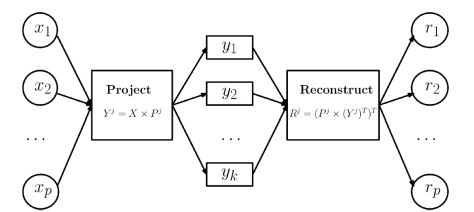
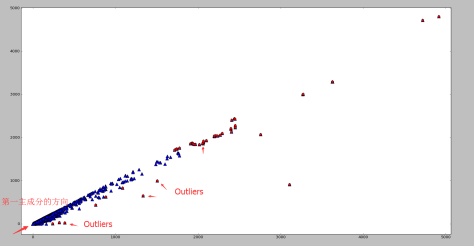
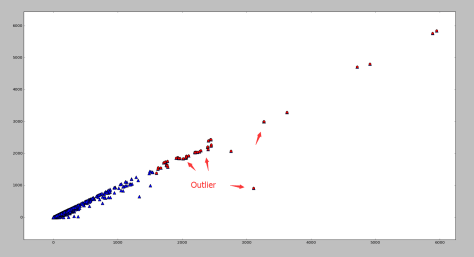
整个算法的结构如图所示:

PCC


(三)效果展示

下面两幅图使用了同一批数据集,分别采用了基于矩阵分解的异常点检测算法和基于高斯分布的概率模型的异常点算法。

PCC2

基于矩阵分解的异常点检测


Gauss

基于高斯分布的概率模型的异常点检测

根据图像可以看出,如果使用基于矩阵分解的异常点检测算法的话,偏离第一主成分较多的点都被标记为异常点,其中包括部分左下角的点。需要注意的是如果使用基于高斯分布的概率模型的话,是不太可能标记出左下角的点的,两者形成鲜明对比。

异常点检测算法(一)

异常点检测(又称为离群点检测)是找出其行为很不同于预期对象的一个检测过程。这些对象被称为异常点或者离群点。异常点检测在很多实际的生产生活中都有着具体的应用,比如信用卡欺诈,工业损毁检测,图像检测等。

异常点(outlier)是一个数据对象,它明显不同于其他的数据对象,就好像它是被不同的机制产生的一样。例如下图红色的点,就明显区别于蓝色的点。相对于蓝色的点而言,红色的点就是异常点。

outlier

一般来说,进行异常点检测的方法有很多,最常见的就是基于统计学的方法。

(一)基于正态分布的一元离群点检测方法

假设有 n 个点 (x_{1},...,x_{n}),那么可以计算出这 n 个点的均值 \mu 和方差 \sigma。均值和方差分别被定义为:

\mu=\sum_{i=1}^{n}x_{i}/n,

\sigma^{2}=\sum_{i=1}^{n}(x_{i}-\mu)^{2}/n.

在正态分布的假设下,区域 \mu\pm 3\sigma 包含了99.7% 的数据,如果某个值距离分布的均值 \mu 超过了 3\sigma,那么这个值就可以被简单的标记为一个异常点(outlier)。

(二)多元离群点的检测方法

涉及两个或者两个以上变量的数据称为多元数据,很多一元离群点的检测方法都可以扩展到高维空间中,从而处理多元数据。

(1)基于一元正态分布的离群点检测方法

假设 n 维的数据集合形如 \vec{x}_{i}=(x_{i,1},...,x_{i,n}), i\in \{1,...,m\},那么可以计算每个维度的均值和方差 \mu_{j},\sigma_{j}, j\in\{1,...,n\}. 具体来说,对于 j\in \{1,...,n\},可以计算

\mu_{j}=\sum_{i=1}^{m}x_{i,j}/m

\sigma_{j}^{2}=\sum_{i=1}^{m}(x_{i,j}-\mu_{j})^{2}/m

在正态分布的假设下,如果有一个新的数据 \vec{x},可以计算概率 p(\vec{x}) 如下:

p(\vec{x})=\prod_{j=1}^{n} p(x_{j};\mu_{j},\sigma_{j}^{2})=\prod_{j=1}^{n}\frac{1}{\sqrt{2\pi}\sigma_{j}}\exp(-\frac{(x_{j}-\mu_{j})^{2}}{2\sigma_{j}^{2}})

根据概率值的大小就可以判断 x 是否属于异常值。运用该方法检测到的异常点如图,红色标记为异常点,蓝色表示原始的数据点。

Gauss

(2)多元高斯分布的异常点检测

假设 n 维的数据集合 \vec{x}=(x_{1},...,x_{n}), ,可以计算 n 维的均值向量

\vec{\mu}=(E(x_{1}),...,E(x_{n}))

n\times n 的协方差矩阵:

\Sigma=[Cov(x_{i},x_{j})], i,j \in \{1,...,n\}

如果有一个新的数据 \vec{x},可以计算

p(\vec{x})=\frac{1}{(2\pi)^{\frac{n}{2}}|\Sigma|^{\frac{1}{2}}} \exp(-\frac{1}{2}(\vec{x}-\vec{\mu})^{T}\Sigma^{-1}(\vec{x}-\vec{\mu}))

根据概率值的大小就可以判断 \vec{x} 是否属于异常值。

(3)使用 Mahalanobis 距离检测多元离群点

对于一个多维的数据集合 D,假设 \overline{a} 是均值向量,那么对于数据集 D 中的其他对象 a,从 a\overline{a} 的 Mahalanobis 距离是

MDist(a,\overline{a})=\sqrt{(a-\overline{a})^{T}S^{-1}(a-\overline{a})},

其中 S 是协方差矩阵。

在这里,MDist(a,\overline{a}) 是数值,可以对这个数值进行排序,如果数值过大,那么就可以认为点 a 是离群点。或者对一元实数集合 \{MDist(a,\overline{a})|a\in D\} 进行离群点检测,如果 MDist(a,\overline{a}) 被检测为异常点,那么就认为 a 在多维的数据集合 D 中就是离群点。

运用 Mahalanobis 距离方法检测到的异常点如图,红色标记为异常点,蓝色表示原始的数据点。

Mahalanobis

(4)使用 \chi^{2} 统计量检测多元离群点

在正态分布的假设下,\chi^{2} 统计量可以用来检测多元离群点。对于某个对象 \bold{a}\chi^{2} 统计量是

\chi^{2}=\sum_{i=1}^{n}(a_{i}-E_{i})^{2}/E_{i}.

其中,a_{i}\bold{a} 在第 i 维上的取值,E_{i} 是所有对象在第 i 维的均值,n 是维度。如果对象 \bold{a}\chi^{2} 统计量很大,那么该对象就可以认为是离群点。

运用 \chi^{2} 统计量检测到的异常点如图,红色标记为异常点,蓝色表示原始的数据点。

ChiSquare


异常点检测算法(三)Replicator Neural Networks

异常值检测算法在数据挖掘的诸多领域有着应用场景,例如金融领域,信息传输领域,图像领域等。在研究过程中,有学者给出了异常点的一个定义:

An outlier is an observation that deviates so much from other observations as as to arouse suspicion that it was generated by a different mechanism.

RNN 算法的主要思想

在这篇文章中,我们将会介绍一个多层的前馈神经网络,该神经网络可以用来进行异常值的检测。这个神经网络模拟的是一个恒等映射,输入层的神经元个数和输出层的神经元个数是一样的。这类的神经网络被称为 Replicator Neural Networks (RNNs),请注意这里的 RNN 算法指的并不是 Recurrent Neural Networks(RNNs),而是 Replicator Neural Networks,尽管它们拥有着同样的缩写名字 RNNs。具体来说, Replicator Neural Networks (RNNs),或者说自编码器,是一个多层前馈的神经网络 (multi-layer feed-forward neural networks)。在 Replicator Neural Networks 中,输入的变量也是输出的变量,模型中间层节点的个数少于输入层和输出层节点的个数。这样的话,模型就起到了压缩数据和恢复数据的作用。

rnn1

如图所示,这里的 RNNs 有三个隐藏层,输入层和输出层的节点个数都是6,第一个隐藏层和第三个隐藏层的节点个数(图中是4个节点)少于输入层,第二个隐藏层的节点个数是最少的(图中是2个节点)。在神经网络传输的时候,中间使用了 tanh 函数和 sigmoid 函数。这个神经网络是训练一个从输入层到输出层的恒等函数(identity mapping),传输的时候从输入层开始压缩数据,然后到了第二个隐藏层的时候开始解压数据。训练的目标就是使得整体的输出误差足够小,整体的误差是由所有的样本误差之和除以样本的个数得到的。由于图中只画出了6个特征,因此第 i 个样本的误差是

e_{i}=\sum_{j=1}^{6}(x_{i j}-r_{i j})^{2}/6

如果使用已经训练好的 RNN 模型,异常值的分数就可以定义为重构误差(reconstruction error)。

下面简要介绍一下 RNN 模型是如何构建的:

rnn2

根据上图所示,左边的是输入层,右边的输出层。假设第 k 层中第 i 个神经元的输出是 S_{k}(I_{ki}),其中 I_{ki} 表示第 k 层中第 i 个神经元的输入,S_{k} 表示第 k 层使用的激活函数。那么

\theta=I_{ki}=\sum_{j=0}^{L_{k-1}}w_{kij}Z_{(k-1)j}

其中 Z_{kj} 是第 k 层中第 j 个神经元的输出,L_{k} 是第 k 层神经元的个数。对于第二层和第四层而言 (k=2,4),激活函数选择为

S_{k}(\theta)=tanh(a_{k}\theta)  \text{ for } k=2 \text{ or } 4,

这里的 a_{k} 是一个参数,通常假设为1。对于中间层 (k=3) 而言,激活函数是一个类阶梯 (step-like) 函数。有两个参数 N 和 a_{3},N 表示阶梯的个数,a_{3} 表示从这一层到下一层的提升率 (transition rate):

S_{3}(\theta)=\frac{1}{2}+\frac{1}{4}\sum_{j=1}^{N-1}tanh(a_{3}(\theta-\frac{j}{N})).

在这里可以假设 a_{3}=100N=4. 那么 S_{3}(\theta) 就如下图所示。

S3

第三层的激活函数的输出就变成了 N 个离散的变量:0, 1/(N-1), 2/(N-1),…,1。这个阶梯型的激活函数是把第三层的连续输入值变成了一批离散的值。也就意味着把样本映射到了 N 个簇,那么 RNN 就可以计算出单个的异常点和一小簇的异常点。

备注:

根据上面的分析,可以看出如果按照以上算法,则不能使用反向传播算法来训练模型,原因是 S_{3}(\theta) 的导数不能够通过它的取值来表示。这一点与 tanh 函数,\sigma 函数是不一致的,因为 tanh^{'}(x) = 1-tanh^{2}(x)\sigma^{'}(x)=\sigma(x)(1-\sigma(x))。因此有学者指出 [1],使用三个隐藏层是没有必要的,使用1个或者2个隐藏层的神经网络也能够得到类似的结果;同样,没有必要使用 S_{3}(\theta) 这样类型的阶梯函数,使用传统的 \sigma 激活函数也能够得到类似的结果。并且 S_{3}(\theta) 是一个 step-like 函数,很多地方的导数取值都是接近于零的。
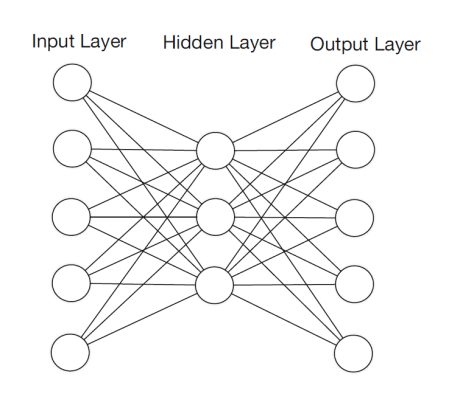
后向传播算法:

一般来说,为了训练神经网络模型,需要使用后向传播算法(back propagation),也简称为 BP 算法,或者误差逆传播算法(error back propagation)。在本文中,仅针对最简单的 RNN 模型介绍如何使用 BP 算法进行模型训练,至于多层的神经网络模型或者其他的神经网络模型,方法则是完全类似的。

rnn3

给定训练集合 D=\{(\bold{x}_{1},\bold{y}_{1}),...,(\bold{x}_{m},\bold{y}_{m})\},其中有 m 个样本,并且输入和输出是一样的值。换句话说,也就是 n 维向量

\bold{x}_{i}=\bold{y}_{i}\in\mathbb{R}^{n} \text{ for all } 1\leq i\leq m.

换句话说,输入样例是由 n 个属性描述,输出的结果也是 n 个属性。隐藏层只有一个,隐藏层的神经元个数是 q=[(n+1)/2],这里的 [] 表示 Gauss 取整函数。输出层第 j 个神经元的阈值使用 \theta_{j} 表示,隐藏层第 h 个神经元的阈值使用 \gamma_{h} 表示。输入层第 i 个神经元与隐藏层第 h 个神经元之间的连接权重是 v_{i h}, 隐藏层第 h 个神经元与输出层第 j 个神经元之间的连接权重是 w_{h j}, 其中 1\leq i \leq n, 1\leq h \leq q, 1\leq j \leq n.

记隐藏层第 h 个神经元接收到的输入为

\alpha_{h} = \sum_{i=1}^{n}v_{i h}x_{i} \text{ for all } 1\leq h \leq q.

写成矩阵形式就是:

(\alpha_{1},\cdot\cdot\cdot,\alpha_{q})=(x_{1},\cdot\cdot\cdot,x_{n})\begin{bmatrix} v_{11} & ... & v_{1q} \\ ... & ... & ... \\ v_{n1} & ... & v_{nq} \end{bmatrix}.

记输出层第 j 个神经元接收到的输入为

\beta_{j}=\sum_{h=1}^{q}w_{h j}b_{h} \text{ for all } 1\leq j\leq n,

其中 b_{h} 是隐藏层第 h 个神经元的输出,b_{h} = f(\alpha_{h}-\gamma_{h}) \text{ for all } 1\leq h \leq q, f 是激活函数。写成矩阵形式就是:

(\beta_{1},\cdot\cdot\cdot,\beta_{n})=(b_{1},\cdot\cdot\cdot,b_{q})\begin{bmatrix} w_{11} & ... & w_{1n} \\ ... & ... & ... \\ w_{q1} & ... & w_{qn} \end{bmatrix}.

输出层第 j 个神经元的输出是 f(\beta_{j}-\theta_{j}), 其中 1\leq j \leq n.

下面可以假定激活函数都使用 f(x)=1/(1+\exp(-x)), 那么直接通过导数计算可以得到 f^{'}(x)=f(x)(1-f(x)).

对于训练集 (\bold{x}_{k},\bold{y}_{k}), 通过神经网络得到的输出是 \hat{\bold{y}}_{k}=(\hat{y}_{k1},...,\hat{y}_{kn}), 并且 \hat{y}_{kj} = f(\beta_{j}-\theta_{j}) 对于 1\leq j \leq n 都成立。那么神经网络在训练集 (\bold{x}_{k},\bold{y}_{k}) 的均方误差是

E_{k} =\frac{1}{2}\sum_{j=1}^{n}(\hat{y}_{kj}-y_{kj})^{2},

其中 \bold{y}_{k}=(y_{k1},...,y_{kn}). 整体的误差是

E = \frac{1}{m}\sum_{k=1}^{m}E_{k} = \frac{1}{2m}\sum_{k=1}^{m}\sum_{j=1}^{n}(\hat{y}_{kj}-y_{kj})^{2}

标准 BP 算法:

网络中有 个参数需要确定:输入层到隐藏层的 n*q 个权重值,隐藏层到输出层的 n*q 个权重值,q个隐层神经元的阈值,n 个输出层神经元的阈值。BP 算法是一个迭代学习算法,在迭代的每一轮采用了梯度下降法来进行参数的更新。任意参数的更新规则是

v \leftarrow v+\Delta v.

标准 BP 算法是根据每一个 E_{k} 来获得更新规则,下面来推导每一个参数的更新规则。对于 1\leq h \leq q, 1\leq j \leq n, 计算梯度

\Delta w_{hj} = -\eta \frac{\partial E_{k}}{\partial w_{hj}},

注意到 w_{hj} 先影响到第 j 个输出层神经元的输入值 \beta_{j}, 再影响到第 j 个输出层神经元的输出值 \hat{y}_{kj},最后影响到 E_{k},根据高等数学的链式法则可以得到

\frac{\partial E_{k}}{\partial w_{hj}} = \frac{\partial E_{k}}{\partial \hat{y}_{kj}} \cdot \frac{\partial \hat{y}_{kj}}{\partial \beta_{j}} \cdot \frac{\partial \beta_{j}}{\partial w_{hj}}

根据定义 \beta_{j}=\sum_{h=1}^{q}w_{hj}b_{h} 可以得到 \frac{\partial \beta_{j}}{\partial w_{hj}}=b_{h} 对于 1\leq j \leq n 都成立。

根据定义 E_{k}=\frac{1}{2}\sum_{j=1}^{n}(\hat{y}_{kj}-y_{kj})^{2} 可以得到 \frac{\partial E_{k}}{\partial \hat{y}_{kj}}=(\hat{y}_{kj}-y_{kj}).

根据定义 \hat{y}_{kj}=f(\beta_{j}-\theta_{j})f^{'}(x)=f(x)\cdot(1-f(x)) 可以得到 \frac{\partial \hat{y}_{kj}}{\partial \beta_{j}}=f^{'}(\beta_{j}-\theta_{j})=f(\beta_{j}-\theta_{j})\cdot(1-f(\beta_{j}-\theta_{j}))=\hat{y}_{kj}\cdot (1-\hat{y}_{kj}).

所以可以计算出对于 1\leq h \leq q, 1\leq j \leq n,

\frac{\partial E_{k}}{\partial w_{hj}} = (\hat{y}_{kj}-y_{kj})\cdot\hat{y}_{kj}\cdot(1-\hat{y}_{kj})\cdot b_{h}

如果假设

g_{j}=-\frac{\partial E_{k}}{\partial \beta_{j}}=-\frac{\partial E_{k}}{\partial \hat{y}_{kj}}\cdot \frac{\hat{y}_{kj}}{\partial \beta_{j}}

那么可以得到

g_{j}=\hat{y}_{kj}\cdot(1-\hat{y}_{kj})\cdot(y_{kj}-\hat{y}_{kj})

因此对于 1\leq h \leq q, 1\leq j \leq n, 可以得到\Delta w_{hj}=\eta g_{j}b_{h}.

根据类似的想法,有

\Delta \theta_{j}=-\eta\cdot\frac{\partial E_{k}}{\partial \theta_{j}}, \Delta v_{ih}=-\eta\cdot\frac{\partial E_{k}}{\partial v_{ih}}, \Delta \gamma_{h}=-\eta\cdot\frac{\partial E_{k}}{\partial \gamma_{h}}.

逐个计算:

\frac{\partial E_{k}}{\partial \theta_{j}}=\frac{\partial E_{k}}{\partial \hat{y}_{kj}}\cdot\frac{\partial\hat{y}_{kj}}{\partial\theta_{j}}=(\hat{y}_{kj}-y_{kj})\cdot(-1)\cdot f^{'}(\beta_{j}-\theta_{j})=(y_{kj}-\hat{y}_{kj})\cdot\hat{y}_{kj}\cdot(1-\hat{y}_{kj})=g_{j}

\frac{\partial E_{k}}{\partial v_{ih}}=\frac{\partial E_{k}}{\partial\alpha_{h}}\cdot\frac{\partial\alpha_{h}}{\partial v_{ih}}=\frac{\partial E_{k}}{\partial b_{h}}\cdot\frac{\partial b_{h}}{\partial \alpha_{h}}\cdot\frac{\partial\alpha_{h}}{\partial v_{ih}}

由于

\frac{\partial \alpha_{h}}{\partial v_{ih}}=x_{ki}

\frac{\partial b_{h}}{\partial\alpha_{h}}=f^{'}(\alpha_{h}-\gamma_{h})=f(\alpha_{h}-\gamma_{h})\cdot(1-f(\alpha_{h}-\gamma_{h}))=b_{h}\cdot(1-b_{h})

\frac{\partial E_{k}}{\partial b_{h}}=\sum_{j=1}^{n}\frac{\partial E_{k}}{\partial \beta_{j}}\cdot\frac{\partial \beta_{j}}{\partial b_{h}}=\sum_{j=1}^{n}(-g_{j})\cdot w_{hj}

所以,

\Delta v_{ih}=\eta(\sum_{j=1}^{n}g_{j}w_{hj})\cdot b_{h}\cdot (1-b_{h})x_{ki} = \eta e_{h}x_{ki}, 其中 e_{h}=-\partial E_{k}/\partial\alpha_{h}=(\sum_{j=1}^{n}g_{j}w_{hj})\cdot b_{h}\cdot(1-b_{h}).

\Delta \gamma_{h}=(-\eta)\cdot\frac{\partial E_{k}}{\partial\gamma_{h}}=(-\eta)\cdot\frac{\partial E_{k}}{\partial b_{h}}\cdot\frac{\partial b_{h}}{\partial\gamma_{h}}=\eta\cdot(\sum_{j=1}^{n}g_{j}w_{hj})\cdot(-1)\cdot f^{'}(\alpha_{h}-\gamma_{h})=(-\eta)\cdot(\sum_{j=1}^{n}g_{j}w_{hj})\cdot b_{h}\cdot(1-b_{h})=(-\eta)\cdot e_{h} .

整理之后,任意参数 v 的更新式子是 v\leftarrow v+\Delta v, 并且更新的规则如下:

\Delta w_{hj}=\eta g_{j}b_{h} \text{ for all } 1\leq j\leq n, 1\leq h \leq q,

\Delta \theta_{j}=-\eta g_{j} \text{ for all } 1\leq j\leq n,

\Delta v_{ih}=\eta e_{h}x_{ki} \text{ for all } 1\leq i\leq n, 1\leq h\leq q,

\Delta \gamma_{h}=-\eta e_{h} \text{ for all } 1\leq h\leq q,

其中学习率 \eta\in(0,1) 控制着算法每一轮迭代中的更新步长,若步长太大则容易振荡,太小则收敛速度过慢,需要人工调整学习率。 对每个训练样例,BP 算法执行下面的步骤:先把输入样例提供给输入层神经元,然后逐层将信号往前传,直到计算出输出层的结果;然后根据输出层的误差,再将误差逆向传播至隐藏层的神经元,根据隐藏层的神经元误差来对连接权和阈值进行迭代(梯度下降法)。该迭代过程循环进行,直到达到某个停止条件为止。

标准 BP 算法的训练流程:
输入:训练集合 D={(\bold{x}_{k},\bold{y}_{k})}_{k=1}^{m} 和学习率 \eta.
过程:
1. 在 (0,1) 范围内随机神经网络中的所有连接权重和阈值
2. repeat
for all (\bold{x}_{k},\bold{y}_{k}) do
根据当前参数,计算出当前的样本输出 \bold{y}_{k}
计算输出层神经元的梯度项 g_{j}
计算隐藏层神经元的梯度项 e_{h}
更新连接权重 w_{hj}, v_{ih} 与阈值 \theta_{j},\gamma_{h}
end for
3. 达到停止条件
输出:链接权与阈值都确定的神经网络模型

累积 BP 算法:

BP 算法的目的是最小化训练集上的累计误差 E=\sum_{k=1}^{m}E_{k}/m, 其中 m 是训练集合中样本的个数。不过,标准的 BP 算法每次仅针对一个训练样例更新连接权重和阈值,也就是说,标准 BP 算法的更新规则是基于单个的 E_{k} 推导而得到的。通过类似的计算方法可以推导出累计误差的最小化更新规则,那就得到了累计误差逆传播(accumulate error backpropagation)算法。标准 BP 算法需要进行更多次的迭代,并且参数的更新速度快,累积 BP 算法必须扫描一次训练集合才会进行一次参数的更新,而且累计误差下降到一定的程度以后 ,进一步下降就会明显变慢,此时标准 BP 算法往往会更快的得到较好的解,尤其是训练集合大的时候。
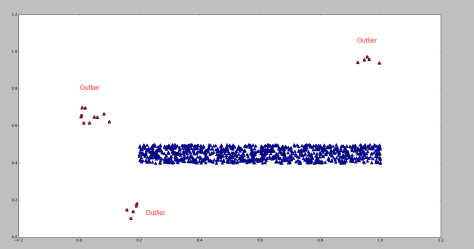
训练方法:

(1)把数据集合的每一列都进行归一化;

(2)选择 70% 的数据集合作为训练集合,30% 的数据集合作为验证集合。或者 训练集合 : 验证集合 = 8 : 2,这个需要根据情况而定。

(3)随机生成一个三层的神经网络结构,里面的权重都是随机生成,范围在 [0,1] 内。输入层的数据和输出层的数据保持一致,并且神经网络中间层的节点个数是输入层的一半。

(4)使用后向传播算法(back-propagation)来训练模型。为了防止神经网络的过拟合,通常有两种策略来防止这个问题。(i)第一种策略是“早停”(early stopping):当训练集合的误差降低,但是验证集合的误差增加时,则停止训练,同时返回具有最小验证集合误差的神经网络;(ii)第二种策略是“正则化”(regularization):基本思想是在误差目标函数中增加一个用于描述网络复杂度的部分,例如链接权和阀值的平方和。

测试效果:

其中蓝色的点表示正常点,红色的点表示被 RNN 算法标记的异常点。

rnn_result1

rnn_result2

参考文献:

[1] Anomaly Detection Using Replicator Neural Networks Trained on Examples of One Class, Hoang Anh Dau, Vic Ciesielski, Andy Song

[2] Replicator Neural Networks for Outlier Modeling in Segmental Speech Recognition, Laszlo Toth and Gabor Gosztolya

[3] Outlier Detection Using Replicator Neural Networks, Simon Hawkins, Honxing He, Graham Williams and Rohan Baxter


聚类算法(一)

聚类是一种无监督学习(无监督学习是指事先并不知道要寻找的内容,没有固定的目标变量)的算法,它将相似的一批对象划归到一个簇,簇里面的对象越相似,聚类的效果越好。聚类的目标是在保持簇数目不变的情况下提高簇的质量。给定一个 n 个对象的集合。把这 n 个对象划分到 K 个区域,每个对象只属于一个区域。所遵守的一般准则是:同一个簇的对象尽可能的相互接近或者相关,而不同簇的对象尽可能的区分开。最常见的一种聚类算法则是 K-均值 算法。

K-均值(K-Means)聚类算法

K 均值聚类算法是用来发现给定数据集的 K 个簇的一种无监督学习算法,簇的个数是由人工给定的,每个簇使用质心(Centroid)和相应的半径(Radius)来描述。需要量化的误差指标有误差平方和(sum of squared error)等。

K-均值算法是一种启发式的算法。它会渐近地提高聚类的质量,达到局部的最优解,但是就是因为这样,才容易陷入局部最优解,而没有达到全局最优解,所有有人提出了二分 K-均值算法。启发式的聚类算法很适合发现中小规模的簇,对于大数据集合,从计算量来说成本则会很高。K-均值算法也有着自己的不足之处,通过下面算法可以发现 K-均值算法对离群点特别敏感,离群点的存在会直接影响着 K-均值算法的效果。

K 均值算法的流程是这样的。首先,随机确定 K 个初始点作为质心。然后将数据集中的每个点分配到每一个簇中,具体来讲,为每一个数据点找距离其最近的质心,并将其分配给该质心所对应的簇。这一步完成之后,每个簇的质心更新为该簇所有点的平均值。

K-Means 的伪代码:

创建K个点作为初始的质心(经常是随机选择数据点中的K个点,而不是平面上随机的K个点)

当任意一个点的簇分配结果发生变化时:

    对数据集中每个数据点

        对每个质心,计算质心与数据点之间的距离

        将数据点分配到距离其最近的簇

    对每一个簇,计算簇中所有点的均值并将均值作为质心

注:K 均值算法在某些时候容易收敛到局部最小值。

使用一批二维数据集合,进行 4 均值聚类算法可以得到下图:’+’ 表示的是质心的位置,其余就是数据点的位置。

聚类1


效果评估:

SSE 指的是 Sum of Squared Error(误差平方和)越小表示数据点越接近它们的质心,聚类的效果也就越好。质心使用 c[i] 表示,质心 c[i] 所包含的对象集合使用 C[i] 表示。如果用 p 表示 C[i] 中的某个对象,dist(p,c[i]) 表示的就是对象和质心 c[i] 的距离。那么误差平方和则定义为

E=\sum_{i=1}^{K}\sum_{p \in C[i]} dist(p, c[i])^{2}


二分 K 均值聚类(Bisecting K-Means)

为了解决 K 均值算法可能会收敛到局部最小值的情况,有人提出了二分 K 均值算法(bisecting K-means)。该算法首先将所有点作为一个簇,然后将该簇一分为二,之后选择其中的一个簇继续进行划分,选择哪一个簇进行划分取决于对其划分是否可以最大程度降低 SSE 的值。上述基于SSE的划分过程不断重复,直到得到用户指定的簇的数目为止。

二分 K-Means 的伪代码如下:

将所有的点看成一个簇

当簇的数量小于K时

    对于每一个簇

        计算总误差

        在给定的簇上面进行2均值聚类

        计算将该簇一分为二之后的总误差(指的是这两个簇的误差与其他剩余集的误差之和)

    选择使得总误差最小的那个簇进行划分操作

另一种做法就是:每次进行下一步划分的时候,选择误差平方和最大的簇进行划分,直到簇的数目达到用户指定的数目为止。这样的启发式算法就使得整体的误差平方和尽可能的小,也就是簇的划分更加精确。

使用一批二维数据集合,进行 3 均值聚类算法可以得到下图:’+’ 表示的是质心的位置,其余就是数据点的位置。

聚类2


Follow the Regularized Leader (FTRL) 算法

(一)FTRL 的算法原理:

FTRL 算法综合考虑了 FOBOS 和 RDA 对于梯度和正则项的优势和不足,其特征权重的更新公式是:

W^{(t+1)}=argmin_{W}\{G^{(1:t)}\cdot W+\lambda_{1}||W||_{1}+\frac{\lambda_{2}}{2}||W||_{2}^{2}+\frac{1}{2}\sum_{s=1}^{t}\sigma^{(s)}||W-W^{(s)}||_{2}^{2}\}

上面的公式出现了 L2 范数,不过这一项的引入不会影响 FTRL 的稀疏性,只是使得求解结果更加“平滑”。通过数学计算并且放弃常数项可以得到上面的优化问题相当于求使得下面式子的最小的参数 W:

(G^{(1:t)}-\sum_{s=1}^{t}\sigma^{(s)}W^{(s)})\cdot W + \lambda_{1}||W||_{1}+\frac{1}{2}(\lambda_{2}+\sum_{s=1}^{t}\sigma^{(s)})||W||_{2}^{2}

如果假设 Z^{(t)}=G^{(1:t)}-\sum_{s=1}^{t}\sigma^{(s)}W^{(s)}=Z^{(t-1)}+G^{(t)}-\sigma^{(t)}W^{(t)}, 上式等价于

W^{(t+1)}=argmin_{W}\{Z^{(t)}\cdot W + \lambda_{1}||W||_{1}+\frac{1}{2}(\lambda_{2}+\sum_{s=1}^{t}\sigma^{(s)})||W||_{2}^{2}\}

写成分量的形式就是:

argmin_{w_{i}}\{z_{i}^{(t)}w_{i}+\lambda_{1}|w_{i}|+\frac{1}{2}(\lambda_{2}+\sum_{s=1}^{t}\sigma^{(s)})w_{i}^{2}\}

通过计算可以直接得到:

w_{i}^{(t+1)}=0, \text{ if } |z_{i}^{(t)}|<\lambda_{1}

w_{i}^{(t+1)}=-(\lambda_{2}+\sum_{s=1}^{t}\sigma^{(s)})^{-1}\cdot(z_{i}^{(t)}-\lambda_{1}\cdot sgn(z_{i}^{(t)})) \text{ otherwise }

由此可以证明:引入 L2 正则化并没有对 FTRL 的稀疏性产生影响。

(二)学习率

在 SGD 的算法里面使用的是一个全局的学习率 \eta^{(t)}=O(t^{-0.5}),意味着学习率是一个正数并且逐渐递减,对每一个维度都是一样的。而在 FTRL 算法里面,每个维度的学习率是不一样的。如果特征 A 比特征 B变化快,那么在维度 A 上面的学习率应该比维度 B 上面的学习率下降得更快。在 FTRL 中,维度 i 的学习率是这样定义的:

\eta_{i}^{(t)}=\alpha/(\beta+\sqrt{\sum_{s=1}^{t}(g_{i}^{(s)})^{2}})

按照之前的定义 \sigma^{(1:t)}=1/\eta^{(t)}, 所以

\sum_{s=1}^{t}\sigma^{(s)}=\eta_{i}^{(t)}=\alpha/(\beta+\sqrt{\sum_{s=1}^{t}(g_{i}^{(s)})^{2}})

(三)FTRL 算法

FTRL Algorithm

(1)输入 \alpha, \beta, \lambda_{1},\lambda_{2},初始化 W\in\mathbb{R}^{N}, Z=0\in\mathbb{R}^{N}, Q=0\in\mathbb{R}^{N}

(2)for t=1,2,3,.....
        G=\nabla_{W}\ell(W,X^{(t)},Y^{(t)})
        for i=1,2,...,N
         \sigma_{i}=\alpha^{-1}(\sqrt{q_{i}+g_{i}^{2}}-\sqrt{q_{i}})
         q_{i}=q_{i}+g_{i}^{2} // equals to (\eta^{(t)})^{-1}-(\eta^{(t-1)})^{-1}
         z_{i}=z_{i}+g_{i}-\sigma_{i}w_{i}
         \text{if } |z_{i}^{(t)}|<\lambda_{1}, w_{i}=0
         \text{otherwise, }
         w_{i}^{(t+1)}=-(\lambda_{2}+\sum_{s=1}^{t}\sigma^{(s)})^{-1}\cdot(z_{i}^{(t)}-\lambda_{1}\cdot sgn(z_{i}^{(t)}))
        end
     end

(四)Logistic Regression 的 FTRL 形式

在 Logistic Regression 中,假设 \sigma(a)=1/(1+\exp(-a)) 是 sigmoid 函数,y_{t} \in \{0,1\},需要预估 p_{t}=\sigma(w_{t}\cdot w_{t}),那么 LogLoss 函数是

\ell_{t}(w_{t})=-y_{t}log(p_{t})-(1-y_{t})log(1-p_{t})

直接计算可得 \nabla\ell(w)=(\sigma(w\cdot x_{t})-y_{t})x_{t}=(p_{t}-y_{t})x_{t},所以 Logistic Regression 的 FTRL 算法就是:

FTRL Algorithm (Logistic Regression)

(1)输入 \alpha, \beta, \lambda_{1},\lambda_{2},初始化 W\in\mathbb{R}^{N}, Z=0\in\mathbb{R}^{N}, Q=0\in\mathbb{R}^{N}

(2)for t=1,2,3,.....
        for i=1,2,...,N
         g_{i}=(p_{t}-y_{t})x_{i} // gradient of loss function
         \sigma_{i}=\alpha^{-1}(\sqrt{q_{i}+g_{i}^{2}}-\sqrt{q_{i}})
         q_{i}=q_{i}+g_{i}^{2} // equals to (\eta^{(t)})^{-1}-(\eta^{(t-1)})^{-1}
         z_{i}=z_{i}+g_{i}-\sigma_{i}w_{i}
         \text{if } |z_{i}^{(t)}|<\lambda_{1}, w_{i}=0
         \text{otherwise, }
         w_{i}^{(t+1)}=-(\lambda_{2}+\sum_{s=1}^{t}\sigma^{(s)})^{-1}\cdot(z_{i}^{(t)}-\lambda_{1}\cdot sgn(z_{i}^{(t)}))
        end
     end


HIVE 简介

HIVE 介绍

(1)hive是基于Hadoop的一个数据仓库工具,可以将结构化的数据文件映射为一张数据库表,并提供完整的sql查询功能,可以将sql语句转换为MapReduce任务进行运行。其优点是学习成本低,可以通过类SQL语句快速实现简单的MapReduce统计,不必开发专门的MapReduce应用,十分适合数据仓库的统计分析。

(2)Hive是建立在 Hadoop 上的数据仓库基础构架。它提供了一系列的工具,可以用来进行数据提取转化加载(ETL),这是一种可以存储、查询和分析存储在 Hadoop 中的大规模数据的机制。Hive 定义了简单的类 SQL 查询语言,称为 HQL,它允许熟悉 SQL 的用户查询数据。同时,这个语言也允许熟悉 MapReduce 开发者的开发自定义的 mapper 和 reducer 来处理内建的 mapper 和 reducer 无法完成的复杂的分析工作。

要理解hive,必须先理解hadoop和mapreduce,如果有不熟悉的童鞋,可以百度一下。

使用hive的命令行接口,感觉很像操作关系数据库,但是hive和关系数据库还是有很大的不同,下面我就比较下hive与关系数据库的区别,具体如下:

  1. hive和关系数据库存储文件的系统不同,hive使用的是hadoop的HDFS(hadoop的分布式文件系统),关系数据库则是服务器本地的文件系统;
  2. hive使用的计算模型是mapreduce,而关系数据库则是自己设计的计算模型;
  3. 关系数据库都是为实时查询的业务进行设计的,而hive则是为海量数据做数据挖掘设计的,实时性很差;实时性的区别导致hive的应用场景和关系数据库有很大的不同;
  4. Hive很容易扩展自己的存储能力和计算能力,这个是继承hadoop的,而关系数据库在这个方面要比数据库差很多。

以上都是从宏观的角度比较hive和关系数据库的区别,下面介绍一下在实际工作中遇到的一些常用语句和方法。

HIVE 基础

hive 常用命令

假设有数据库 fm_data,里面有表格 shield_fm_feature_item_ctr

show databases; //列出数据库

desc database fm_data; // 展示数据库 fm_data 的信息

use fm_data; // 使用某个数据库 fm_data\

set hive.cli.print.current.db=true; 显示列头
set hive.cli.print.current.db=false; 关闭列头

show tables; // 展示这个数据库里面的所有表格

show tables in fm_data; // 展示数据库 fm_data 里面的所有表格

show tables like ‘*ctr*’; // 模糊查找

show create table shield_fm_feature_item_ctr; // 获得表格 shield_fm_feature_item_ctr 的建表语句,其中包括表格的字段,HDFS 的 location 等信息

desc shield_fm_feature_item_ctr; // 展示表格 shield_fm_feature_item_ctr 的字段以及字段类型

desc formatted shield_fm_feature_item_ctr; // 详细描述表格 shield_fm_feature_item_ctr,包括表格的结构,所在的 database,owner,location,表格的类型 (Managed Table or External Table),存储信息等

内部表与外部表

hive 的表格分两种,一种是 managed tables,另一种是 external tables。hive 创建表格时,默认创建的是 managed table,这种表会把数据移动到自己的数据仓库目录下;另外一种是 external tables,它关联的数据不是 hive 维护的,也不在 hive 的数据仓库内。

创建内部表格和外部表格:
create table test(name string);
create external table test(name string); 创建外部表格需要加上external;

修改表属性:
alter table test set tblproperties (‘EXTERNAL’=’TRUE’); 内部表转外部表
alter table test set tblproperties (‘EXTERNAL’=’FALSE’); 外部表转内部表

归纳一下Hive中表与外部表的区别:

1. 在导入数据到外部表,数据并没有移动到自己的数据仓库目录下(如果指定了location的话),也就是说外部表中的数据并不是由它自己来管理的!而内部表则不一样;

2. 在删除内部表的时候,Hive将会把属于表的元数据和数据全部删掉;而删除外部表的时候,Hive仅仅删除外部表的元数据,数据是不会删除的!换言之,内部表DROP时会删除HDFS上的数据;外部表DROP时不会删除HDFS上的数据。

3. 在创建内部表或外部表时加上location 的效果是一样的,只不过表目录的位置不同而已,加上partition用法也一样,只不过表目录下会有分区目录而已,load data local inpath直接把本地文件系统的数据上传到hdfs上,有location上传到location指定的位置上,没有的话上传到hive默认配置的数据仓库中。

4. 使用场景:内部表:HIVE中间表,结果表,一般不需要从外部(如本地文件,HDFS上 load 数据)的情况;外部表:源表,需要定期将外部数据映射到表格中。

创建表格

create table test1 like test; 只是复制了表的结构,并没有复制内容;
create table test2 as select name from test; 从其他表格查询,再创建表格;

创建表的语法选项特别多,这里只列出常用的选项。

其他请参见Hive官方文档:

https://cwiki.apache.org/confluence/display/Hive/LanguageManual+DDL#LanguageManualDDL-CreateTable

举一个例子来说吧:

CREATE EXTERNAL TABLE t_zr9558 (
id INT,
ip STRING COMMENT ‘访问者IP’,
avg_view_depth DECIMAL(5,1),
bounce_rate DECIMAL(6,5)
) COMMENT ‘test.com’
PARTITIONED BY (day STRING)
ROW FORMAT DELIMITED
FIELDS TERMINATED BY ‘,’
STORED AS textfile
LOCATION ‘hdfs://cdh5/tmp/zr9558/’;

(1)关键字EXTERNAL:表示该表为外部表,如果不指定EXTERNAL关键字,则表示内部表

(2)关键字COMMENT:为表和列添加注释

(3)关键字PARTITIONED BY:表示该表为分区表,分区字段为day,类型为string

(4)关键字ROW FORMAT DELIMITED:指定表的分隔符,通常后面要与以下关键字连用:
FIELDS TERMINATED BY ‘,’ //指定每行中字段分隔符为逗号
LINES TERMINATED BY ‘\n’ //指定行分隔符
COLLECTION ITEMS TERMINATED BY ‘,’ //指定集合中元素之间的分隔符
MAP KEYS TERMINATED BY ‘:’ //指定数据中Map类型的Key与Value之间的分隔符

(5)关键字STORED AS:指定表在HDFS上的文件存储格式,可选的文件存储格式有:
TEXTFILE //文本,默认值
SEQUENCEFILE // 二进制序列文件
RCFILE //列式存储格式文件 Hive0.6以后开始支持
ORC //列式存储格式文件,比RCFILE有更高的压缩比和读写效率,Hive0.11以后开始支持
PARQUET //列出存储格式文件,Hive0.13以后开始支持

(6)关键词LOCATION:指定表在HDFS上的存储位置。

注:hive 建表的时候默认的分隔符是’\001’,如果建表的时候没有指定分隔符,load文件的时候的分隔符是’\001’。如果需要在建表的时候指定分隔符,需要如下操作:
create table pokes(foo int,bar string)
row format delimited fields terminated by ‘\t’ lines terminated by ‘\n’ stored as textfile;
load data local inpath ‘/root/pokes.txt’ into table pokes;

修改表格

alter table shield_fm_feature_item_ctr add columns ( reporttime STRING COMMENT ‘上报日期时间’) //为表格增加列

alter table test rename to test2; //修改表名

alter table test add partition (day=20160301); //增加分区

alter table test drop partition (day=20160301); //删除分区

alter table test partition (day=20160301) rename to partition (day=20160302); //修改分区

load data local inpath ‘/liguodong/hivedata/datatest’ overwrite into table test;  // 从文件加载数据:覆盖原来数据

load data local inpath ‘/liguodong/hivedata/datatest’ into table test; // 从文件加载数据:添加数据

insert overwrite directory ‘tmp/csl_rule_cfg’ select a.* from test a; // 导出数据到文件

查询和分析数据

dfs -ls /user/hive/warehouse/fm_data.db/shield_fm_feature_item_ctr // 查看 hdfs 文件信息

set hive.cli.print.header=true;  显示列名称

set hive.cli.print.header=false; 不显示列名称

(i)基础操作

假设表格 shield_fm_feature_item_ctr 的格式是:owner (string), key (string), value (int), day (bigint);

select * from shield_fm_feature_item_ctr; // 查找数据

select * from shield_fm_feature_item_ctr limit 10; // 查找10行数据

select * from shield_fm_feature_item_ctr where day=20160301; //查询 day=20160301 的数据

select * from shield_fm_feature_item_ctr where day >= 20160301 and day<=20160302; //查询 day>=20160301 并且 day<=20160302 的数据

select * from shield_fm_feature_item_ctr where day = 20160301 or day =20160302; //查询 day=20160301 或者 day=20160302 的数据

select * from shield_fm_feature_item_ctr where day=20160301 order by value; // 按照value 的值增序排列

select * from shield_fm_feature_item_ctr where day=20160301 order by value desc; // 按照 value 的值降序排列

insert [overwrite] into table shield_fm_feature_item_ctr partition (day=20160301) values (‘20032′,’key_20032’,1.0) // 不使用overwrite是往表格里追加一条数据,如果使用overwrite就是覆盖整个表格。

(ii)高级操作

select * from shield_fm_feature_item_ctr where day between 20160301 and 20160302; //查询表格中从20160301到20160302的数据

JOIN 操作:

inner join: 在表格中至少存在一个匹配时,inner join 的关键字返回行;注:inner join 和 join 是相同的。

left join: 会从左边的表格返回所有的行,即使在右边的表格中没有匹配的行。

right join:会从右边的表格返回所有的行,即使在左边的表格中没有匹配的行。

full join:只要其中的一张表存在匹配,full join 就会返回行。在某些数据库中,full join 也称作 full outer join。

union:用于合并两个或者多个 select 语句的结果集。

is NULL & is not NULL:来判断某个字段是否是空集。

(iii)聚合函数

group by:通常和聚合函数一起使用,根据一个或者多个列对结果进行分组

常见的聚合函数有:

AVG:返回数列值的平均值

COUNT:返回一列值的数目

MAX/MIN:返回一列值的最大值/最小值

SUM:返回数列值的总和


(iv)数值函数:Scalar Functions

MOD(x,y):取模 x%y

ln(double a):返回给定数值的自然对数

power(double a, double b):返回某数的乘幂

sqrt(double a):开平方

sin/cos/asin/acos:三角函数


(v)字符串函数

字符串函数(替换,拼接,逆序等)

(vi)日期函数

进行unix的时间转换等


hive命令行操作

[avilazhang@hadoop-bigdata-hive ~]$ hive -e ‘select * from fm_data.shield_fm_feature_item_ctr where day=20160508;’

[avilazhang@hadoop-bigdata-hive ~]$ hive -S -e ‘select * from fm_data.shield_fm_feature_item_ctr where day=20160508;’ 终端的输出不会有mapreduce的进度,只会输出结果。

执行sql文件:hive -f hive_sql.sql

杀掉任务

杀掉某个任务:kill hadoop jobs:依赖于版本:
如果 version<2.3.0    : hadoop job -kill $jobId
获取所有运行的 jobId: hadoop job -list
如果 version>=2.3.0  : yarn application -kill $ApplicationId
获取所有运行的 jobId: yarn application -list


FS Shell

调用文件系统 (FS)Shell 命令应使用 bin/hadoop fs <args>的形式。 所有的的 FS shell 命令使用 URI路径作为参数。URI 格式是 scheme://authority/path。对HDFS文件系统,scheme 是 hdfs,对本地文件系统,scheme 是 file。其中 scheme 和 authority 参数都是可选的,如果未加指定,就会使用配置中指定的默认 scheme。一个 HDFS 文件或目录比如 /parent/child 可以表示成 hdfs://namenode:namenodeport/parent/child,或者更简单的 /parent/child(假设你配置文件中的默认值是 namenode:namenodeport)。大多数 FS Shell 命令的行为和对应的 Unix Shell 命令类似,不同之处会在下面介绍各命令使用详情时指出。出错信息会输出到 stderr,其他信息输出到 stdout。

fs 最常用的命令:

hadoop fs -ls hdfs_path //查看HDFS目录下的文件和子目录

hadoop fs -mkdir hdfs_path //在HDFS上创建文件夹

hadoop fs -rm hdfs_path //删除HDFS上的文件

hadoop fs -rmr hdfs_path //删除HDFS上的文件夹

hadoop fs -put local_file hdfs_path //将本地文件copy到HDFS上

hadoop fs -get hdfs_file local_path //复制HDFS文件到本地

hadoop fs -cat hdfs_file //查看HDFS上某文件的内容

fs 查看目录下文件夹或者文件的大小:

//单位Byte:
hadoop fs -du / | sort -n
//单位MB:
hadoop fs -du / | awk -F ‘ ‘ ‘{printf “%.2fMB\t\t%s\n”, $1/1024/1024,$2}’ | sort -n
//单位GB,大于1G:
hadoop fs -du / | awk -F ‘ ‘ ‘{num=$1/1024/1024/1024; if(num>1){printf “%.2fGB\t\t%s\n”, num, $2} }’ | sort -n

sort -n 表示按照文件大小,从小到大排列顺序。

hadoop fs -du -h hdfs_path    

使用-h显示hdfs对应路径下每个文件夹和文件的大小,文件的大小用方便阅读的形式表示,例如用64M代替67108864

其余FS Shell命令:

hadoop fs -cat hdfs_path //将路径指定的文件内容输出到 stdout

hadoop fs -tail hdfs_path //将文件尾部1k字节的内容输出到 stdout

hadoop fs -stat hdfs_path //返回指定路径的统计信息

hadoop fs -du hdfs_path //返回目录中所有文件的大小,或者只指定一个文件时,显示该文件的大小

详细可见:https://hadoop.apache.org/docs/r1.0.4/cn/hdfs_shell.html

DistCp 概述

DistCp(分布式拷贝)是用于大规模集群内部和集群之间拷贝的工具。 它使用Map/Reduce实现文件分发,错误处理和恢复,以及报告生成。 它把文件和目录的列表作为map任务的输入,每个任务会完成源列表中部分文件的拷贝。 由于使用了Map/Reduce方法,这个工具在语义和执行上都会有特殊的地方。 这篇文档会为常用DistCp操作提供指南并阐述它的工作模型。

详细可见:https://hadoop.apache.org/docs/r1.0.4/cn/distcp.html

量子计算(一)

进入公司之后第一次听到“量子计算”这个概念,一直觉得十分神秘。从维基百科或者知乎上看来说什么量子计算机利用量子来提升效率,有极强的并行能力,可以加速很多算法等。但是个人还是对这个方向了解甚少。直到前几天听完组里面大神的讲座,并用《Quantum Computing: From Linear Algebra to Physical Realizations》一书的作为量子计算的入门读物。读后豁然开朗,虽然也对这个方向了解也不够深入,不过还是略做笔记作为分享。作为一个量子计算的初学者,还是有很多理解不够到位之处,希望大家指正。

普通计算机一个比特(bit)可以表示 0 或者 1。而量子具有不确定性,这使得一个量子比特(qubit)需要描述成 α0|0⟩+α1|1⟩(量子比特的 0 状态记作 |0⟩,1 状态记作 |1⟩),其中 |α0|^2+|α1|^2=1。也就是表示了这个量子比特有 |α0|^2 的概率是 |0⟩,有 |α1|^2 的概率是 |1⟩。这里面的 α0 和 α1 都是复数,所以要先取模再平方才是其概率。可以记作 p(0)=|α0|^2, p(1)=|α1|^2, p(0)+p(1)=1。举例说明:

如果某个量子的状态是 \phi\rangle=\sqrt{1/3}|0 \rangle + \sqrt{2/3}|1 \rangle, 那么 p(0)=1/3,p(1)=2/3。如果测量的结果是0,那么这个 qubit 的状态就是0,换言之,|\phi \rangle=|0\rangle;如果测量的结果是1,那么这个 qubit 的状态也就变成了1,换言之, |\phi \rangle=|1\rangle

总之,量子状态有很多的可能性,因为复数 α0 和 α1 只有一个限制条件,那就是它们模的平方和是1。测量一个 qubit 只会给出 0 或者 1 的结果,这一点和传统的 bit 是一样的。同时,如果再次测量的话,只会给出和前一次一样的结果,结果并不会再次改变。除此之外,我们还可以把单个量子比特推广到两个量子比特为: α0|00⟩+α1|01⟩+α2|10⟩+α3|11⟩。同样的,系数的模的平方和为 1。换言之,α0,α1,α2,α3 这几个复数的模的平方和是1。

这里就能看出量子计算的厉害之处了,普通计算机 n 比特可以描述 2^n 个整数之一,而 n 个量子比特可以同时描述 2^n 个复数(一个 2^n 维的复数向量)。

如果仅仅是有表达向量的能力,传统的计算机就可以搞定。量子计算机之所以能成为量子计算机,更在于其对于量子比特的特殊计算操作。那么这里就需要引入量子逻辑门(Quantum Logic Gates)的概念。每一个 Quantum Logic Gate 都对应了一个数学上面的一个酉矩阵(Unitary Matrix)。如果 n*n 的矩阵 U 满足 UU^{T}=U^{T}U=I,这里的 I 指的是 n*n 的单位矩阵,U^{T} 指的是矩阵 U 的转置,那么 U 就被成为酉矩阵。

(1)量子非门(Quantum NOT Gate)是把 α0|0⟩+α1|1⟩ 映射成 α1|0⟩+α0|1⟩,也就是把 α0 和 α1 交换顺序。

(2)Quantum Controlled NOT Gate 是把 α0|00⟩+α1|01⟩+α2|10⟩+α3|11⟩ 映射成 α0|00⟩+α1|01⟩+α3|10⟩+α2|11⟩,也就是把 α2 和 α3 交换顺序。

(3)一个很著名的计算单元是 Hadamard Gate,输入 α0|0⟩+α1|1⟩,输出 2^{-1/2}(α0+α1)|0⟩+2^{-1/2}(α0-α1)|1⟩ 。Hadamard Gate 就是把经典的状态 |0⟩ 和 |1⟩ 转换成 |0⟩ 和 |1⟩ 的“halfway” 状态。不要小看这个操作,即使仅仅对 n 个量子比特中的第一位进行了 Hadamard gate 运算,所有的 2^{n} 个系数都会改变,证明如下:

假设我们有一个在 n 个 qubits 的量子状态 |\alpha\rangle=\sum_{x\in\{0,1\}^{n}}\alpha_{x}|x\rangle,如果我们对第一个 qubit 使用 Hadamard Gate,那么状态就会变成|\beta\rangle=\sum_{x\in\{0,1\}^{n}}\beta_{x}|x\rangle,其中\beta_{0y}=(\alpha_{0y}+\alpha_{1y})/\sqrt{2}\beta_{1y}=(\alpha_{0y}-\alpha_{1y})/\sqrt{2}。也就是说每一对 \alpha_{0y}\alpha_{1y} 都会被映射成 (\alpha_{0y}+\alpha_{1y})/\sqrt{2}(\alpha_{0y}-\alpha_{1y})/\sqrt{2}。因此就证明了,仅仅对 n 个量子比特中的第一位进行了 Hadamard gate 运算,所有的 2^n 个系数都会改变。这个就是在 quantum fourier transform 算法中达到指数级别加速的基础。

最后,薛定谔的猫要出场了。怎么把计算结果从混沌的量子态变成我们可理解的结果呢?这就需要“观测”。每次观测,量子就会按照 |α0|^2、|α1|^2 的概率塌缩到 |0⟩ 或者 |1⟩。量子存在一个 No-Cloning Theorem,这就导致了我们不能简单地“反复观测”量子计算的结果了,而需要反复计算+观测。通过 No-Cloning Theorem,我们可以得出一个观点:We can not copy a genderal quantum state. 为了能够加深读者对定理的理解,No-Cloning Theorem 的证明采取了数学上经典的反证法,先假设存在一个系统能够完全的拷贝任意量子比特,从而推导出矛盾。细节如下:

Theorem. (No-Cloning Theorem, Wootters and Zurek, Dieks) An unknown quantum system cannot be cloned by unitary transformations.

Proof. By contradiction, there exists a unitary transformation U that makes a clone of a quantum system. That means for any state |\varphi\rangle,

U: |\varphi 0\rangle \rightarrow |\varphi\varphi\rangle.

Consider two linear independent states |\varphi\rangle and |\phi\rangle. Then we have U|\varphi 0\rangle=|\varphi\varphi\rangle, U|\phi 0\rangle=|\phi\phi\rangle from the assumption of U. Let |\psi\rangle=\frac{1}{\sqrt{2}}(|\varphi\rangle +|\phi\rangle), we get

U|\psi 0\rangle=\frac{1}{\sqrt{2}}(U|\varphi 0\rangle+U|\phi 0\rangle).

However,

U|\psi 0\rangle=|\psi\psi\rangle=\frac{1}{2}(|\varphi\varphi\rangle+|\varphi\phi\rangle+|\phi\varphi\rangle+|\phi\phi\rangle)

which contradicts the previous result. Therefore, there does not exist a unitary cloning transformation.

借助量子计算机,FFT 的复杂度可以降低到 O((log(n))^2),甚至连读一遍数据的 O(n) 时间都不用,因为只要 log(n) 个量子比特就可以描述 n 维向量了。利用高性能的 FFT,因子分解的复杂度可以达到 sub-exponential time [Shor’s Algorithm],RSA 加密就失效了。而且目前量子计算机已经第一次以可扩展的方式,使用 Shor’s Algorithm 完成了对15的素数分解。有人表示:用 Shor 算法实现素数分解这一件事情,可以与经典计算机中的 “Hello World!” 相提并论。

总结一下,从我目前理解来看,借助更快的 FFT 算法,量子计算的优势主要在素数分解上,可以把原来指数复杂度的算法减少至多项式复杂度的算法。对于传统的一些问题,量子计算机和传统计算机相比目前还是不具备绝对的优势。当然量子计算机这种强大的表达能力和计算能力还是非常有潜力和令人期待的。


分类模型的正负样本

在机器学习,数据挖掘和推荐系统这几个大领域中,用支持向量机模型(Support Vector Machines)或者逻辑回归模型(Logistic Regression)做模型的预估是十分常见的事情。既然是分类模型,那么就需要确定正负样本,以便模型进行合理而有效的分类,因此如何根据具体的业务来确定正负样本就是一个十分关键的问题。

点击率预测的正负样本如何产生:

对于视频或者音频节目而言,分成几个种类:

喜欢的节目:用户当天播放过的节目;

历史的节目:用户在过去的一段时间内播放过所有节目;

曝光的节目:一段时间内对用户曝光的节目。

由此,正样本可以定义为用户当天播放过的节目,也就是“喜欢”。负样本则有两种选择方案:

(1)负样本指的是对用户曝光过的节目,但是用户至始至终都没有播放过,也就是说该节目并不在“历史”和“喜欢”两个分类里面。

(2)负样本指的是在整个抽样的池子里面,但是用户至始至终都没有播放过,也就是说该节目并不在“历史”和“喜欢”这两个分类里面。

此时还需注意抽样比例,一般来说 负样本的个数/正样本的个数 = 1:1 或者 2:1。

但是视频类节目和广告有区别,有可能该节目只是因为标题取得好或者图片配的好,才会吸引用户进去点击,但是用户观看了很短的时间就发现不喜欢该节目。所以在选择正样本的时候,从某种层面上来说需要考虑用户的观看时间,设定一定的阀值或者一定的观看比例才能够反映用户是否喜欢该节目。比如YouTube的视频节目,不止有“订阅”,“添加到”,“分享”,还有能够反映用户喜好的“like”(顶一下),“dislike”(踩一下)。有的时候顶一下可能不足以反映用户是否喜欢,但是踩一下基本上可以确定该用户不喜欢这个视频节目。除了“like”和“dislike”,对于其余的一些APP或者视频网站,还会有其余的操作,比方说评论,分享,收藏,下载等操作。这些操作从某些层面上也会看出用户是否喜欢该节目。